Putin visits China to reaffirm Russia ties : NPR

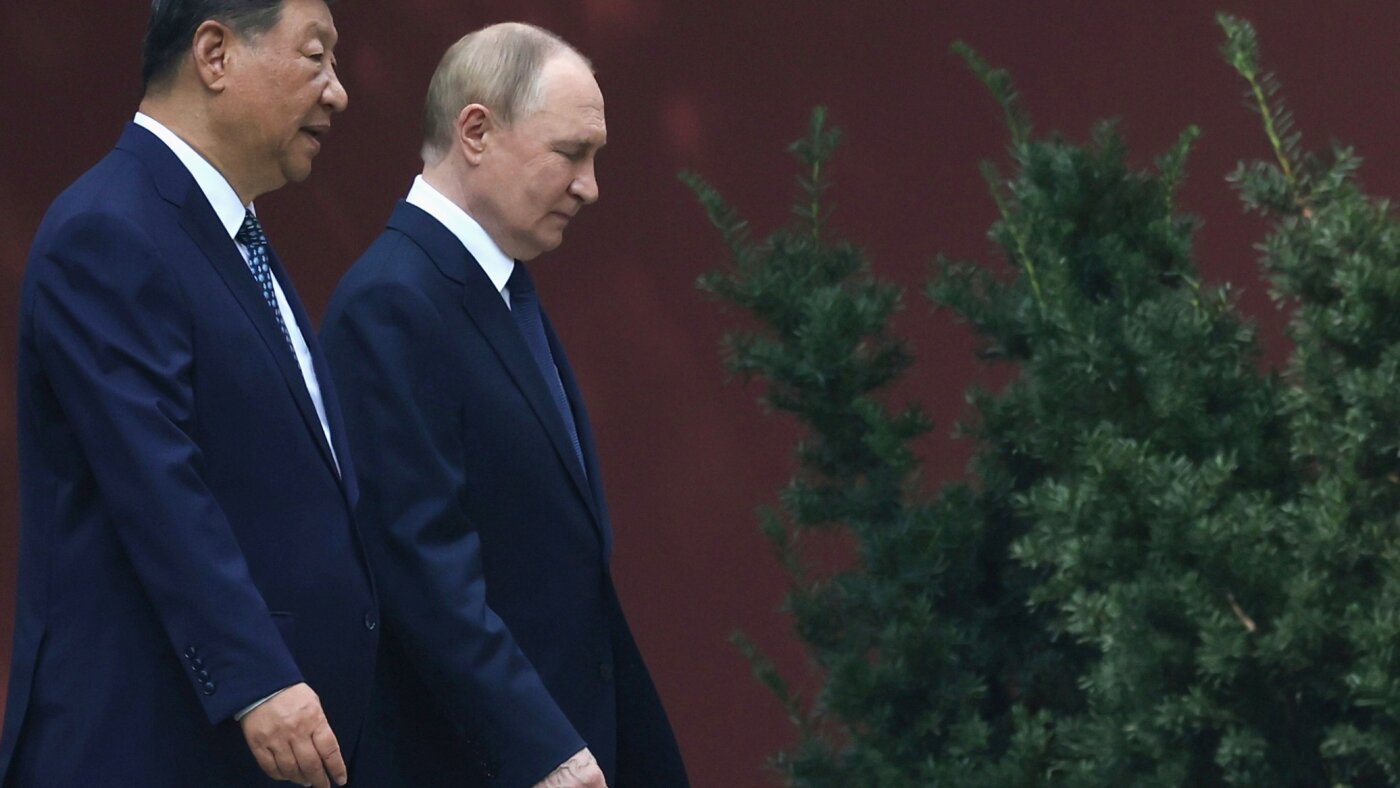

FILE – Russian President Vladimir Putin, right, talks with Chinese President Xi Jinping during a walk through the Zhongnanhai leadership compound in Beijing, China, September 2, 2025.
Alexander Kazakov/Sputnik Photo of the Kremlin swimming pool via AP
hide caption
toggle caption
Alexander Kazakov/Sputnik Photo of the Kremlin swimming pool via AP
BEIJING — Russian President Vladimir Putin is traveling to China to meet with Chinese leader Xi Jinping less than a week after U.S. President Donald Trump completed his own trip to Beijing.
Putin is expected to travel to China on Tuesday and Wednesday for a visit that will likely be closely watched as Beijing seeks to maintain stable relations with the United States while preserving strong ties with Russia.

The Kremlin said Putin and Xi planned to discuss economic cooperation between the two countries, but also “key international and regional issues.” The visit coincides with the 25th anniversary of the China-Russia Friendship Treaty signed in 2001.
Putin said in a video speech broadcast ahead of his visit that bilateral relations have reached “a truly unprecedented level” and that relations play an important role on a global scale, China’s official Xinhua news agency reported Tuesday.
There is “no connection” between Trump’s visit to China and Putin’s, presidential adviser Yuri Ushakov told reporters Monday, noting that the Russian leader’s trip was agreed in advance, several days after Putin and Xi spoke by video conference on February 4.
“Trump’s visit was aimed at stabilizing the world’s most important bilateral relationship; Putin’s visit is aimed at reassuring a long-standing strategic partner,” said Wang Zichen, deputy secretary-general of the Beijing-based think tank the Center for China and Globalization. “For China, these two tracks are not mutually exclusive.”
Putin and Xi call each other “friends”
Putin last visited China in September 2025 to attend the Shanghai Cooperation Organization’s annual summit in Tianjin, watch a military parade honoring the 80th anniversary of the end of World War II and hold talks with Xi.
At the time, Xi called his counterpart an “old friend,” while Putin called Xi a “dear friend.” In China, “old friend” is a very rare diplomatic term used by the government and the party to describe favored foreigners.
In April, Russian Foreign Minister Sergei Lavrov visited Beijing and met with Xi, who called bilateral relations “valuable” in the current international context. Xi said China and Russia should resort to stronger strategic collaboration to defend their legitimate and common interests and safeguard the unity of the South.
Kremlin spokesman Dmitry Peskov said over the weekend that Putin’s trip would also allow Russia to receive direct updates and exchange views with China regarding its negotiations with the United States.
During Trump’s visit, Xi described bilateral relations between the United States and China as the most important in the world and said they should view each other as partners rather than rivals. At the end of the two-day summit, the two countries said they would work on a new framework to manage “a constructive China-US relationship of strategic stability.”
Wang, of the Center for China and Globalization, observed: “Beijing wants stable relations with the West, continued strategic trust with Moscow, and enough diplomatic space to present itself as an impartial great power capable of engaging with all sides.” »
China is Russia’s main trading partner
For some, Putin’s visit is aimed at strengthening the Russia-China partnership that has strengthened in recent years, particularly after Russia’s invasion of Ukraine in February 2022. China has said it is neutral in the Ukraine conflict while maintaining trade ties with Russia despite economic and financial sanctions imposed by the United States and Europe.
China has become Russia’s largest trading partner. Beijing is now the main customer for Russian oil and gas supplies and Moscow expects the war in Iran to increase demand. China has also ignored Western demands to stop supplying high-tech components to Russian arms industries.
Ushakov, the Russian presidential adviser, said Russian oil exports to China increased by 35% in the first quarter of 2026 and that Russia was one of the largest exporters of natural gas to China.
During “the crisis in the Middle East,” Russia remains a reliable energy supplier and China is a “responsible consumer,” Ushakov said.
Putin noted earlier this month that Moscow and Beijing had taken “a very substantial step forward in our cooperation in the oil and gas sector.”
“Almost all key issues have been resolved,” the Russian leader said. “If we can finalize these details and bring them to fruition during this visit, I will be extremely happy.”
Putin also hailed their bilateral relationship as a crucial and balancing force in international relations.
“The interaction between countries like China and Russia undoubtedly constitutes a factor of deterrence and stability,” he said.
Moscow welcomes the dialogue between China and the United States, which it sees as another stabilizing element in the global economy, Putin added.
“We can only benefit from this, from the stability and constructive engagement between the United States and China,” he said.


