Quitting weight-loss drugs or a diet can cause weight regain—two strategies could help prevent that


May 13, 2026
3 min reading
 Add us on GoogleAdd SciAm
Stopping Losing Weight Can Lead to Weight Regain: Two Strategies Could Help Avoid This
With millions of people now using GLP-1 drugs such as Wegovy and Zepbound, scientists are working to find ways to help people maintain their weight loss after they stop taking the drug.
Jon Challicom/Getty Images
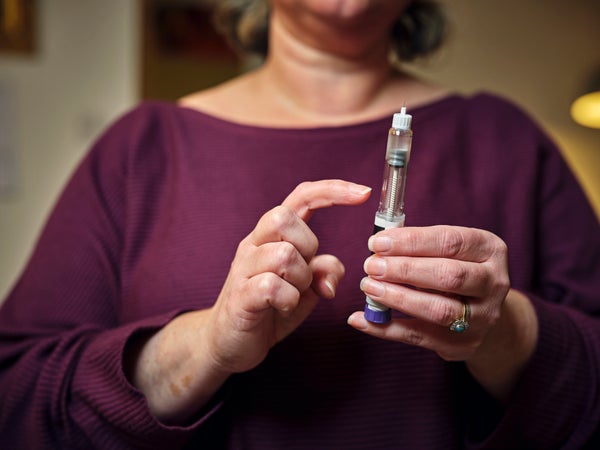
An estimated one in eight American adults takes glucagonlike peptide 1 (GLP-1) medications, including Wegovy and Zepbound, to treat conditions such as diabetes or to lose weight. Some experts believe that some people will need to take these medications for life to maintain their results. But research suggests that most of these people will stop taking medications, and when people do, most of their weight will tend to return. The same goes for those who lose weight through dieting: once the diet is over, they usually gain the weight back.
Now, two independent clinical trials indicate two possible methods to prevent weight regain: taking a daily oral GLP-1 medication called orforglipron or taking a supplement containing a pasteurized strain of Akkermansia muciniphila bacteria. Both studies were published Tuesday in the journal Natural medicine.
In the orforglipron study, funded by the drug’s maker, Eli Lily, researchers conducted a controlled trial that followed more than 370 people who injected either semaglutide (sold under brand names such as Ozempic and Wegovy) or tirzepatide (sold under the names Mounjaro and Zepbound). After 72 weeks of treatment with one of these drugs, participants were switched to a daily orforglipron pill or a placebo.
On supporting science journalism
If you enjoy this article, please consider supporting our award-winning journalism by subscription. By purchasing a subscription, you are helping to ensure the future of impactful stories about the discoveries and ideas shaping our world today.
After about a year, participants who took orforglipron tended to maintain more of their weight loss — about 79 percent of what they lost with semaglutide and 75 percent of what they lost with tirzepatide — than the placebo group. Meanwhile, people who received the placebo maintained about 38 percent of the weight they lost on semaglutide and about 49 percent of what they lost on tirzepatide.
The results suggest that it is “feasible” to move from a weekly injection to a once-daily GLP-1 tablet “with fairly good preservation of initial weight loss,” says Daniel Drucker, a professor of medicine at the University of Toronto, who has previously consulted with Eli Lilly but was not involved in the trial. “These results provide more options for some people who might prefer a once-daily pill rather than a once-a-week injection,” he says.
Drucker notes, however, that orforglipron (sold under the brand name Foundayo) was only recently approved by the U.S. Food and Drug Administration, in April, and that there is “much less” safety data for orforglipron than for the injectable forms of semaglutide and tirzepatide.
In the second clinical trial, researchers followed 84 adults who lost weight on an eight-week low-calorie diet and were then randomly assigned to follow a A. muciniphila supplement or a placebo while following a regular and balanced diet.
After about six months, the researchers found that the group taking the A. muciniphila The supplement regained less weight on average and ended the study with a total weight loss of about three kilograms more than those who did not take the supplement. (The study was funded by the company Akkermansia, which makes a A. muciniphila supplement.)
The results are “interesting,” but “the effect size is quite modest,” so it’s unclear how well the treatment would translate into real-world use, Drucker says.
There is precedent for the use A. muciniphila for maintaining weight loss, says Ellen Blaak, lead author of the second study and professor of human biology at Maastricht University in the Netherlands. (Blaak is a scientific advisor for the company Akkermansia and is the inventor of a patent application related to the study.) The bacteria has been shown to help with weight loss in animal studies and a small human trial. Until now, its effectiveness in maintaining weight loss has not been tested in a longer-term randomized clinical trial.
Weight regain after dieting or even after using GLP-1 is the “most important problem” in obesity management, says Blaak – and the results indicate that A. muciniphila could be a “tool” to help fight against this phenomenon, she says. “Most people manage to lose weight at some point in their lives… This would be helpful in maintaining that weight,” Blaak says.
In the future, Blaak says, his research team hopes to follow patients for more than six months and study whether natural levels of A. muciniphila in a person’s gut may play a role in their weight loss, as well as to research other potential microbial treatments. “There are many possibilities,” she says.
It’s time to defend science
If you enjoyed this article, I would like to ask for your support. Scientific American has been defending science and industry for 180 years, and we are currently experiencing perhaps the most critical moment in these two centuries of history.
I was a Scientific American subscriber since the age of 12, and it helped shape the way I see the world. SciAm always educates and delights me, and inspires a sense of respect for our vast and beautiful universe. I hope this is the case for you too.
If you subscribe to Scientific Americanyou help ensure our coverage centers on meaningful research and discoveries; that we have the resources to account for decisions that threaten laboratories across the United States; and that we support budding and working scientists at a time when the value of science itself too often goes unrecognized.
In exchange, you receive essential information, captivating podcasts, brilliant infographics, newsletters not to be missed, unmissable videos, stimulating games and the best writings and reports from the scientific world. You can even offer a subscription to someone.
There has never been a more important time for us to stand up and show why science matters. I hope you will support us in this mission.


