Rare Fossil of Baby Dome-Headed Dinosaur Unearthed in Canada


For many years, the fossil record of pachycephalosaurs (bulged-headed dinosaurs) was dominated by fossilized skulls. The postcranial material of young pachycephalosaurs, in contrast, has remained almost entirely unknown. Paleontologists have described the youngest example of a pachycephalosaur body, providing insight into how these dinosaurs grew and moved during their first months of life.
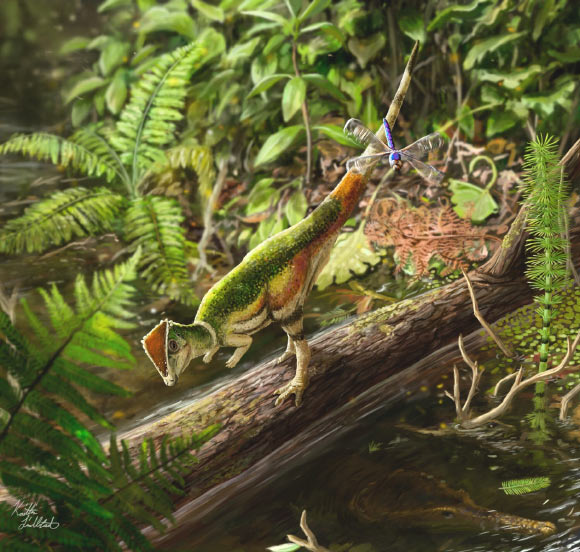
Reconstruction of the life of the pachycephalosaur individual CMNFV 22039 in an environment typical of the Frenchman Formation of the Upper Maastrichtian. Image credit: Kaitlin Lindblad.
“Pachycephalosauria primarily comprises small (between 2 and 6 m long) bipedal dinosaurs from the Santonian to Maastrichtian ages (85 to 66 million years ago) from Asia and North America,” said paleontologist Bryan Moore of Carleton University and colleagues.
“The clade is best known for the fusion of its frontal and parietal bones into an inflated dome.”
“Surrounding cranial features are sometimes incorporated into this structure and are often decorated with knots, spikes, and other ornaments.”
“Since frontoparietal domes are the taphonomically strongest parts of pachycephalosaur skeletons (except for teeth), the pachycephalosaur fossil record is dominated by these partial cranial remains.”
“As a result, much of what is known about pachycephalosaur ontogeny and phylogeny relies heavily on skull morphology.”
Cataloged under the number CMNFV 22039, the newly described pachycephalosaurian specimen is approximately 67 million years old (Late Cretaceous Maastrichtian age).
The fossil was found in the Frenchman Formation, the youngest of five Maastrichtian formations in southern Saskatchewan, Canada.
This dinosaur was probably less than a year old when it died, making it the youngest pachycephalosaur known from skeletal remains.
“Despite its small size (total length estimated at 90 cm), the skeleton presents several diagnostic characters of Pachycephalosauria,” the paleontologists indicated.
The results show that many of the characteristics that scientists rely on to identify adult pachycephalosaurs were already present very early in life.
They also allude to the way young pachycephalosaurs moved: compared to adults, the hindlimbs of juveniles were proportionately long, suggesting a more cursive or speed-oriented build in early life.
As the animals grew, their bodies appear to have evolved toward the stockier proportions seen in adults, indicating a change in their locomotion as they grew larger and heavier.
“The relatively long hindlimbs of the juvenile compared to those of adult pachycephalosaurs indicate probable negative ontogenetic allometry in the hindlimbs,” the researchers said.
The team’s article was published on February 26 in the Journal of Vertebrate Paleontology.
_____
Bryan RS Moore and others. The youngest known pachycephalosaurus (Dinosauria: Ornithischia) postcranium from an ontogeny perspective. Journal of Vertebrate Paleontologypublished online February 26, 2026; doi: 10.1080/02724634.2026.2616325


:max_bytes(150000):strip_icc()/Health-GettyImages-DietitiansAgree-AlternativeMilk-f6e38430e82b476692cf4fa1239b53d0.jpg?w=390&resize=390,220&ssl=1 "We Asked 3 Dietitians the Best Dairy-Free Milk You Can Drink—And They All Said the Same Thing")

