UCLA appeared on the verge of a late recruiting victory Tuesday when David Schwerzel, a high school defensive lineman from Seattle, tweeted that he was “1000% committed” to becoming a Bruin, including a picture of himself in a blue and gold uniform.
By midday Wednesday, Schwerzel sent out another tweet, saying he remained undecided “due to unforeseen circumstances.” He ended up signing with Washington by day’s end.
Regardless of whether the reversal was attributable to miscommunication with coaches or a change of heart, it illustrated the volatility of the early signing period in even the best of times.
And these clearly weren’t the best of times for the Bruins.
Having done its best to salvage a rapidly dwindling recruiting class after the September dismissal of coach DeShaun Foster, UCLA suffered several more defections Wednesday from prospects who had been previously committed to becoming Bruins.
Four-star edge rusher Carter Gooden signed with Tennessee. Three-star safety Toray Davis signed with Texas. Three-star offensive lineman Micah Smith signed with Illinois. Three-star offensive lineman Travis Robertson signed with Bowling Green.
UCLA was left with a 12-player class that general manager Khary Darlington said could grow a bit. Among the possible additions is Anthony Jones, a four-star defensive lineman from Crean Lutheran High in Irvine who remained publicly committed to the team and could significantly bolster a class that dropped to No. 82 in the 247 Sports national rankings.
“Just the mere fact that we were able to land the amount of players that we have landed,” Darlington said, “have our staff be as motivated as they were throughout the entire process and finish strong the way that we did is encouraging.”
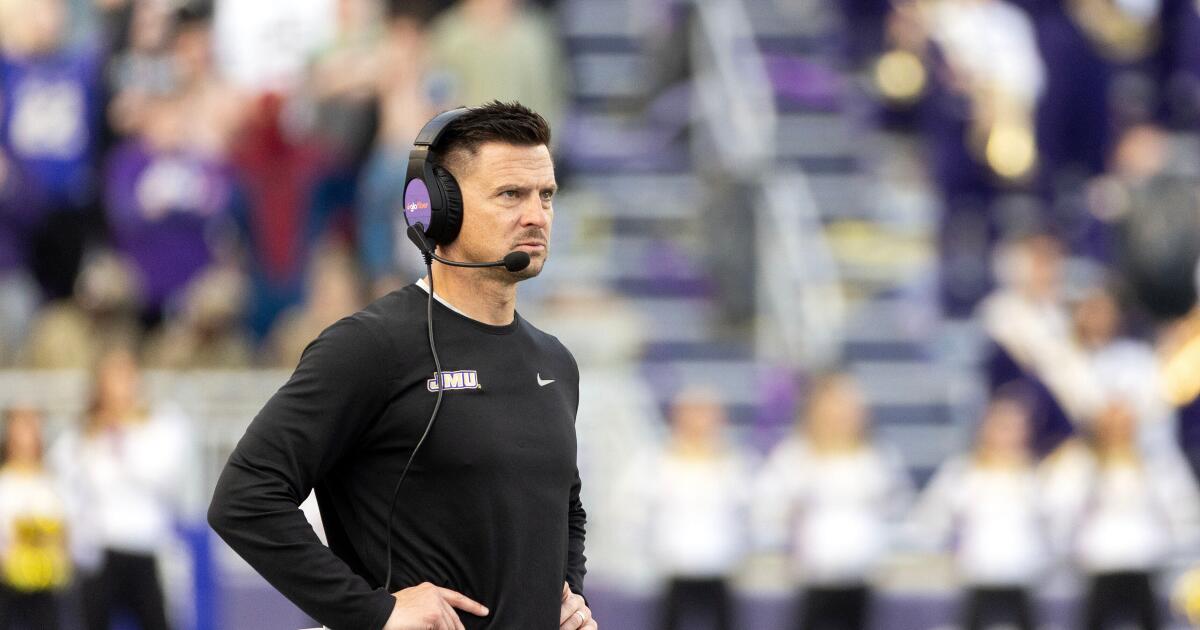
A class that could be labeled the Sturdy Dozen given its resolve amid the uncertainty could also help jump-start the early rebuilding efforts of Bob Chesney, the James Madison coach who is expected to be formally announced as Foster’s successor later this week.
Darlington said there weren’t any surprises given that some of the defections were to teams going through significantly less turmoil than one transitioning to a new coaching staff.
“What I’ve learned very quickly in this business in the collegiate space is that things could change at the drop of a dime,” Darlington said, “so we had our fingers crossed for a couple of players, hoping that we could keep them committed.
“But then with some of the previous conversations we had with the families and understanding everything that was involved this go-around in regards of what individual players and families were looking for to give themselves a sense of stability, it still felt good to know that the people you may have lost, you lost to legitimate competitors that did have the things that those individuals were looking for in some of those previous conversations. That being said, I think we have laid a good foundation for whoever will be coming in here next to build from.”
Among the successes that UCLA could celebrate was the signing of C.J. Lavender, a cornerback from Mater Dei High who made seven interceptions last season as one of the Monarchs’ top defenders. Lavender had previously been committed to Washington but said being able to play collegiately in his home state was a big draw.
“The idea of my entire family being able to come enjoy themselves at my games while I do what I do on the field was a dream come true,” said Lavender, who also cited his relationships with Darlington and Marshawn Friloux, the Bruins’ senior director of football recruiting operations, as selling points.
Lavender’s signing became all the more critical after four UCLA defensive backs — Scooter Jackson, Andre Jordan Jr., Cole Martin and LaRue Zamorano III — entered the transfer portal, though they could return at a later date.
UCLA also signed two defensive linemen in Marcus Almada and James Moffat along with a trio of wide receivers in Kenneth Moore III, Marcus Kier and Major Pride. Moore earned the distinction of having been committed the longest, pledging his allegiance in November 2024 and never publicly wavering.
Darlington said the recruiting staff’s approach was to fully acknowledge the uncertainty of the situation and encourage prospects to assess what was best for them, only asking that they keep the staff updated along the way. That’s not to say it was an easy process for anyone involved.
“I say this without exaggeration,” Darlington said, “there’s been tears on both ends of the phone call, there’s been sleepless nights.”
With at least a dozen players on board, any fears of coming up empty were put to bed.


