Researchers Create Detailed Map of Smell Receptors in Mouse Nose


By mapping millions of odor neurons in mice, scientists have discovered precise striped patterns inside the nose, overturning decades-old assumptions about how olfaction is programmed.
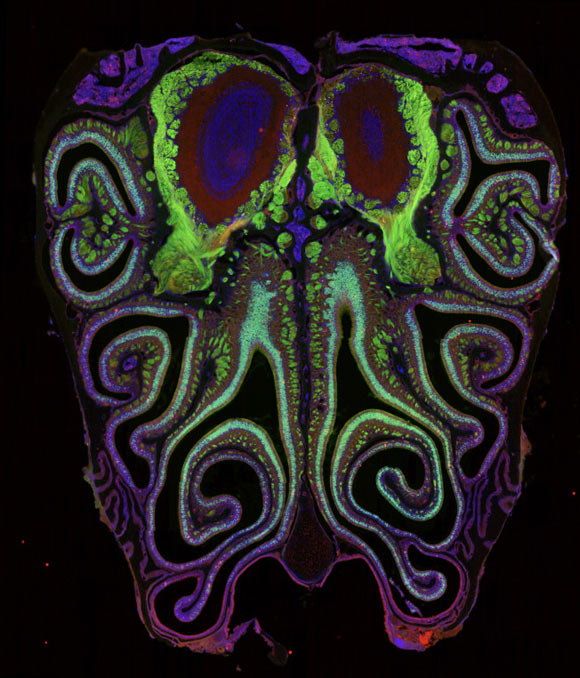
A cross section of a mouse nose. Image credit: Datta Lab, Harvard Medical School.
“For most of us, smell is an integral part of daily life,” said Professor Sandeep (Robert) Datta of Harvard Medical School.
“It plays a vital role in providing information about our surroundings, alerting us to potential dangers, enhancing our sense of taste, and evoking emotions and memories.”
“However, from a scientific point of view, olfaction is extremely mysterious.”
Working in mice, Professor Datta and his colleagues discovered that contrary to what scientists had long thought, neurons expressing these receptors have a high degree of spatial organization: they form horizontal bands based on receptor type, from the top to the bottom of the nose.
Additionally, they established that the map of receptors in the nose matched the olfactory maps of the brain’s olfactory bulb, providing clues about how information travels from the nose to the brain.
“While the odor map is an exciting discovery in its own right, it also provides fundamental information that could help scientists develop therapies for loss of smell, which are currently lacking,” Professor Datta said.
“We can’t fix odors without understanding how they work at a basic level.”
“There have long been maps describing how receptors in the eye, ear and skin are organized to capture and interpret auditory, visual and tactile information. And scientists have understood how these maps correspond to those in the brain.”
“However, olfaction is the only exception; it is the sense that has been missing the map for the longest.”
In the new study, researchers combined single-cell sequencing and spatial transcriptomics techniques to examine approximately 5.5 million neurons in more than 300 individual mice.
The first technique allowed them to identify which olfactory receptors were expressed by neurons in the nose, and the second allowed them to determine the location of these receptors.
“This is arguably the most sequenced neuronal tissue ever made, but we needed this scale of data to understand the system,” Professor Datta said.
Scientists have discovered that neurons are organized in tight, overlapping horizontal bands from the top of the nose to the bottom, depending on the type of olfactory receptor they express.
This highly organized receptor map was consistent across all mice and reflected the organization of olfactory maps in the brain, just as the researchers observed for vision, hearing and touch.
The authors then studied how the olfactory map in the nose is formed and identified retinoic acid – a molecule that helps control gene activity – as a key factor.
They discovered that a gradient of retinoic acid in the nose guided each neuron to express the correct type of olfactory receptor based on its spatial location.
Addition or removal of retinoic acid caused the receptor map to shift up or down.
“We show that development can achieve this feat of organizing a thousand different olfactory receptors into an incredibly precise and consistent map between animals,” Professor Datta said.
An article describing the results has been published in the journal Cell.
_____
David H. Brann and others. A spatial code governs the choice of olfactory receptors and aligns the sensory maps of the nose and the brain. Cellpublished online April 28, 2026; doi: 10.1016/j.cell.2026.03.051


