Resolved: Laundry folding is the future of home robotics


Rejoice, humans. If you’re wondering how you’ll integrate robot assistants into your life (you know, beyond robot vacuums and lawn mowers), you can sleep easier knowing that your laundry folding tasks will be solved by robots.
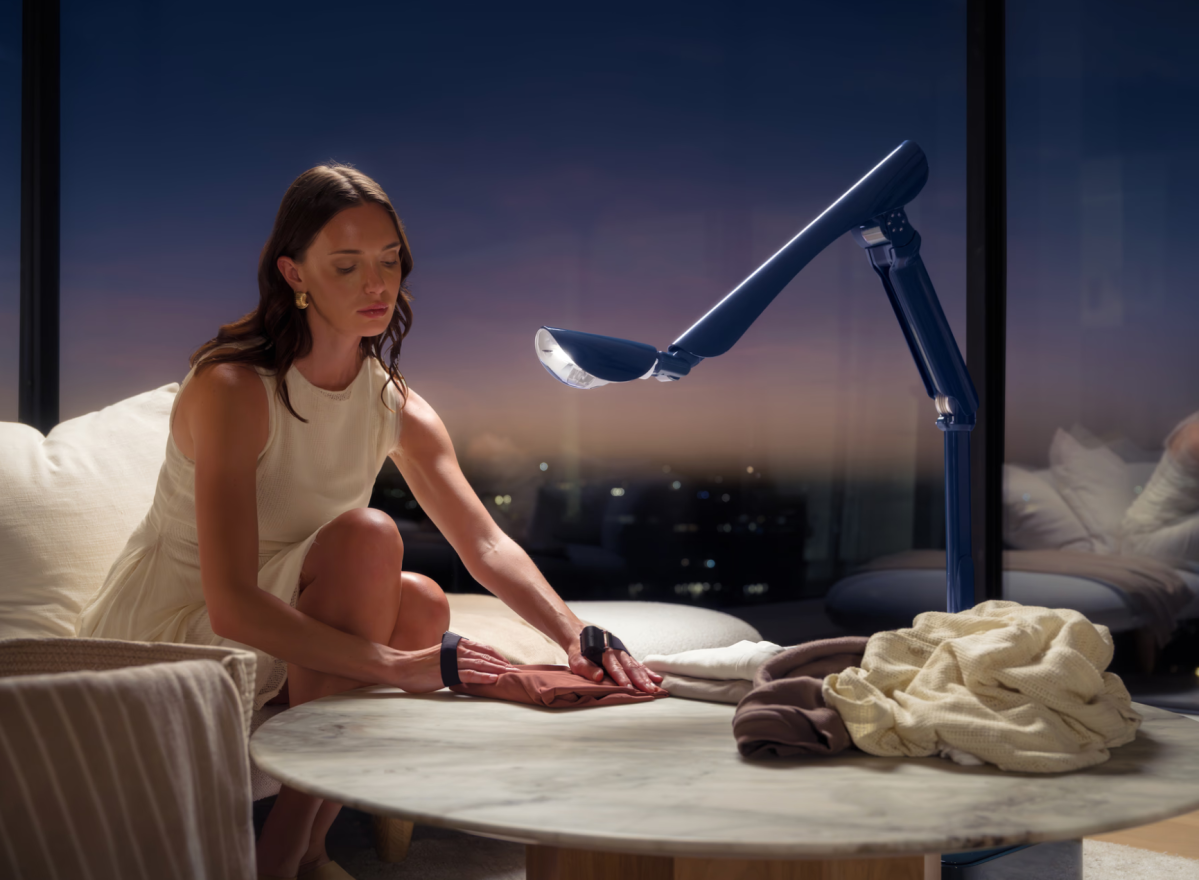
Arriving like a pretentious ad for a ’90s cologne, a new product launch video from Syncere (which looks like cologne, right?) reveals a home robot called Lume. Our robot assistant seems to do two things: move around the house like a moving lamppost and fold your laundry… painfully slowly.
Lume’s video is breathtakingly pretentious, set in a cavernous post-modern mansion complete with floor-to-ceiling windows and inhabited by a beautiful, picture-perfect couple. They dance effortlessly as Lume moves to light the space, folds a suspiciously small pile of laundry, and seemingly finishes making a bed (although we never see him struggle to apply a fitted sheet).
There’s a lot to learn from this Lume launch, but your first takeaway is that the home robotics industry is looking to folding laundry as the next nuisance task it aims to tackle.
Indeed, it’s impossible to look at Lume without immediately thinking of one of the biggest shows at CES 2026: LG’s humanoid-style laundry-folding robot, which worked so slowly that most of us just wanted to shout, “Give it to me! I can do it myself.” Other laundry files in the wild include the Figure 2 Robot and Weave Isaac.
Your second takeaway: Home robotics, and its marriage with AI, is clearly becoming a venture capital-fueled sector, “let’s just get some funding and try this!” ” thing. I’m immediately reminded of my reporting a decade ago, when the hardware developer community latched onto “sensors” and we saw companies testing crazy gadgets like “smart cups” for counting calories.
But it gets catchier than Lume itself. Syncere also released an ambitious and extremely well-produced “Meet Syncere” video that introduces its company to the world, and, in the reel, founding designer Kevin Li utters a mission statement so perfect – so both cringe-worthy and reasonable – that I can’t help but think the world has just changed in a material way:
“We view robotics as a service. »And this is how the RaaS industry was born!
No, I’m joking. This term was gaining traction years ago, but it’s now entering the mainstream space, and I fear we’re all paying monthly subscription fees to keep our laundry folded and… “updated” reliably.
Syncere
As beautifully designed as the Lume is, all arms articulated and shiny, anodized to perfection, I give credit to CEO Dr. Aaron Tan for creating a “workshop” for developing home robots. Syncere’s hardware DIY takes place not in a cold storage or office park, but rather in a typical upper-middle-class home in Palo Alto, California. I think Tan and I use the same espresso machine.
The suburban lab helps give Syncere that HP/Apple garage hacker origin story, and props to Tan: if you’re going to design the future of home robotics, it’s definitely best to do it in a WFH environment.
On its Lume product page, Syncere says the light can “handle soft material tasks like making the bed, folding laundry, and resetting pillows.” Tellingly, “there is no subscription for the first batch” (emphasis mine). You can pre-order one Lume for $1,500 and two for $2,500.


