Rice feeds billions of people – but its role in fueling climate change is growing

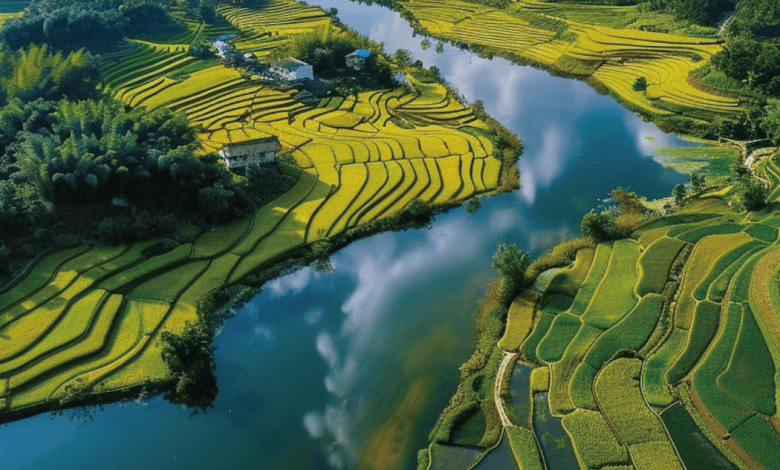
Rice feeds more than half the planet. From the rice terraces of Southeast Asia to the irrigated fields of China and India, it forms the basis of daily meals for billions of people.
But the same flooded soils that help rice thrive also create ideal conditions for microbes that release gases responsible for global warming.
In a new study, our team of environmental and agricultural scientists found that greenhouse gas emissions from rice fields have nearly doubled globally since the 1960s, averaging about 1.1 billion tons of carbon dioxide equivalent per year in the 2010s. That’s roughly equivalent to the annual emissions of 239 million cars.
This makes rice cultivation the largest source of agricultural emissions outside of livestock, and demand for rice is expected to continue to increase.
Farmers have ways to reduce emissions from their rice crops without reducing their yields. If every producer used the best “climate smart” options currently available, we would find that global rice emissions could be reduced by around 10% by mid-century. However, deeper reductions are needed to slow climate change, which would require the development of additional, more effective strategies.
Why rice emissions have increased
Rice emissions have increased for two reasons: the expansion of rice areas and the intensification of management practices.
A little more than half of the global increase is due to the expansion of rice areas. In Africa, for example, the area under rice cultivation has almost doubled since the 1960s, contributing to a doubling of methane emissions in the region.
At the same time, rice farmers are using more organic fertilizers and amendments, such as straw and manure, planting more productive rice varieties and placing the plants closer together. The result is more rice but also more greenhouse gas emissions.

Once the rice is harvested, one technique to improve soil fertility is to rebury the dried rice stalks in the soil. But it also increases methane emissions. Jingting Zhang
We found that one practice in particular – leaving rice stalks in the field after harvest, then burying them in the soil to improve soil fertility – was responsible for about 18% of the increase in overall net emissions from rice since the 1960s. The reason: it increases soil organic matter, which microbes then break down, creating more methane emissions.
Rising global temperatures further accelerate microbial activity in soils, leading to even more emissions.
Fertilizers are another major contributor to emissions. The use of synthetic nitrogen increased by about 76% after 2000, increasing nitrous oxide – another potent greenhouse gas. It contributed about 9% to the increase in total global net emissions from human activities.
Irrigation practices also affect emissions. In the past, irrigated rice fields remained flooded throughout the growing season, leading to constant greenhouse gas emissions produced by microbes that thrive in the humid environment. However, over the past two decades, more and more farmers have resorted to intermittent flooding, periodically drying out their fields.
This change reduced methane emissions compared to the continued flooding of rice fields. However, we saw a slight increase in nitrogen oxide emissions when soils alternated between wet and dry conditions, which prompts microbes to convert nitrogen in organic matter into nitrogen oxide gas, specifically nitrous oxide.
Climate impact of rice production
Assessing the overall climate price of rice production is more difficult than measuring one greenhouse gas at a time.
Rice fields emit methane and nitrous oxide from wet or flooded soils. They also remove carbon dioxide from the atmosphere as the rice grows, and lose carbon from their soils between harvest seasons.
A credible global estimate requires consistent consideration of different soil gas and carbon changes, as well as the uncertainty involved in tracking data across space and time.
To do this, we combined three approaches:
-
A computer ecosystem model allowed us to simulate crop growth, water conditions, and soil processes to together estimate changes in methane, nitrous oxide, and soil carbon.
-
An artificial intelligence-based machine learning model improved estimates where measurements were sparse to cover all rice-growing regions around the world.
-
And a meta-analysis of more than 1,200 field experiment sites provided direct evidence of how practices such as irrigation, fertilizer use and crop residue management affect emissions.
Together, they allowed us to quantify emissions from 1961 to 2020, determine the causes of these emissions, and test the potential of mitigation techniques under future climate conditions.
What works and what doesn’t work for climate mitigation
There are ways to reduce emissions from rice production without sacrificing yield.
Our study found that reducing fertilizer use and residue application, managing irrigation to allow dry periods between flood periods, and reducing tillage could, together, reduce global greenhouse gas emissions from rice by about 10% by mid-century.
We were surprised to find that replacing chemical fertilizers with more organic choices is not always preferable from a greenhouse gas perspective, although it is valued in organic farming.
Maintaining moderate amounts of straw and other crop residues in fields can help increase soil fertility, but excessive amounts can increase methane emissions and accelerate soil carbon loss. Another option is to convert some of the residue into biochar, burning it in low-oxygen conditions before mixing it with flooded soils. Biochar can help stabilize soil carbon and reduce methane emissions.

Rice has long been grown in flooded fields, which encourages methane production. By draining fields intermittently, researchers found that farmers could reduce methane emissions from their fields. Jingting Zhang
Improving water management can be a powerful tool for reducing emissions. Periodic drainage of fields reduces methane production, although it can slightly increase nitrogen oxide emissions. This strategy is particularly effective in regions with reliable irrigation infrastructure, including much of Asia.
Managing fertilizer use is also an effective mitigation strategy, particularly in highly fertilized systems, including parts of China and South Asia. Excess nitrogen increases nitrous oxide without a net increase in crop yields and increases water pollution. Reducing excessive nitrogen application reduces emissions and water pollution, saving farmers money.
The effects of tillage, the practice of plowing the soil between harvest seasons, show great regional differences. Reducing tillage is often touted as climate-friendly, but we have found that it does not always minimize net emissions in flooded systems. In temperate rice fields, including much of the United States and China, cooler conditions can limit methane production, allowing the soil carbon benefits of reduced tillage to outweigh the methane risk. However, in warmer, constantly flooded systems, low oxygen conditions can stimulate microbial activity, thereby increasing methane production and accelerating soil carbon loss.
Overall, we found that no single practice works everywhere. Each region will need to evaluate the most effective practices for reducing emissions.
A climate ceiling for rice production
The result is both encouraging and sobering: targeted sets of optimized practices can result in significant emissions reductions without loss of rice yield, but the total reduction possible on a global scale is modest.
Further reducing emissions will require better guidance to help farmers determine the best levels of organic amendments, such as straw or biochar, as well as new approaches to reducing emissions without compromising rice production.
This article is republished from The Conversation, an independent, nonprofit news organization that brings you trusted facts and analysis to help you make sense of our complex world. It was written by: Hanqin Tian, Boston College; Jingting Zhang, Boston College; Pep Canadell, CSIROand Shufen (Susan) Pan, Boston College
Learn more:
Hanqin Tian receives funding from the U.S. Department of Agriculture, the U.S. National Science Foundation, and the Andrew Carnegie Fellowship Program.
Pep Canadell receives funding from the Australian National Environmental Science Program-Climate Systems Hub.
Shufen (Susan) Pan receives funding from the US National Science Foundation
Jingting Zhang does not work for, consult, own shares in, or receive funding from any company or organization that would benefit from this article, and has disclosed no relevant affiliations beyond her academic appointment.


