Roman around the Christmas tree

When you purchase through links on our articles, Future and its syndication partners may earn a commission.

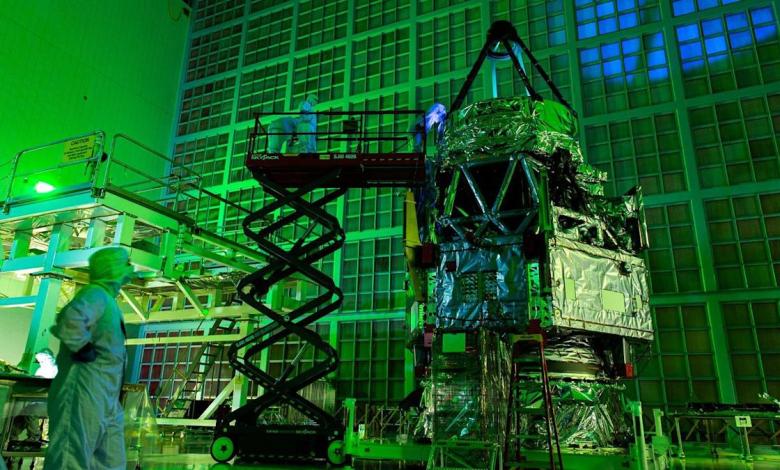
The Nancy Grace Roman Space Telescope inspected on land. | Credit: NASA/Michael Guinto
In a scene that looked more like a midnight vigil than a routine inspection, NASA engineers and scientists gathered in near-total darkness inside a pristine white room. Armed with flashlights and ultraviolet lamps, members of the Nancy Grace Roman Space Telescope team carefully examined the main mirror of the observatory, looking for the slightest trace of contamination.
The strange green glow that illuminated the white room was not party lighting but the result of a long exposure combined with a small indicator light on the wall, an unassuming signal that the airflow in the room was perfect.
In its way, it felt a bit like a high-tech vacation scene: dimmed lights, hushed voices, and a priceless object checked one last time before a long trip.
What is this?
The Roman Space Telescope is one of NASA’s next great observatories, designed to explore some of the biggest questions in modern astronomy. By probing the mysterious nature of dark energy to discover thousands of new exoplanetsRoman will study the universe with a wide-field view far beyond what previous space telescopes have achieved.
To achieve this science, Roman will use extraordinarily sensitive optics, including its main mirror. Even microscopic dust particles or residue can scatter light and degrade observations. This is why inspections take place in clean rooms which are cleaner than hospital operating rooms, in lighting conditions carefully chosen to reveal what the naked eye might otherwise miss.
Ultraviolet light causes certain contaminants to fluoresce, making them easier to spot. The team’s slow, methodical work under flashlights and UV lamps ensures the mirror meets the strict standards required for spaceflight. This is meticulous, patient work – more of a “silent night” than a moment of light – but it is essential to the future success of the telescope.
Where is he?
This image was taken at NASA Headquarters Goddard Space Flight Center in Greenbelt, Maryland.

The Roman Space Telescope is carefully inspected for contaminants. | Credit: NASA/Michael Guinto
Why is this amazing?
Once Roman launches in late 2026 or early 2027, there will be no opportunity to wipe a mirror or re-inspect. Every careful check done on Earth protects years of future science.
As Roman moves closer to launch, images like this remind us that space telescope science begins in clean rooms, with flashlights, UV light, and people dedicated to ensuring humanity’s next window on the universe is as clear as possible.
Want to know more?
You can learn more about the Roman space telescope And astronomy.


