Russia’s long-range bombers kept up attack tempo, showing fleet’s ‘resilience’ despite Ukraine’s Spiderweb attack: UK MOD

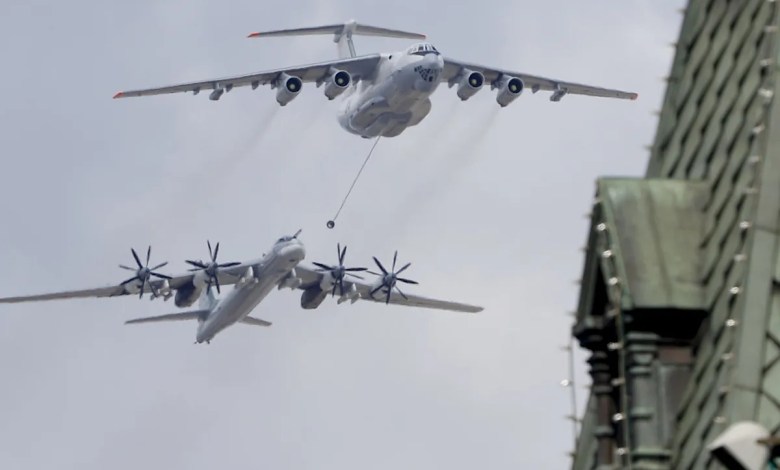
-
Russian bombers are still regularly attacking Ukraine despite the Spiderweb operation, the British mod said.
-
He observed more than 70 cruise missiles fired in July, saying that he shows the “resilience” of the Russian fleet.
-
However, the Ukrainian media previously reported that Russia had to pile up the missiles on its bombers.
Russia’s long -range bombers still season Ukraine at a regular rate despite the daring attack on the June drone against the fleet, the British Defense Ministry said in a recent evaluation.
In an information update on Wednesday, the British ministry wrote that it observed seven long -term attack packages launched against Ukraine in July, involving at least 70 “first” ammunition ” – powerful cruise missiles.
“Long -range Russian aeronautical bombers have maintained their offensive tempo, continuing to demonstrate the resilience and the preserved capacity of the fleet after operation Ukraine Spiderweb on June 1, 2025,” wrote the ministry.
The evaluation comes six weeks after Ukraine launched a surprise drone attack on four air bases deep in Russia, which housed the Kremlin strategic bombers and early alert aircraft.
Using first -person drones transported by truck, Ukraine has damaged what it said is at least a third of the Russian bombers fleet.
Nicknamed Operation Spiderweb, the attack was greeted as one of the most sudden examples of how the asymmetrical war can endanger high-level military assets such as the TU-95 MS bomber of $ 150 million. Ukrainian officials said the attack had a value of $ 7 billion in damage.
Before the attack, Russia aligned approximately 67 strategic bombers in its active inventory, and videos published by Ukraine show that at least nine of them were strongly damaged in the Spiderweb operation. Ukraine said the attack had damaged or destroyed at least 41 planes in total, but independent analysts said it was difficult to assert this assertion.

The aftermath of a drone shot show Tu-95 bombers destroyed on the Tarmac in Belaya Airbase.Satellite image (C) 2025 Maxar technologies via Getty Images.
Above all, these planes cannot be easily replaced. Russia would have ceased the production of the TU-95 and the TU-22M, and although it always manufactures the Tu-160 more recent, only two have been manufactured in the past three years. In particular, long -range bombers are also one of the three key pillars of the Russian nuclear triad.
However, Russia continued to bomb Ukraine after the June attack with a combination of one -way and missile drones.
Russia is generally based on its strategic bombers to shoot cruise missiles, most often ammunition from the KH air-surface missile family.
After operation Spiderweb, one of the largest strategic Russian bombers attacks took place on June 6, when Ukraine reported that Moscow launched at least 36 kH-101 cruise missiles in one night.
The Ukrainian media, however, cited anonymous sources saying that the Russian forces had to compensate for a reduced fleet during the attack by loading each bombardier with full capacity.
Be that as it may, Russia continued to use its fleet of bombers during high -level attacks. On July 12, Ukraine’s Air Force reported another wave of 26 kH-101 cruise missiles fired in Ukrainian airspace.
Ukrainian President Volodymyr Zelenskyy said that in July only, Russia had drawn more than 3,800 Shahed explosive drones and 260 missiles. However, he did not specify which of the latter was launched by strategic bombers.
Read the original article on Business Insider


