Rwanda tries to protect farmland in Africa’s most densely populated nation

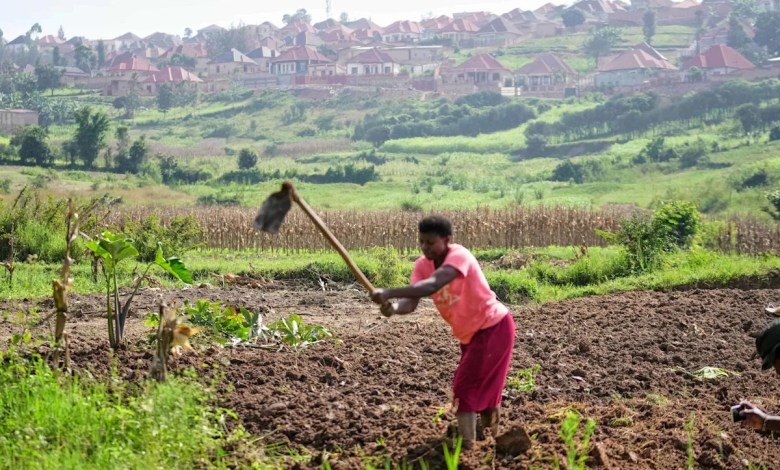
KIGALI, Rwanda (AP) — The rhythmic sounds of construction work drown out the sound of farmers’ hoes on a frigid morning in Rwanda’s capital, where new efforts aim to protect remaining farmland from relentless development in Africa’s most densely populated country.
Eighty-four-year-old Mukarusini Purisikira was a farmer before fleeing the country for Congo during the 1994 Rwandan genocide. When she returned, she said, her family’s land, which stretched across the hills, had been confiscated for construction. She pointed to the high-rise buildings of Kigali.
Today, she grows corn and sweet potatoes on a plot of land the size of a small house, which she says is barely enough to feed her.
“This is all I have,” she said, eyeing construction equipment on a nearby ridge warily.
She now benefits from a measure of protection. Since September, the Rwandan government has been mapping farmland and using satellite imagery to track any development encroaching on farmland and forests in a country where the population is expected to reach 22 million in a few years.
Rwanda is struggling to ensure its food security in the face of the latest global pressure on agricultural inputs such as fertilizers, the prices of which have increased since the start of the war in Iran.
The capital has reserved almost a quarter of the land for agriculture
The government has imposed fines of up to $3,000 and prison terms of up to six months on developers who encroach on rights.
Some buildings in Kigali were demolished, although those associated with them declined to comment for fear of government reprisals. The government is now planning to integrate drones for better real-time surveillance.
Meanwhile, land use data provided by the city hall shows that Kigali’s master plan has dedicated almost a quarter of the land, or 22%, to agriculture.
City officials acknowledge that housing construction is attractive because of demand, but say future projections show “agriculture will be even more productive.” They say the demand for food is also increasing and believe that with innovation it can be grown on smaller plots of land.
While most of the food consumed in Kigali comes from other districts of Rwanda, agricultural land in those areas is also dwindling, a spokeswoman for the mayor’s office, Emma-Claudine Ntirenganya, told The Associated Press.
Last year, the government printed and displayed maps showing areas of Rwanda’s districts designated for construction and reserved for agriculture.
Ntirenganya spoke of getting into agriculture “in an urban way. We will be able to show Kigalans that they can also farm and be productive.”
The city administration, which installs a greenhouse on its roof, requires developers seeking building permits to include green spaces and gardens in their designs.
Some are exploring vertical gardens and hydroponics
Other approaches in Kigali include vertical farms, where vegetables and fruits such as strawberries are grown in stackable plastic containers.
Christian Irakoze co-founded a local company, Eza Neza or “grow well”, which sets up vertical farms in the city and describes them as scalable. The AP visited two of them in local homes and another that supplies inventory to a grocery store. 600 plants are grown in vertical rows extending about 50 meters (yards) along a surrounding wall.
Irakoze described his work as “a different way of thinking about agriculture, from traditional large-scale farming in the hinterland to something smaller, modular and that anyone can really do.”
Through the use of locally available inputs such as manure and volcanic sediments in place of soil, Irakoze said agriculture should be adapted to reduce external impacts.
“We really need to find ways to find our own solutions, whether it’s through inputs like fertilizer or seeds. Some of these world events always remind us that we absolutely need to have alternatives,” he said.
Elsewhere in Kigali, a group of young agronomists are training farmers to adopt technologies such as hydroponics to maximize productivity, using water rather than land.
“The population is increasing, but our land is not increasing. We are making sure we find solutions that can help farmers overcome this, and then they produce more,” said one of the agronomists, Richard Bucyana.
Bucyana acknowledged that solutions such as Rwanda’s help protect against global events.
“African governments should start thinking about how they can become self-reliant,” he said.
___
To learn more about Africa and development: https://apnews.com/hub/africa-pulse
The Associated Press receives financial support from the Gates Foundation for global health and development coverage in Africa. The AP is solely responsible for all content. Find AP’s standards for working with philanthropic organizations, a list of supporters, and funded coverage areas at AP.org.


