Scientists claimed the world’s oldest rock art is 67,800 years old. But is the science behind that estimate flawed?


In recent years, researchers around the world have published increasingly ancient data on prehistoric rock art. Among the headliners is a painting of a warty pig in Indonesia believed to date from 51,000 years ago and a hand stencil that researchers said was stunning 67,800 years.
Most of these dates were determined by measuring the radioactive decay of certain versions, or isotopes, of uranium into thorium — a method called uranium-thorium (U-Th) dating. However, the validity of some of these dates has been questioned, Georges Sauvetresearcher at Center for Research and Studies on Prehistoric Art of France, suggesting that the method tends to overestimate the age of dated samples.
In a short communication published on March 23 in the journal AOJ of Histoarchaeology and Anthropological ExplorationSauvet has criticized published dates for some prehistoric rock art, saying researchers are being less cautious in a “race for the oldest rock art”.
If these dates are not contested, Sauvet argues, this distorts our understanding of early intelligence. Homo sapiens and human relatives, such as Neanderthals.
Sauvet believes it is absolutely necessary to cross-date with other dating methods to ensure the accuracy of U-Th dating, which in itself “is not acceptable,” Sauvet said.
What is uranium-thorium dating?
As water floods and breaks down limestone, then drips into caves, it slowly deposits calcite. As calcite forms, it traps small amounts of uranium which is also dissolved in water. Uranium then radioactively decays into several “daughter” isotopes, including thorium isotopes.
The method in question, U-Th dating, involves uranium-234, which contains 92 protons and 142 neutrons, and will spit out two protons and two neutrons (called an alpha particle) to form thorium-230, which contains 90 protons and 140 neutrons. It takes approximately 245,629 years for half of a given amount of uranium 234 to decay into thorium 230. So, assuming nothing has been added to or removed from the system since the uranium was deposited, the ratio of these two isotopes can determine the age of a calcite layer deposit.
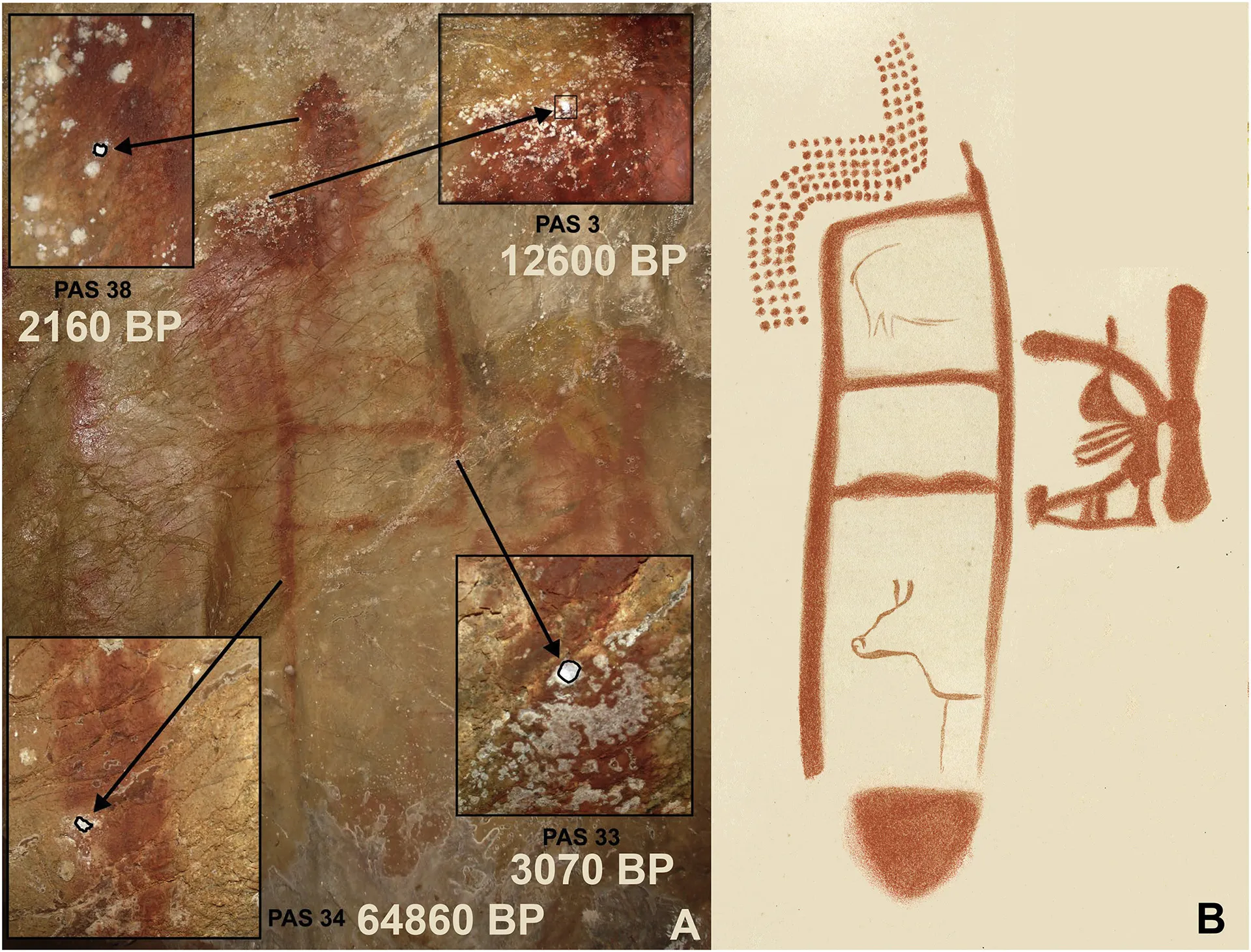
A dated rock art panel at La Pasiega C in Spain that shows a divergence between uranium-thorium dates on the left and right sides of the same rectangle, as reported by Hoffmann and colleagues.
(Image credit: adapted from White et al. 2018)
In theory, this type of U-Th dating can be an incredibly powerful tool for archaeologists.
Indeed, in some cases, rock art contains carbon, an organic element that can be dated. But often, rock art is made from the mineral ocher or from stone engravings, none of which can be radiocarbon dated.
This is where U-Th meetings come in handy. Calcite can grow as art progresses, creating a minimum age for its creation.
Questioning the age of rock art
However, in his article Sauvet argued that U-Th dating can provide unreliable dates and that they all need to be cross-referenced with other methods before a date can be estimated.
“My first alarm against the danger of the method was to read” a paper 2018 by Dirk Hoffmannresearcher in the Department of Human Evolution at the Max Planck Institute for Evolutionary Anthropology, and colleagues, “in which they report that three Spanish caves [drawings] were dated 65,000 years ago and were due to Neanderthals“Sauvet told Live Science in an email. The drawings show red ocher dots, a ladder, and hand stencils, and some researchers have suggested they show Neanderthals’ ability to think artistically.
In a response in 2020, Sauvet and 42 other researchers published a response highlighting the disadvantages of U-Th dating. The problem, Sauvet said, is that the method relies on forming calcite deposits and maintaining them in a “closed system,” meaning no uranium is leached from the calcite deposit from the moment it forms. In an “open system,” rainwater and groundwater seep through the calcite and wash away the uranium, distorting the U-Th ratio and making the deposit appear artificially older than it is.
“The dating of rock art is a particularly difficult subject,” Adelphine Bonneauassistant professor in the Department of Chemistry at the University of Sherbrooke in Quebec, told Live Science in an email. “In theory, Mr. [Dr.] Sauvet is right. U Series Encounters [which includes U-Th dating] can lead to overestimated dates.
According to Sauvet’s article, the hunt for increasingly old dates is partly due to the subsidies and prestige that accompany them. This resulted in a series of increasingly older dates, including supposedly 65,000-year-old art in Spain.
That date “would imply that the paintings were made by Neanderthals, when there is absolutely no archaeological evidence” that Neanderthals were capable of artistic creation, Sauvet said. (Other researchers, however, disagree and believe Neanderthals created art.)
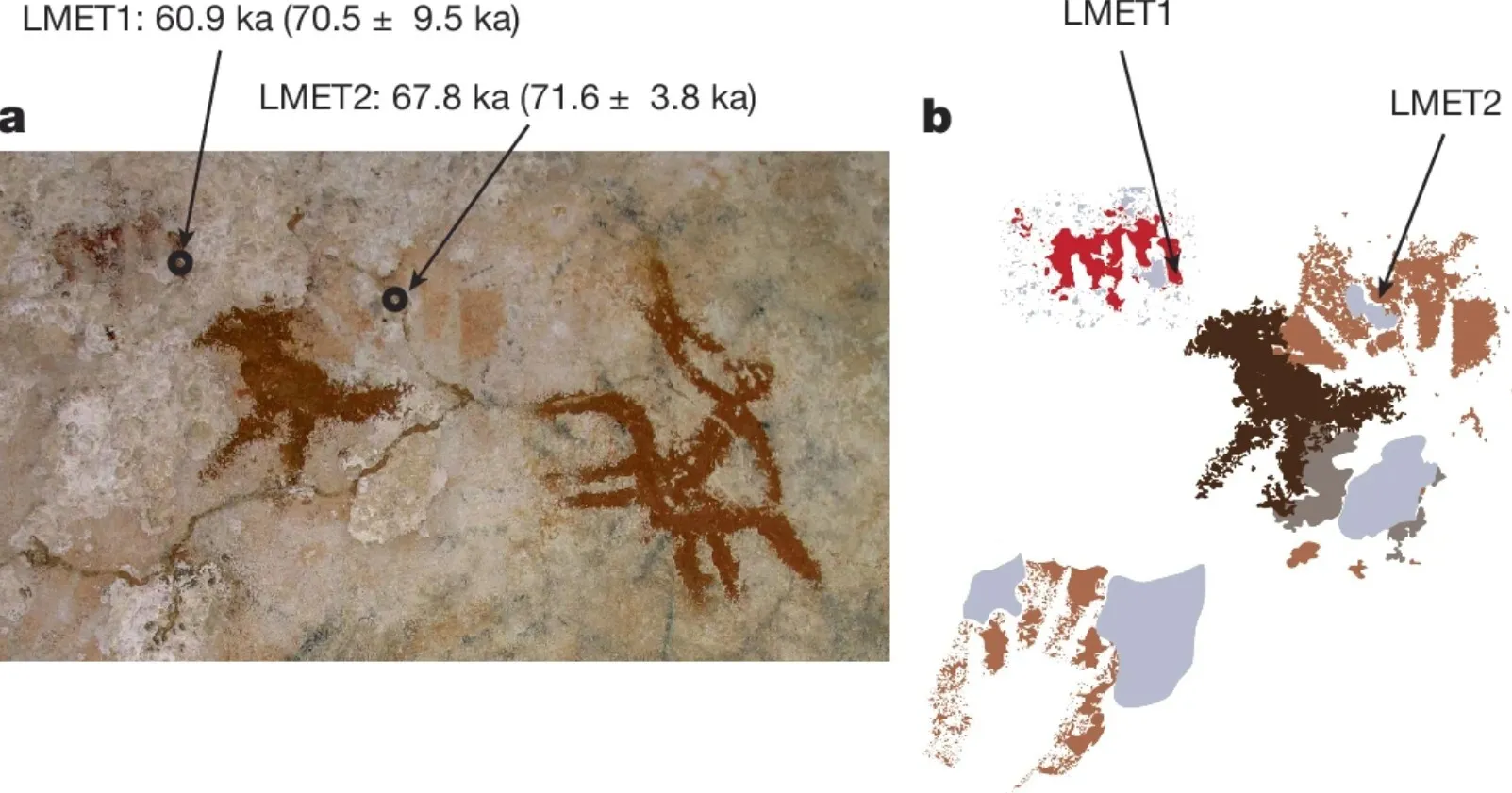
Photograph of rock art from Liang Metanduno in Sulawesi and a digital plot showing the location of dating samples LMET1 and LMET2.
(Image credit: Oktaviana et al. 2026)
The debate was relaunched with the discovery of negative hand stencils in Sulawesi, Indonesia, dated to the U-Th approximately 67,800 years ago, which recently surpassed all previous records.
To highlight the unreliability of U-Th dating, Sauvet cited several cases in his new paper in which U-Th and radiocarbon dates did not match when cross-checked. In Nerja Cave in southern Spain, a U-Th date gave a age 119,000 yearswhile a radiocarbon date of a charcoal mark which was part of the same drawing was approximately 19,000 years old; Meanwhile, another radiocarbon dating of a calcite layer from the same art dated it to around 14,000 years ago.
HAS Leang Balangajiathe outer calcite layer, expected to be the youngest, was dated to 37,300 years ago, about 7,800 years older than the layer below. In all of these cases it is suggested that the calcite layers were open systems.
In defense of U-Th meetings
Not all researchers agree with Sauvet’s assessment. João Zilhãoresearch professor at the University of Lisbon and co-author of the Spanish rock art studies, said any dating method can be prone to errors. In an email to Live Science, he drew parallels with radiocarbon dating, in which the ratio of carbon-14 to carbon-12 is measured – a method that can be prone to contamination.
Likewise, optically stimulated luminescence, which measures when something was last exposed to light, can give an artificially advanced age if someone doesn’t account for residual emissions from mineral grains in a sample, he noted.
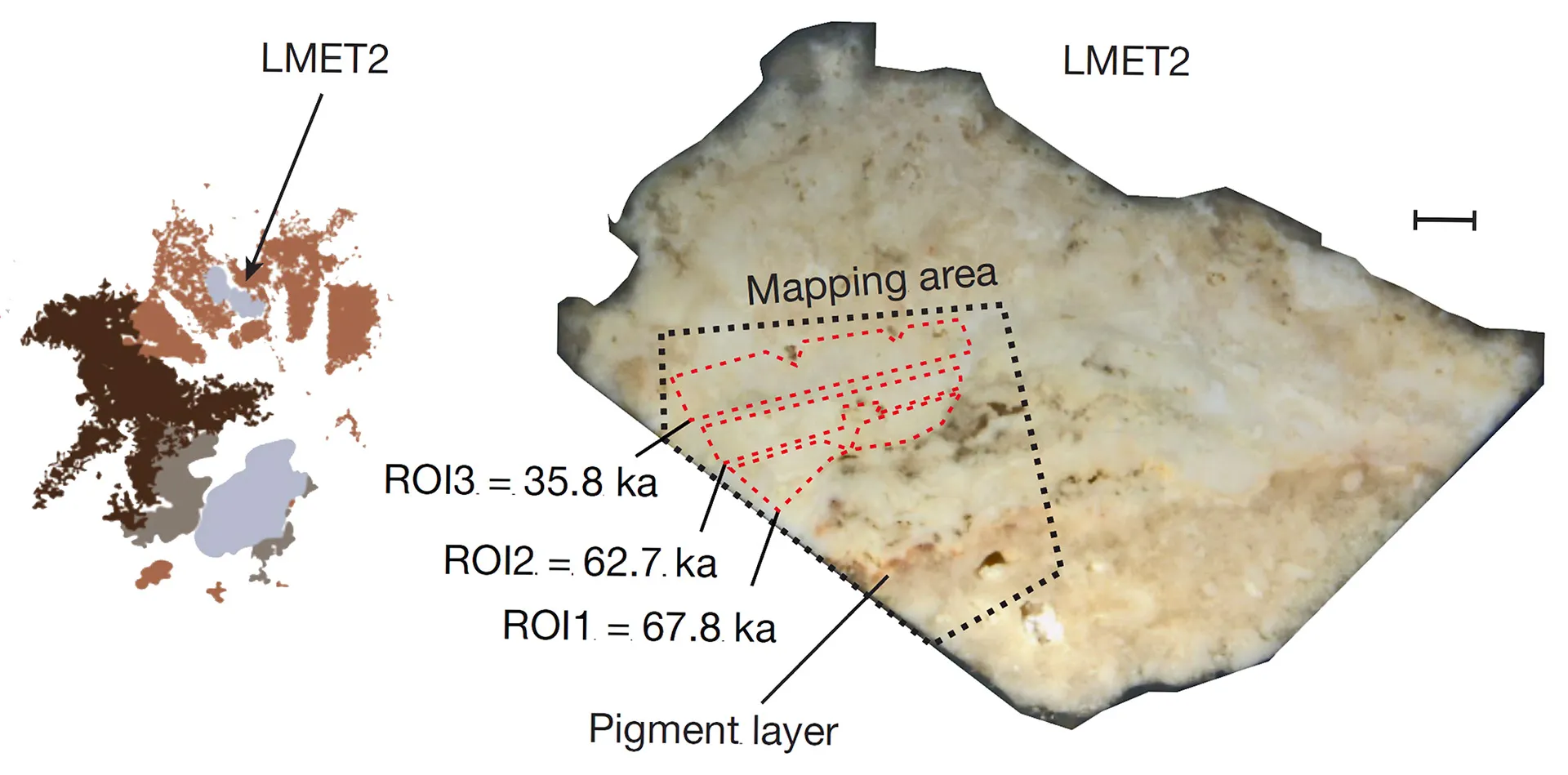
Rock art from Liang Metanduno in Sulawesi showing the location of three samples dated by the uranium-thorium method.
(Image credit: Sauvet 2026)
There will always be ways in which dating estimates can be subject to error, and U-Th is not particularly special in this regard, experts told Live Science.
“To say that dating the uranium series doesn’t work for rock art because there are cases where some calcite samples show open-system behavior is an overgeneralization,” said Maxime Aubertarchaeologist and geochemist at Griffith University in Australia, whose team was behind the Sulawesi dates.
Aubert recognized that uranium can leak out of or enter calcite deposits, distorting their true ages. To get around this problem, his team has in recent years developed a laser ablation approach that allows areas altered by external water infiltration “to be identified and excluded from the age calculation,” he told Live Science.
To ensure their dates, including those of the world’s oldest stencil, were accurate, Aubert’s team used lasers to remove small sections of each sample. Then they measured the isotope ratios in several of these sections to create a map of the isotope ratios in each calcite layer. Finally, they excluded layers where isotope ratios varied greatly, which would have suggested contamination.
Scientists have developed other ways to ensure their dates are reliable, Bonneau added. “There are several ways to treat these open systems and correct the dates accordingly… Laser ablation and mapping of the calcite layers allows you to select the most reliable parts and then extract the dates,” she explained.
Bonneau noted that Hoffmann and colleagues did not have access to laser ablation at the time of their study because the technology was still in development.
To get around this problem, in his previous work, Aubert “always published a lot of information regarding the different isotopic ratios, the composition of the calcite layers, etc.,” Bonneau explained. “This data is necessary to assess the reliability of the dates.” Hoffmann’s study does not have this data, she added, “so we cannot assess the reliability of the dates.”
Even though U-Th dating can be prone to errors, that doesn’t make their age estimates worthless, she said. “Sauvet is right in principle, but if scientists do their work correctly, the dates are reliable,” concludes Bonneau.
What do you know about our closest relatives? Find out with our Neanderthal quiz!


