Scientists discover first direct evidence that slivers of ‘proto-Earth’ may survive today


Fragments of the hellish lava-covered “proto-planet” that existed before Earth 4.5 billion years ago have survived unaltered in ancient rocks, groundbreaking new research reveals.
The fragments contain telltale potassic signatures not found in any other rock or meteorite examined so far by scientists, according to a study published October 14 in the journal Natural geosciences. Theoretically, these signatures should have disappeared in the giant collision that formed the moonbut it now appears that a handful of them survived this cataclysmic event and have subsequently stood the test of time.
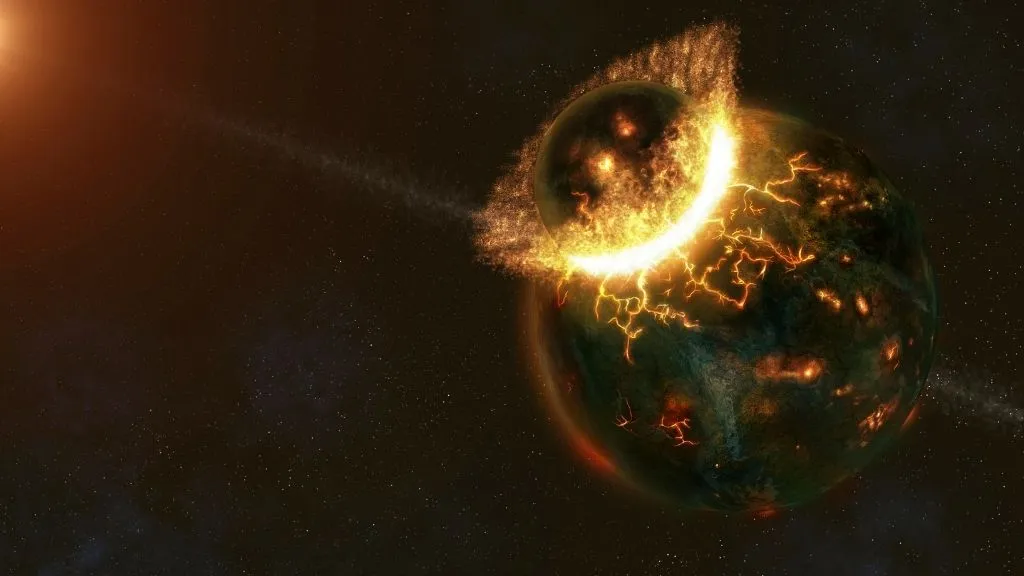
Proto-Earth was a sizzling ball of seething molten rock that formed from cosmic dust and meteorites at the beginning of the solar system. But after 100 million years, our first planet was rocked by a catastrophic impact with a Mars-sized planet called Theia. The collision was so powerful that it completely scrambled the interior of proto-Earth and blew up a piece of the Earth precursor that became the Moon.
Theia also delivered large quantities of new materials to proto-Earth, irreversibly altering the chemistry of Earth’s precursor and transforming it into a planet more like today. Over the eons, plate tectonics appearedand the materials were repeatedly recycled within the Earth. As a result, scientists did not think it was possible to find intact fragments of proto-Earth in modern rocks.
Researchers have already found rocks with unusual chemical signatures related to the element ruthenium that could predate the moon-forming impact, but these signatures could also come from after the collision, so they don’t provide strong evidence. Philippe Cartercomputational planetary scientist and astrophysicist at the University of Bristol in the United Kingdom, told Live Science.
The newly discovered potassium signatures, on the other hand, are the most definitive evidence yet that fragments of proto-Earth still exist, added Carter, who was not involved in the study. “The most reasonable explanation is that these are materials that survived before the impact,” he said.
Potassium ratio clues
The new signatures are subtle imbalances in the proportion of different versions, or isotopes, of the element potassium relative to other materials on Earth. Potassium contains three natural isotopes – potassium-39, potassium-40 and potassium-41 – which have the same number of protons but different numbers of neutrons, giving them different atomic masses.
Potassium 39 and potassium 41 dominate in terrestrial rocks, with potassium 40 existing only in trace amounts. In previous workThe authors of the new study discovered anomalous amounts of potassium-40 in meteorites, which record changes in conditions in the solar system over long periods. This suggests that potassium isotope anomalies can identify materials that predate the formation of modern Earth.
For the new study, Nie and his colleagues sampled ancient rocks from a handful of places that previously produced strange ruthenium signatures, including outcrops in Greenland, Canada and Hawaii. To detect possible potassium isotopic anomalies, the researchers ground the rocks into powder and dissolved them in acid. They then isolated the potassium in the samples and measured the ratio of different potassium isotopes using a mass spectrometer.
The rocks were deficient in potassium-40 compared to amounts found in other materials on Earth, the researchers found. To determine whether this potassium isotope anomaly could be traced back to proto-Earth, the team performed computer simulations. Using data from every known meteorite to have landed on Earth, they modeled the effects of these impacts and the impact of the moon’s formation on Earth’s composition through the delivery of new materials over eons.
The simulations revealed that the collision with Theia, in particular, dumped a lot of potassium-40 onto Earth, explaining the higher amount of potassium-40 we see in rocks today. “You have to add a significant amount of material to…change the overall signature and overall isotopic composition of potassium in most rocks,” Carter said. “Most of this change comes from the impact itself of the formation of the moon – that’s the argument they use in the paper.”
The potassium signature discovered in the ancient rocks is different from what Nie and his colleagues previously found in meteorites. It is therefore unlikely that meteorites could have created Earth’s current potassium profile after the moon-forming impact. “What this actually means is that proto-Earth formed from material that is isotopically distinct from any meteorites we have,” Carter said.
The Moon-forming impact is the only known event that could have significantly increased the amount of potassium-40 in rocks on Earth, Carter said. This means that potassium-40-deficient rocks in Greenland, Canada and Hawaii are older than the moon-forming impact and date back to proto-Earth, he said.
Martin Schillerassociate professor of geochemistry at the University of Copenhagen in Denmark who was not involved in the study, agreed that the results are convincing. “The really surprising/new observation is that the isotope signature of potassium [in the ancient rocks] cannot be explained with a mixture of primitive meteorites,” he told Live Science in an email.
The results imply that the remains of proto-Earth survived geological processes such as constant mixing of the mantle, the layer of Earth beneath the crust.
“It’s a signature that has been preserved separately from the rest of Earth’s rocks for a long period of time,” Carter said. And there’s likely more of this proto-Earth material hidden at the base of the mantle, he said. “We just get the little bits that come up.”