Climate change worsened rains and floods which killed dozens in southern Africa, study shows

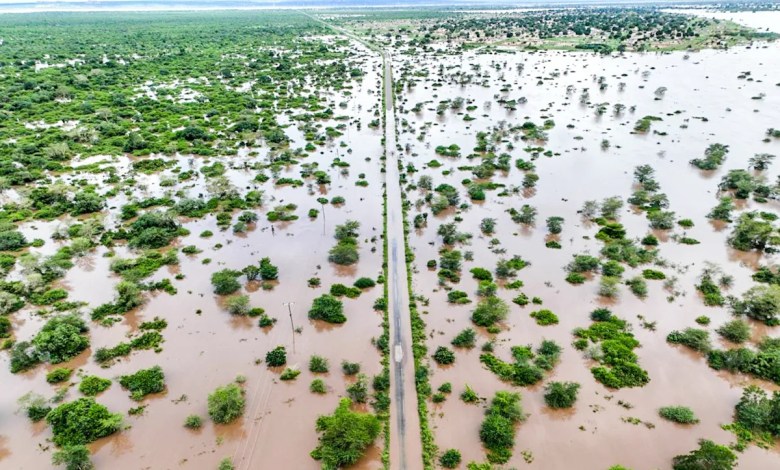
JOHANNESBURG (AP) — Human-caused climate change has worsened recent torrential rains and floods that devastated parts of southern Africa, killing more than 100 people and displacing more than 300,000, researchers said Thursday.
A study by World Weather Attribution, which analyzed recent heavy rains that caused severe flooding in parts of South Africa, Mozambique and Zimbabwe, showed that the region experienced a year’s worth of rain over a 10-day period.
This resulted in extensive damage to housing and infrastructure, estimated at millions of dollars, and caused untold human suffering, including loss of life.
Many homes and buildings in Mozambique were completely submerged under water, while roads and bridges were washed away in South Africa’s Limpopo and Mpumalanga provinces and parts of Zimbabwe.
The study was conducted by scientists around the world using peer-reviewed methods to assess the impact of climate change on extreme weather events and events.
A unique event every 50 years
Data obtained on recent downpours, the rare magnitude of which occurs approximately once every 50 years, confirmed a “clear evolution towards more violent downpours”, according to the study.
This situation has also been worsened by the current La Nina weather phenomenon, which naturally brings wetter conditions to the southern African region, but now operates in a much warmer atmosphere.
“Our analysis clearly shows that our continued burning of fossil fuels not only increases the intensity of extreme precipitation, but turns events that would have happened anyway into something much more severe,” said Izidine Pinto, a senior climate researcher at the Royal Netherlands Meteorological Institute.
Pinto, co-author of the study, said the climate models used struggled to determine exactly how much recent flooding has been made worse by climate change, but that a 40% increase in rainfall intensity would be impossible to explain without human-caused climate change.
“This means that what would have already been a period of heavy rain has turned into an even more severe deluge that communities are not equipped to cope with,” he said.
Far beyond expectations
Affected regions in southern Africa are no stranger to heavy rains and flooding, but scientists have been alarmed by the scale of recent events.
“This event was a surprise for us because we experienced the previous ones 25 years ago, which flooded the same areas,” said Bernardino Nhantumbo, a researcher with Mozambique Meteorological Services.
“There are places that recorded the expected rainfall for the entire rainy season in two or three days, so it was very difficult to manage, whatever the circumstances. »
According to Nhantumbo, Mozambique lies downstream of nine international rivers. So when an event like this occurs, a lot of damage is expected, not only from the heavy rainfall, but also from the flow of the rivers.
“We forecast well because we have different models, but these are the events where even with a good forecast you can’t predict the damage associated with it,” he said.
Mozambique’s central and southern regions were hardest hit, with the Gaza provincial capital of Xai-Xai and the neighboring town of Chokwe largely submerged under water.
Africa-focused climate models
Researchers have also called for the development of climate models in Africa to better understand the dynamics and scale of the impact of climate change in different regions of the continent.
According to Friederike Otto, professor of climate science at the Environmental Policy Center at Imperial College London, the lack of climate models developed in Africa partly explains why most models have struggled to determine exactly how much recent floods have been made worse by climate change.
“All the climate models that we have that are freely available are developed outside of Africa. They are all developed in climate modeling centers in the United States, Europe and some countries in Asia.
“But there is not a single climate model developed in Africa. For this reason, they are usually designed in a way to get the best weather conditions in the regions they are designed for, and this is true for all models,” she said.


