Senators propose bill to require PPE for wildland firefighters, but some have reservations


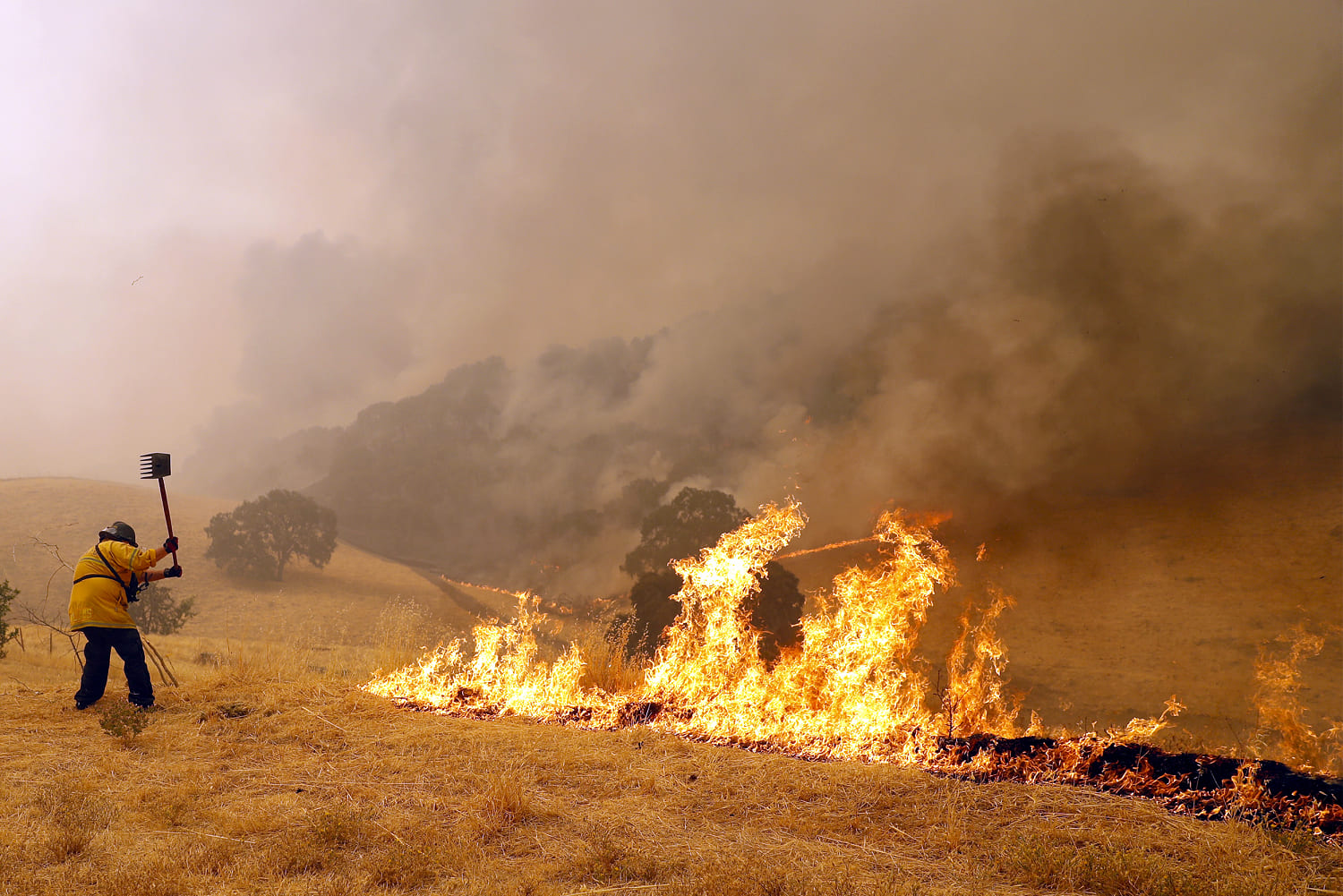
For decades, federal firefighters have trudged and parachuted into wildfires with only “a bandana and a prayer,” as the saying goes, to protect them from inhaling dangerous toxins. Meanwhile, studies increasingly link smoke inhalation to lung cancer and premature death.
A new bipartisan Senate bill would direct the U.S. Forest Service and the Department of the Interior to develop and implement mandatory respiratory protection for wildland firefighters and support personnel.
Under the Healthy Lungs for Heroes Act, co-authored by Sens. Adam Schiff, D-Calif., and John Curtis, R-Utah., firefighters would be required to wear approved respirators or masks when smoke exposure exceeds limits set in consultation with the Occupational Safety and Health Administration and the National Institute for Occupational Safety and Health.
“Firefighters are heroes, and it is critical that we do everything we can to ensure they are protected from the health risks associated with wildfires,” Schiff said in an emailed statement. “I will push for Congress to pass this common-sense proposal.”
Current and former federal firefighters say they welcome the proposed changes, but worry that without carefully selected equipment tailored to their specific needs, an inappropriate respirator or mask could make an already arduous job more difficult.
Many municipal firefighters already use a self-contained breathing apparatus, or SCBA, which includes a full face mask and an oxygen tank worn like a backpack. But federal firefighters carry heavy bags and tools deep into wilderness areas, making the idea of adding an oxygen tank unthinkable.
“Anything extra makes our job very difficult,” said Lalo Romo, a fire captain with the Cleveland National Forest in Southern California.
“You’re limited to how long these things last without any real effort,” he said, referring to the oxygen tanks, which he added could only last a few minutes. “The harder you breathe, the quicker you’ll get that air.”
Romo said he supports the bill but has concerns about its implementation and would not approve the use of SCBAs, for example. after seeing them in action.
In 2006, while Romo worked on a Hotshot Team — elite firefighters with specialized training — he battled a fire in Morongo Valley alongside municipal firefighters who wore respirators. They attempted to climb a hill with the Hotshots, but climbed about 200 feet before showing signs of heat exhaustion, Romo said. They were forced to turn back as the Hotshots, who were not wearing any respiratory protection, moved deeper into the fire, he said.
“If something is developed correctly that prevents us from inhaling what’s there, I’m all for it,” he said. “But we need to be able to breathe.”
In an emailed statement Friday, the Forest Service said it was working with the Departments of Labor and Interior to test new equipment and create “respiratory protection policies that meet both the regulatory needs and operational realities of firefighters.”
“Our firefighters deserve comprehensive respiratory protection that is both safe and practical,” the release read in part.
Federal firefighters frequently work in grueling and dangerous conditions requiring shifts of more than 16 hours with 80 pounds or more of equipment. Depending on the crew, some parachute into rugged territory inaccessible by foot or vehicle, or trek for miles into a wilderness covered in flames, smoke and ash.
Research has shown that no exposure to wildfire smoke is safe. Firefighters with repeated acute exposure have a reduced life expectancy of about 10 years compared to the average adult, according to a 2020 report from Stanford University.
“The light is finally being shed on this issue,” said Steve Gutierrez, union representative for the National Federation of Federal Employees. “If it’s a small step, who knows, maybe it could trigger a wave of new security features that could come.”
Even fires deep within a forest could expose first responders to high levels of carbon monoxide, aldehydes and crystalline silica, a mineral found in sand and rocks, the Forest Service warned in a 2013 report. Some compounds found in wildfire smoke are confirmed carcinogens, such as benzene and formaldehyde.
Short-term exposure can cause headaches, fatigue, nausea and respiratory distress, while long-term exposure can lead to cardiovascular disease and death.
It’s a risk that firefighters say is worth taking to protect the 193 million acres of public lands managed by the Forest Service. But the creation of stricter safety measures is essential to ensure the succession of new generations of firefighters.
In September, new guidelines were issued allowing the voluntary wearing of N95 masks for the first time in the department’s history. Only respirators approved by the National Institute for Occupational Safety and Health are allowed, and they cannot be worn “during strenuous work performed by wildland firefighters on the fire line,” according to guidelines issued by the National Interagency Fire Center.
“Although N95 respirators can filter particles encountered on the fire line, they cannot protect against gases, vapors, or very small solid particles from vapors or smoke that may also be present,” the guidelines state. “Currently, there are no respirators available that filter all inhalation hazards in the wildfire environment and that would meet OSHA regulations for use during strenuous fireline work.”
Riva Duncan, a retired federal firefighter, said she still remembers when administrators scoffed at a request for a washer and dryer to decontaminate fire equipment.
“People don’t think about what they can’t see,” Duncan said, adding that damage mitigation crews typically wear protective gear when cleaning homes damaged by fire or smoke.
“This should be a wake-up call to all of us,” she said.
It has become standard practice for municipal and state departments, such as the California Department of Forestry and Fire Protection, to remove, wash and change the jackets, pants and other specialized equipment worn by firefighters after their shift.
Municipal fire departments practice what is colloquially known as the “clean cab” concept, which involves keeping the interior of fire trucks free of contamination by storing protective clothing and tools outside the vehicle.
But in the Forest Service, it’s not always possible to exchange equipment in the heat of the moment. Firefighters often sleep in the field and may spend a day or two before changing.
“We could do a lot more,” said Gutierrez, the union representative. “But that would require a total culture change.”


