Small Ants Observed Cleaning Large Ants in the Arizona Desert — a New Behavior in Insects


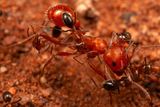
Insect expert Mark Moffett visited Portal, Arizona, in June 2006, ready to study insects at the nearby Southwest Research Station. Little did he know that he would make a discovery on his first morning – not at the station, but at the back of the chalet he was staying in.
Moffett recorded an unusual interaction between two species of ants that he had never seen before. The smaller cone ants were climbing all over the larger harvester ants, appearing to clean their bodies. Two decades later, Moffett now publishes his observations in the journal Ecology and evolutionpartly because no other reports of these “cleaner” ants had been recorded at that time.
Learn more: Crazy ants lead the way in swarm intelligence, helping colonies plan complex tasks
Two species of ants working together
The morning of his discovery, Moffett was drinking a cup of coffee while observing harvester ants (Pogonomyrmex barbatus) when leaving their nest. Most of the insects were wandering around, but a few, he noticed, were frozen in place, their jaws open and their legs extended. He realized that these ants were covered in ants.
“Given the usual tendencies of ants, I initially assumed that I was observing aggression,” Moffett said in a press release. “But the larger ants seemed to attract the attention of the smaller ones by first visiting their nests and then allowing the smaller ants to lick and nibble them all over.”
These smaller ants, which he has since concluded belong to an unidentified species of cone ants (Dorymyrmex), explored the bodies of the larger ants, nibbling and licking their shells. The harvester ants, if they wanted, could have easily devoured the smaller ants – some even cleaned the insides of the larger insects’ jaws – but instead they remained completely still, waiting for the cone ants to be sated.
“This new species of ant is the insect equivalent of the cleaner fish in the ocean,” Moffett said. Cleaner fish roam the ocean in search of larger fish that are harassed by parasites or covered in dead skin. They then clean the scales of the larger fish. Larger fish, like harvester ants, are happy to let the cleaning happen, although larger fish usually predate the cleaners.
Observe ant interactions
Moffett took high-resolution photographs of the scavenging behavior and recorded more than 90 interactions between the two ant species over the following days. All interactions involved the same behavior: Harvesters walked toward the cone ant nests, got into position, and waited for their cleaner. Sometimes up to five smaller ants would arrive to clean a harvester at the same time.
Some cleanups lasted only a few seconds, while Moffett saw others last more than five minutes. Eventually, the harvesters shook the smaller ants with enough force to sometimes turn them upside down. Housekeeping time was over.
Moffett said he found no other evidence of this behavior in other insects. Although the interactions between cleaner fish and their parasitized clients are well understood—one fish gets food, the other gets rid of pesky insects or dead skin—it is less clear what the two ant species gained from their interaction.
Moffett suspects their motivations might be similar, but future research exploring the potential health benefits of both species from grooming will answer the question in more detail.
“All kinds of amazing discoveries can still be made outside the lab,” Moffett said. “Discovering new species and behaviors in nature often requires us to pay close attention to the little things, including ants.”
Learn more: Ants weaken individuals to build larger societies
Article sources
Our Discovermagazine.com editors use peer-reviewed research and high-quality sources for our articles, and our editors review the articles for scientific accuracy and editorial standards. See the sources used below for this article:


