SpaceX launches Falcon Heavy rocket carrying powerful satellite

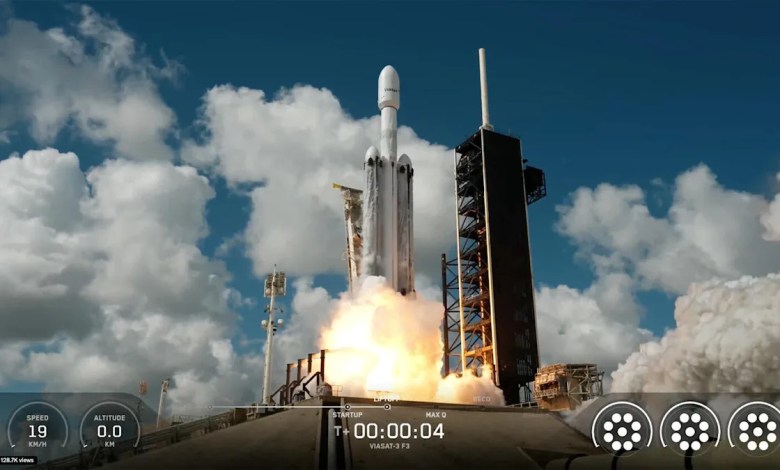
A SpaceX triple-core Falcon Heavy, the company’s most powerful operational rocket, blasted off Wednesday from Florida, propelling a ViaSat internet satellite into space, the company’s third in a global fleet of high-speed broadband relay stations.
In addition to placing the ViaSat-3 satellite into its preliminary planned orbit, the rocket’s two side boosters, heralded by competing sonic booms, executed on-target landings on separate platforms at the Cape Canaveral space station after propelling the vehicle out of the dense lower atmosphere.

SpaceX launched its 12th Falcon Heavy rocket on Wednesday, using its most powerful operational booster to put a state-of-the-art ViaSat internet satellite into orbit. / Credit: William Harwood/CBS News
It was the 12th flight of a Falcon Heavy rocket since the booster’s inaugural launch in 2018 and the first since October 2024, when SpaceX sent NASA’s Europa probe en route to Jupiter. As expected, the heavy rocket once again put on a spectacular show for area residents and tourists along Florida’s Space Coast.
Powered by 27 Merlin engines in three Falcon 9 first stage boosters strapped together, the Falcon Heavy came to life at 10:13 a.m. EDT and majestically flew away from Kennedy Space Center’s historic Pad 39A.
Two minutes and 25 seconds after liftoff, the Heavy’s two side boosters, both veterans of previous flights, lifted off and returned to the Cape Canaveral space station to land while the core stage continued its climb toward space.
A minute and a half later, the core stage, making its first and only flight, collapsed and the rocket’s upper stage took over. Unlike the side boosters, which had reserves of propellant for landing, the core stage burned all of its fuel as planned and was then jettisoned to crash into the Atlantic Ocean.

In this photo provided by SpaceX, cameras pointed down on the rocket’s two side boosters show the view moments before landing, while the lower images show each rocket from the ground. / Credit: SpaceX webcast
Three upper stage engine firings were required to place the ViaSat-3 Flight 3 broadband satellite into an elliptical orbit that will allow the relay station’s onboard propulsion to place the craft in a circular “geosynchronous” orbit 22,300 miles above the equator.
SpaceX is actively building a constellation of Starlink satellites in low Earth orbit that provide Internet access by routing user data to satellites passing overhead, which in turn relay signals to and from stations on the ground. So far, the company has launched nearly 12,000 Starlinks across nearly 400 launches over the past seven years.
Blue Origin is also building a planned constellation of some 3,200 broadband satellites in low Earth orbit, 270 of which have been launched to date. Amazon’s LEO satellites will eventually rival SpaceX’s Starlinks.
ViaSat takes a different approach, placing larger, much more powerful and sophisticated satellites in a geosynchronous orbit where they rotate at the same rate as the planet below and thus appear stationary in the sky, providing global spatial Internet access on a hemispheric scale.
The powerful satellites are equipped with enormous solar panels generating 25 kilowatts of power and spanning 144 feet from tip to tip when fully unfolded.

Artist’s impression of a ViaSat-3 Internet relay satellite in orbit, with its huge mesh antenna deployed to enable high-speed data transfers. / Credit: ViaSat
Capable of processing up to 1 terabyte of data per second, the satellites are equipped with the largest parabolic antenna ever launched on a commercial satellite. Once on station, the enormous reflector will unfold atop an 80- to 90-foot-long telescopic boom based on technology developed for the James Webb Space Telescope.
California-based ViaSat built the communications equipment for the relay station while Boeing provided the satellite that carries it. A division of Northrop Grumman built the deployable reflector.
The first ViaSat-3 satellite was launched in May 2023, but the antenna did not deploy properly and the spacecraft could only reach about 10% of its 1 terabyte capacity. A second ViaSat-3 satellite was launched atop a United Launch Alliance Atlas 5 rocket last November to provide service across the Americas.
If all goes well, the latest ViaSat-3 will provide Internet access to customers throughout Asia and the Pacific Ocean region. The first ViaSat will be moved to an orbital position allowing limited coverage of Europe and Africa.
“It’s kind of the end of an era. We’ve been working on this program for over 10 years now,” Dave Abrahamian, ViaSat’s vice president of satellite systems, told Spaceflight Now. “So that’s a lot of life that happened during the program.
“It’s a different world now than when we started the program. Back then we had a handful of satellites in orbit. Since then, we’ve launched the two ViaSat-3s, we merged with Inmarsat, we have the third one ready to go now. Totally different world, different feel, and it’s pretty cool to have been a part of it all.”


