SpaceX’s 1st ‘Version 3’ Super Heavy Starship booster buckles under pressure during initial tests

When you purchase through links on our articles, Future and its syndication partners may earn a commission.

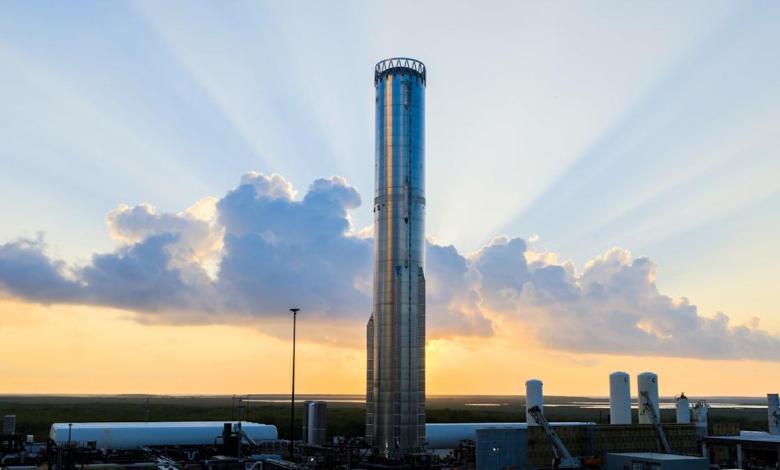
SpaceX launches its first V3 Starship Super Heavy booster to the site for testing at its Starbase site in South Texas. The company published this photo on X on November 20, 2025. | Credit: SpaceX
Additional testing will be needed before SpaceX’s latest version of Starship takes off.
Thursday (November 20), EspaceX deployed Booster 18, first stage of the company’s first “Version 3” Spacecraft megarocket, to begin its first series of tests before the vehicle’s next flight test. V3 will take the mantle from Starship V2, which capped a year of growing pains with two consecutive test flight successes, in August And October of this year.
Now it looks like V3 will have its own growing pains. SpaceX said testing of the new booster would begin at the company’s Starbase facility in South Texas within a year. Article from November 20 on X. “Initial operations will test the booster’s redesigned propulsion systems and structural strength,” the company said. But by Friday morning (November 21), the booster showed signs of serious damage.
In a post on
It appears from the photo that whatever propulsion and structural integrity tests SpaceX conducted overnight did their job and found flaws in the stainless steel vehicle.
“Very significant damage to the entire LOX [liquid oxygen] tank section, “Starship Gazer said in the post.
It’s still too early to know exactly what went wrong, according to SpaceX.
“Booster 18 experienced an anomaly during gas system pressure testing we were conducting prior to structural strength testing. No thrusters were on the vehicle and the engines were not yet installed. Crews need time to investigate before knowing the cause. No one was injured as we maintain a safe distance for personnel during this type of testing. The site remains clear and we are making plans to re-enter the site safely,” the company said. wrote on X Friday.
Visually, Starships V2 and V3 look very similar. The V3 is a bit larger, however – about 5 feet (1.5 meters) longer than the V2 – and also features a built-in “hot stage” ring, the structure that connects Starship’s two stages. (V2’s hot stage ring was a separate component that fell from both Starship stages after separation.) The new booster was also revised to fly under the power of SpaceX’s upgraded Raptor 3 engines. Additionally, the V3 boosters will feature only 3 grid fins, instead of 4, for downhill aerodynamic stability control, each approximately 50% larger than their V2 counterparts.
The latest incident risks slowing SpaceX’s momentum after a difficult year of Starship V2 test flights. This rocket was launched five times in 2025, but only successfully achieved its mission objectives in the last two.
SpaceX succeeded catch the returning Super Heavy boosters back to the launch pad on Starship’s first two flights of the year, using the tower’s mechanical “Mechazilla” wand-shaped arms. The company then successfully relaunched one of these boosters on a subsequent flight in May. And, while Starship’s third launch in 2025 resulted in the loss of the Super Heavy and Ship (the vehicle’s upper stage), its final two flights of the year were considered complete successes; with the deployment by Ship of a set of Star link satellite mass simulator payloads, secure re-entry via Earth’s atmosphere and a smooth landing of both stages in their respective target areas at sea.
Despite recent successes, Starship’s first-half setbacks and now this new incident with V3 before it even takes off, raise questions about the spacecraft’s readiness for SpaceX’s largest current customer.


NASA has contracted SpaceX to use Starship as a lunar lander for the agency’s missions. Artemis 3 mission, which will return astronauts to the surface of the Moon for the first time since 1972. NASA is targeting 2027 for this mission, but recent reports about SpaceX’s internal timelines push those estimates to no earlier than 2028.
It remains to be seen how the failure of Booster 18 will affect that timeline and what it means for the V3 booster design as a whole, but NASA may not be waiting to find out. Even before V3 was deployed for testing, the space agency had started I’m looking at other lunar lander options in light of SpaceX’s delayed progress in Starship development.
Starship was also recently criticized by former NASA Administrator Jim Bridenstine, during a September 3 Senate Commerce Committee hearing led by Senator Ted Cruz (R-Texas) and titled “There’s a Bad Moon on the Horizon.” In his remarks, Bridenstine criticized Starship’s design architecture and highlighted how many steps it still needs to take before it is qualified to land humans on it. the moon.
For example, before flying Artemis astronauts, SpaceX must still demonstrate the transfer of cryogenic fuel in orbit between vehicles on the ship’s upper stages and land at least one uncrewed ship on the moon. One of Bridenstine’s harshest criticisms focused on what SpaceX believes is necessary to accomplish these feats. After launching the Starship lunar lander into Earth’s orbit, it could take a dozen additional Starship launches to provide the lander with enough fuel to make the trip. (The exact number is up for debate, as SpaceX and NASA have made different estimates.)
Now, those goals will remain on the back burner while SpaceX determines the best way to power its V3 booster on the ground without buckling under the pressure.


