State Dept. cuts China experts as administration says countering Beijing top priority : NPR

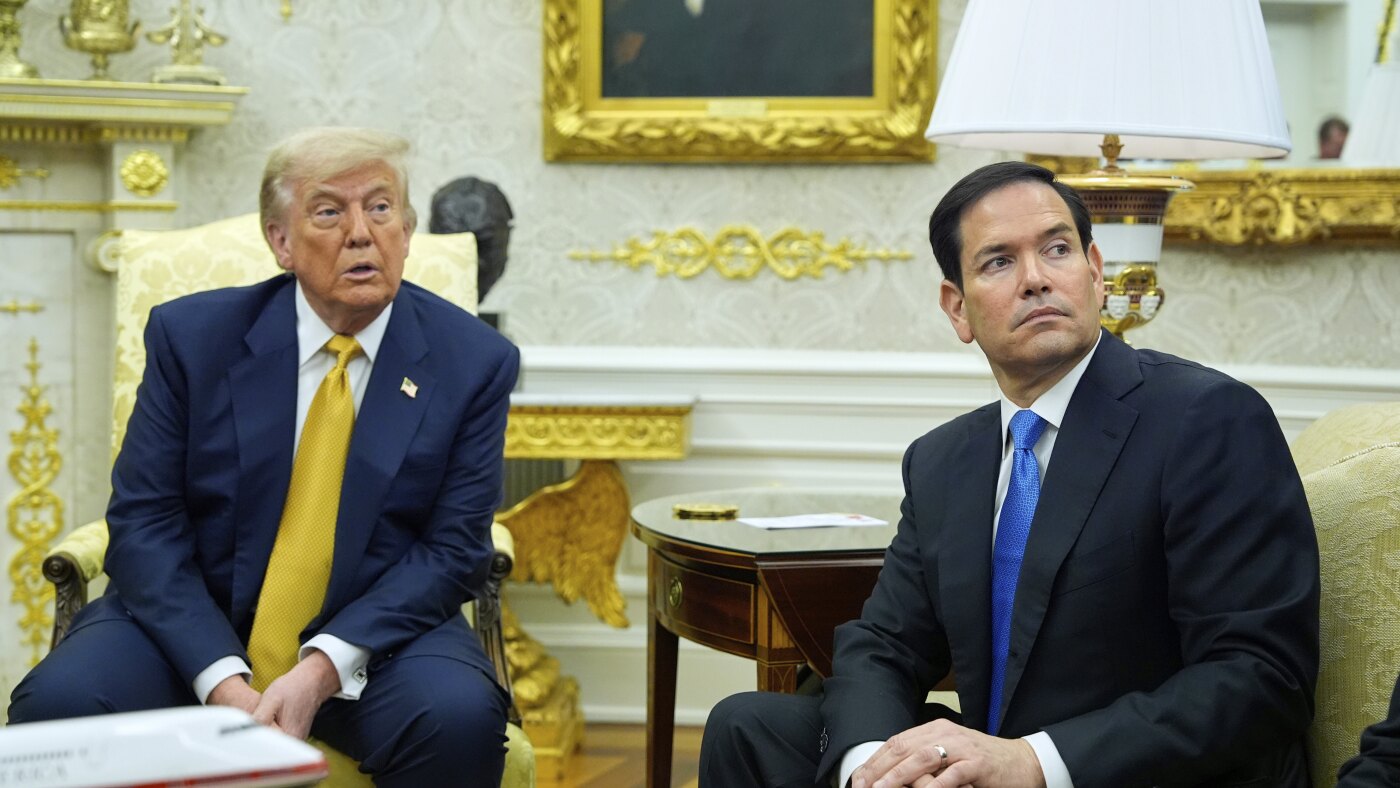

President Trump and Secretary of State Marco Rubio listened to an oval office meeting at the White House on July 16.
Alex Brandon / AP
hide
tilting legend
Alex Brandon / AP
The State Department dismissed its best experts on the Southern China Sea and closed the office with a key emphasis on Indo-Pacific Security in the midst of a radical reorganization earlier this month, leaving gaps in knowledge and experience that are essential to American interests in the region.
The reduction comes while members of the administration of President Trump, as well as democratic and republican legislators, continue to say that the security and free navigation of the Southern China Sea – a passage of shipped shipping for world trade – remain a priority.
For years, China aggressively affirms its territorial affirmations, the construction of artificial islands and military facilities at the Sea of Southern China, while harassing the fisheries and oil exploration of the Philippines, Vietnam and other countries of the Pacific. And for years, the United States has worked with other countries in the region to repel.
“China’s actions undermine peace and stability in the region. The evidence in this is their growing will to use force to achieve their objectives – as shown in the Southern China Sea and around Taiwan while undertaking a massive and unprecedented military accumulation,” said Elbridge Colby, the highest Pentagon Politagon official in June. He made the counterpart of China his top priority, arguing that the United States should refocus his soldiers in the Western Pacific.
The Multilateral Affairs Bureau of the Eastern Asian and Pacific Bureau managed American engagement with the Association of Southeast Asia Nations (ASEAN), coordinated the diplomatic response to Chinese assault in the Southern China Sea and supervised the Mekong River region, according to current and former officers. The office was cut with dozens of others in the recent reduction in force which left more than 1,300 employees of the unemployed government.
It was also the office that helped prepare the Secretary of State Marco Rubio for his trip to Malaysia earlier this month for meetings related to the Anase. The layoffs were announced while Rubio returned home since this trip.
“After using us, he dismissed us,” said a foreign officer who focused on the Southern China Sea. “It’s breathtaking.”
NPR spoke to several members of the office who had been dismissed, who expressed their concerns that their elimination affects American interests and gives China the upper hand. Many thought that even if the office was eliminated, they would be transferred to other offices to continue their work. There was no indication in any of the letters of dismissal that the employees received that performance was a factor; In fact, NPR has verified that many of them recently received exceptional performance reviews. All spoke under the cover of anonymity to avoid reprisals.
All the licensed people from the office were public service employees with years of expertise in the region. Civil servants tend to stay in position for longer periods and on many administrations, while agents of external services modify the position every two or three years.
One of the licensed officers said this: “We are consistency. We keep the train on the way while everyone is running.”
In a statement at NPR, the State Department argued that there were still teams covering the necessary problems, but in various offices, claiming that the critical mission functions of any eliminated office will be integrated elsewhere.
But above all with regard to the Southern China Sea, it is not clear that will fulfill some of these functions, with the best experts now.
“You have people who will make badly informed decisions. They will not know the potential risks of some of the options they have,” said a licensed officer.
Another officer of the dismissed State Department said that, despite a notification of the congress in May that the office was planning to be deleted, nothing was done to transfer information or expertise to another team: “What confused me is that no one was preparing for this.
The Trump administration has long declared that containing Chinese aggression and the maintenance of free navigation of the Southern China Sea is a priority – a position generally shared by the Republicans and Bellisantes Democrats. This week, Philippine President Ferdinand Marcos Jr. went to Washington to meet Trump and Rubio, stressing the importance of the alliance between the two countries, in particular with regard to the Southern China Sea.
Meanwhile, China has maintained an increasingly aggressive position in the region. No later than this week, Chinese aircraft carriers pushed further in waters that have long been dominated by the US military, in a series of exercises reported by joint staff of the Japanese army. And China continued to increase its illegal claim to more and more waters, which the United States firmly rejected in the first Trump administration under the secretary of the state then, Mike Pompeo.
A story of the American withdrawal
All of this has safety and diplomacy experts who closely watch the region confused to explain why the State Department would dismiss its experts on the subject, even if the office was to be reorganized.
Gregory Poling, director of the Asian Maritime Transparency Initiative at the Center for Strategic and International Studies in Washington, calls for “really harmful” move for American efforts in the region.
“You are not going to snatch someone else from an independent office who knows the ins and outs of one of the most complicated problems in the world,” he said.
Poling says he is also concerned about the signal he sends to our allies in the region.
“It strengthens a story in the American strategic withdrawal region. Of course, we could always send the navy, but we are not really interested in diplomatic or economic leadership that the region wants to see,” he said.
Piper Campbell, former diplomat and now president of the US University Foreign Policy and World Security Department, says she was “really disappointed” to hear about the decision to close the multilateral affairs office, and in particular to dismiss the experts. She is worried, it puts the United States in a disadvantage, especially since this office specializes in work in several countries.
“This reduces our influence. This reduces our understanding of what is happening in this important region, and it reduces both our safety and our economic weight in the region,” said Campbell.
Others have expressed their concern that the move, in particular in the context of recent prices imposed on many countries in the region, as well as the aid programs, could let the American allies turn to China to obtain aid.
“If our main objective is to repel Chinese expansionism-how does it help? I would say that it hurts,” said James Caruso, a former diplomat with many years to Southeast Asia.
Henrietta Levin, former Deputy Coordinator of China for World Affairs in the State Department of the Biden Administration, echoes these concerns, saying that she was “surprised and somewhat concerned” by these specific cups.
“I think these cuts eliminate the tools that have been powerful in the United States,” she said. “At a time when China doubles its own commitment to this competition and is trying to win Indo-Pacific countries, I hope the United States would use all the tools available.”


