Stone tools may hint at ancestors of Homo floresiensis


Certain stone tools found near a river on the Indonesian island of Sulawesi suggest that the first hominines had reached the islands of at least 1.04 million years ago. It is roughly at the same time when the ancestors of sadly diminutive “hobbits” can have reached the island of Flores.
Archaeologist Buianto Hakim from the National Indonesian Research and Innovation Agency and his colleagues were those who recently found the tools of a site on Sulawesi. Although a handful of stone flakes on this island do not tell us who were the ancestors of small species Or how they have reached distant islands like Flores and Luzon, the tools are one more part of the puzzle. And this handful of stone flakes could possibly play a role by helping us understand how other hominines have conquered most of the world well before our arrival.
Cross the ocean a million years ago
Sometimes the deep past leaves the smallest traces. On the Calio site, an outcrop of sandstone in what is now a field of corn outside the village of Ujung in the south of Sulawesi, people left just a handful of pointed stone flakes about a million years ago. There are seven, ranging from 22 to 60 millimeters long, and they are striped, worn and cut with tumble down at the bottom of a river. But it is always clear that they were formerly shaped by skilled human hands – or at least of the human type – which used hard stones like hammers to make sharpened art flakes for cutting and scratching.
The oldest of these tools is probably between 1.04 and 1.48 million years. Hakim and his colleagues came out of the teeth of a wild pig at around 1.26 million years. They were one of the archaeologists of the jaw found with a layer just above the oldest flocon. Add statistical modeling, and you get the probable range of dates for the buried stoneflake in the deepest ground for the ground.
Even the youngest end of this estimate would make these tools the oldest proof of hominins (of all species) in the islands of Indonesia and the Philippines. This area, sometimes called Wallacea, is between the continents of Asia and Australia, separated from the two wide canals of deep ocean.
“But Calio’s site has not yet produced hominine fossils,” said Brumm, “so even if we now know that there were tool manufacturers on Sulawesi a million years ago, their identity remains a mystery.” But they can be linked to the hobbits, a group of short homes who lived hundreds of kilometers on the island of Flores up to around 50,000 years ago.
“The discovery of the first artefacts of the Pleistocene de Calio suggests that Sulawesi was populated by hominines at the same time as Flores, if not earlier,” wrote Hakim and his colleagues in their recent article.
Flores connection
The islands that now make up Indonesia and the Philippines have been a hominin hotspot for at least a million years. Our species wandered on the stage between 63,000 and 73,000 years old, but at least another species of hominines had already been there for at least a million years. We just don’t know exactly who they were, when they arrived, or how.
“Precisely when the hominins have crossed for the first time in Sulawesi remains an open question, as is the taxonomic affinity of the colonizing population,” note the authors.
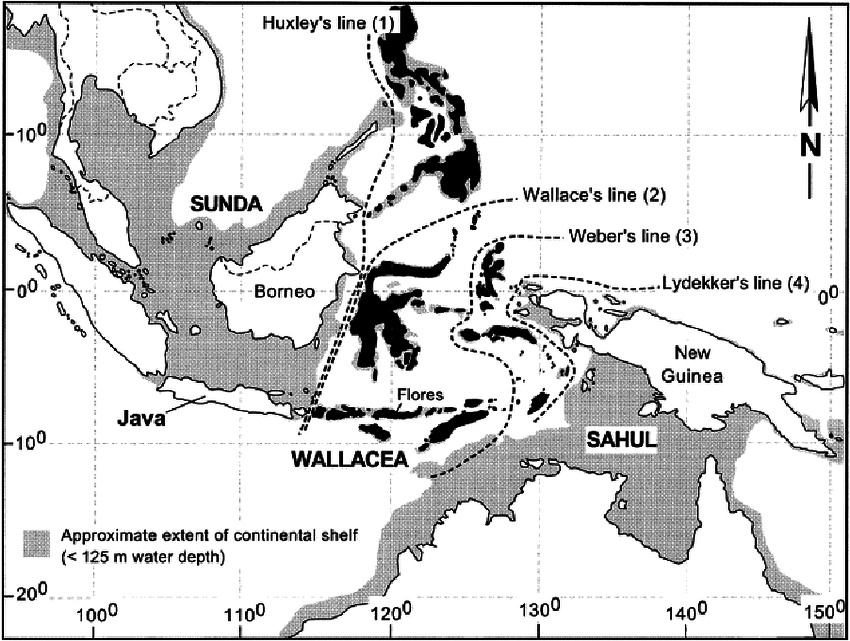
This map shows the Wallacea islands. The big one east of Java is Sulawesi.
Credit: Darren O’Connell
This is why the handful of stone tools that the team recently unearthed to Calio Matter: they are another piece of this puzzle, although a small one. Each slightly older date is a step closer to First of all Tools, bones or fingerprints of hominin in these islands, and another pin on the map of which was where and when.
And this card accumulates many pins, representing an ever increasing number of species. Once the first hominines crossed the Makassar Strait, they found themselves in isolated groups on the cut islands of the continent – and each other – then the genealogical tree of hominines began to branch very quickly. On at least two islands, Flores and Luzon, these original settlers finally gave birth to local species,, Homo Floresiensis And Homo luzonensis. And the University of Wollongong Paleoanthropologist Richard Roberts, co-deputant of Homo FloresiensisThink that there are more isolated island hominine species.
In 2019, when Homo luzonensis was described for the first time, Roberts told Ars: “These new fossils and their assignment to a new species (Homo luzonensis), responds to one of the predictions that Mike Morwood and others (including me) were made when we reported (15 years ago!) The discovery of Homo Floresiensis: that other unknown species of hominins are in the islands of Southeast Asia. »»
Both Homo Floresiensis (original “hobbits”) and Homo luzonensis were short, traveling just over a meter high. Their bones and teeth are sufficiently different from each other to distinguish them as a single species, but they have enough in common that they probably share a common ancestor – they do not share with us. They are more like our distant cousins, and the Wallacea islands may have housed many other cousins of this type, if Roberts and his colleagues are correct.
Complicated family history
But who was the common ancestor of all these hominin cousins? This is where things get complicated (as if they were not already). Most paleoanthropologists look at Homo erectusBut there is a chance – with some attractive clues, and no direct evidence – that much older human parents called Australopithecines may have made the trip a million (or two) years before Homo erectus.
The bones of the finger and toes of Homo luzonensis are curved, as if they spent as much from their lives to climb trees as to walk. It looks more like Australopithecins than any member of our genre Homo. But their teeth are smaller and are more in shape ours. Anthropologists call this mixture of mosaic characteristics, and it can be difficult to understand how hominines are linked. This explains why the question of When The ancestors of the hobbits have arrived on their respective islands are so important.
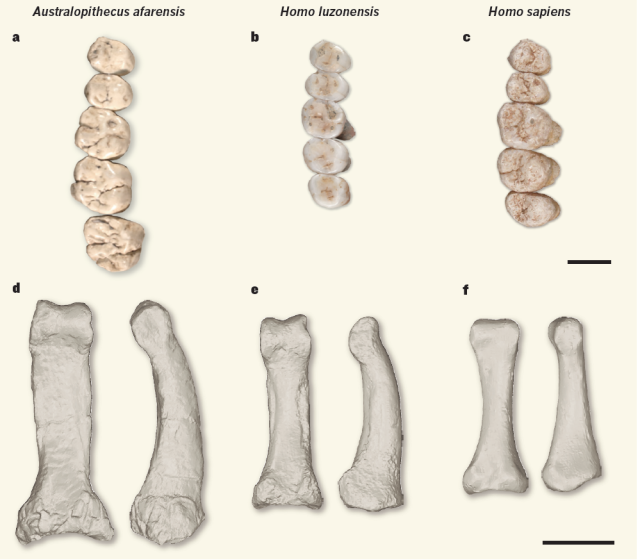
Compare the teeth and the phalanx of Homo luzonensis to those of Homo sapiens (right) and Australopithecus Afarensis (LEFT).
Credit: TCHERI 2019
We do not yet know the answer, but we know that someone was making stone tools on Flores 1.02 million years ago. These tool manufacturers may have been Homo erectusAustralopithecins, or something already recognizable as tiny Homo Floresiensis. The hobbits (or their ancestors) were clearly “hobbity” about 700,000 years ago; fossil teeth and bone A handful of hominines on a site called Mata Menge Do it clear. The hobbits discovered in Liang Bua Cave on Flores date from somewhere between 50,000 and 100,000 years.
Meanwhile, 2,800 kilometers away on the island of Luzon, the oldest stone tools, as well as their obvious cutting marks left on animal bones, go back to 700,000 years. It is as old as the Mata Menge hobbits on Flores. Older Homo LuzonensiFossils are between 50,000 and 67,000 years old. It is quite possible that older evidence, settlers of the island of the island and Homo Luzonensis, may possibly be found, but until then, we find ourselves with a lot of empty space and many questions.
And now we know that the oldest traces of the presence of hominines on Sulawesi have at least 1.04 million years. But could Sulawesi have its own diminutive hominines?
So, are there more hobbits there?
“Sulawesi is a joker – it’s like a mini -continent in itself,” said Brumm. “If the hominins were cut on this enormous and ecologically rich island for a million years, would they have undergone the same evolutionary changes as the Hobbits of Flores? Or would he have happened?

Reconstruction of Homo Floresiensis by workshop Elisabeth Daynes.
Credit: Kinez Riza
A phenomenon called nanism of the island played a role in Homo Floresiensis‘ evolution; The species that live in relative isolation on the small islands tend to evolve in much larger or smaller versions of their ancestors (this is why the hobbits have shared their island house with pygmy elephants and giant Moas). But how small an island should an island before the island’s island is triggered? Sulawesi is about 12 times larger than Flores, for example. So what could the descendants of Calio tools have been like 100,000 years ago?
This is something that we will only know if archaeologists on Sulawesi, like Hakim and his team, find fossil remains of these hominins.
Tsunami sailors or survivors?
Understanding exactly when the hominins set foot for the first time on the island of Sulawesi could possibly help us to understand how they arrived. These islands are thousands of kilometers from the southeast continent of Asia and others, so getting there would have meant to cross large, open and open ocean expanses.
Archaeologists have not found any evidence that anyone preceded our species built boats or rafts, although these motorcycles have been made of materials that tend to decompose fairly quickly, so even remains of wood and ancient rope are extremely rare and lucky discoveries. But some ancient hominines had a decent understanding of all the basic skills they need for at least a simple raft: woodworking and the manufacture of strings.
Another possibility is that hominines living on the continent’s coast in Southeast Asia could have been swept away by a tsunami, and some of them could have had the chance to survive the misadventure and wash on the ground somewhere like Sulawesi, Flores or Luzon (RIP to any other). But for this scenario to work, enough hominines should have reached each island to create a sustainable population, and this probably had to happen more than once to end up with hominines on at least three distant islands.
Anyway, it is not an easy task, even for a hobbit with small feet.
Nature, 2025 DOI: 10.1038 / S41586-025-09348-6 (About DOI).


