Suffolk mum’s campaign to get son access to healthcare services


Alice Cunninghambrandish

 Richard Knights/BBC
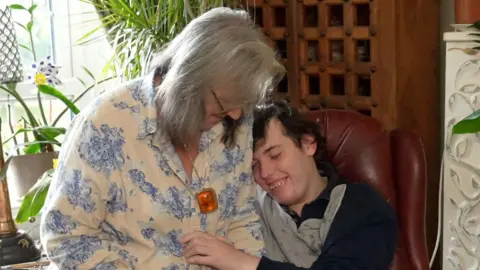
When Chantal Chaervey’s son suffered from cerebral paralysis, lost access to health services at 18, she did not imagine that she would fight four years later to change this situation.
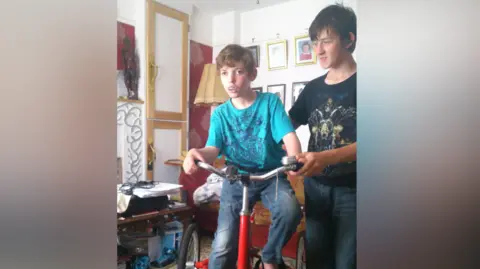
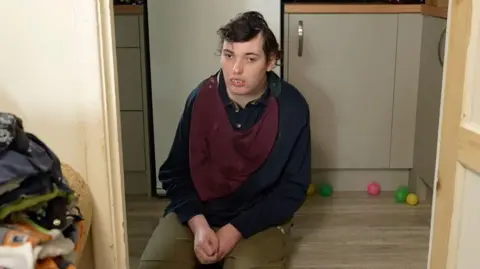
Child, Harry Chaervey, 22, of Brandeston, suffolk, has received a diagnosis of epilepsy and cerebral paralysis, a disease that affects movement and coordination.
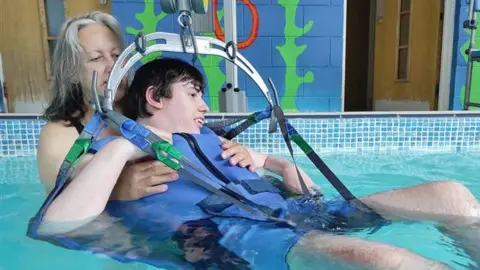
Throughout his stay in a specialized school, Harry, who is non -verbal, had access to hydrotherapy, a form of physiotherapy involving exercises in a hot pool that facilitates movement.
But when he left school, his mother had trouble giving him access to the NHS and thought that without that, his life would be limited.
Ms. Chaervey, 65, said that the last years had been “hell” and has called for answers.
 Alice Cunningham/BBC
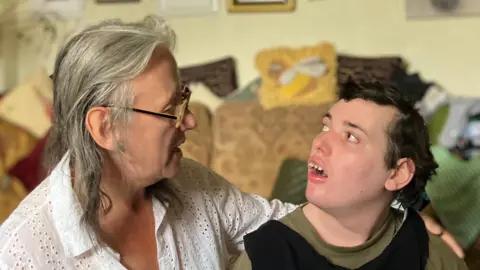
Ms. Chaervey explained that Harry had two liver transplants when he had only 16 and 18 weeks, but the two failed, leading to organ failure and brain damage before he receives a diagnosis of cerebral paralysis.
She said that despite this, he had always been “joy” and that he loved to play football.
“No one could prevent him from running,” she said.
“I have the very lively image of a teacher trying to control him during a sporting day, holding him from the bottom of his shorts because he just wanted to run.
“It was a joy, and it is always. But all of a sudden, things have changed.”
 Contributed
Ms. Chaervey said that without hydrotherapy, Harry had “completely lost the use of his legs”, which means that when he wants to move, he must either drag himself on his knees, or use a wheelchair.
She said that he was suffering “constantly”, that her epilepsy had worsened, that he was likely to die suddenly and unexpectedly because of epilepsy and that he had trouble chewing food, which sometimes led to suffocation.
Chaervey said Harry also suffered from depression.
 Alice Cunningham/BBC
Ms. Chaervey applied for the NHS Continuing Healthcare who could have financed Harry’s care, but he was told that he was not eligible.
She then filed two exceptional funding requests to allow her to access thermalism, but they were also refused.
Earlier this year, she applied for the third time and was still waiting for an answer.
This arises although doctors and physiotherapists recommend Harry to follow hydrotherapy, one of them declaring in a letter that it could end by being more than any change of medication that I can bring “.
Ms. Chaervey said that access to hydrotherapy would mean “everything” for Harry, and she thought that only half an hour could help.
 Contributed
Heather EPPS, physiotherapist expert in hydrotherapy for patients with cerebral paralysis, said it could “improve the quality of life” thanks to the advantages it presented in the reduction of pain and its ability to improve muscle function.
“One of the reasons why you feel pain is that your muscles shoot your bones, pulling them in abnormal positions, so your posture is not good and then because your posture is not good, it becomes a bit of a vicious circle,” she explained.
“You cannot move and move, like you or me, to relieve this pressure and reduce this discomfort.
“While once you are in the pool, you can undertake these movements because you do not have this increase in spasticity and stiffness in your muscles that you feel when you are out of the water.”
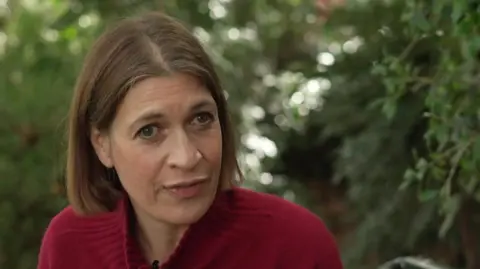
Emma Livingstone is the founder and general manager of the Charitable Up – The Adult Cerebral Palsy Movement association.
She said that access to health services for adults with brain paralysis, which are around 130,000 in the United Kingdom, was a serious problem and that it had struggled.
“Our size is comparable to that of multiple sclerosis and Parkinson’s disease, and yet our visibility and the services we receive are not important,” she said.
She explained that the problem came from the fact that, until recently, the disease was not recognized as long term, as well as the fact that there was “no professional who coordinates care” for patients with brain paralysis due to the existence of many types of brain paralysis.
 Richard Knights/BBC
Ms. Chaervey wants to know why there is no clear framework of the NHS for adults with brain paralysis.
“How is it that the care they needed throughout their youth is no longer necessary as they age,” she asked.
“Are they suddenly healed, because if they are, tell me please, it would make my life better.
“It is a complete stuffing. It is time that the NHS realizes that there are adult patients with brain paralysis in very complex situations and suffering from chronic pain every hour of each day.”
“Happy to speak”
A spokesperson for the Suffolk NHS and the North East Essex Integrated Care Board said that all exceptional financing requests were examined by a panel of health professionals, “emphasizing the patient’s clinical needs”.
“When a candidacy is not retained, there is an appeal procedure open to everyone,” they added.
“We would be very happy to speak directly with the patient’s family to explain the situation.”
A spokesperson for the Ministry of Health and Social Affairs added that he was “determined to guarantee that people with brain paralysis receive appropriate support throughout their lives”.
“We expect the NHS England that he works with children, young people, families and caregivers to provide high-quality services, such as hydrotherapy, people during their transition to adult services,” they said.