Supreme Court likely to uphold state bans on trans athletes competing on girls’ sports teams

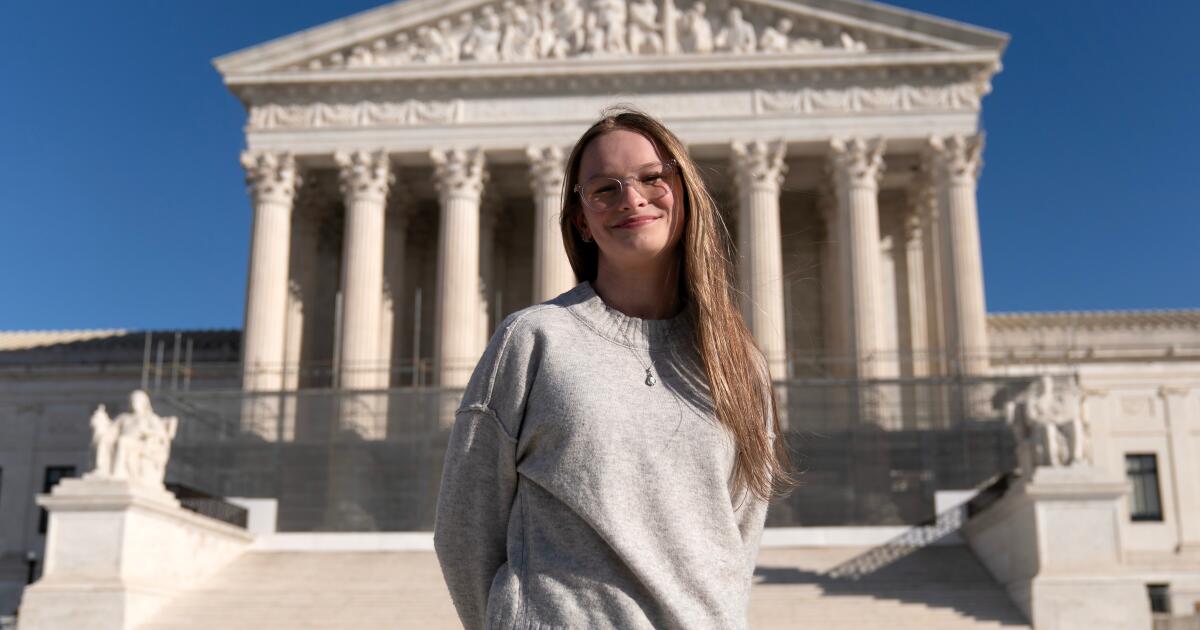
WASHINGTON- Supreme Court justices appeared ready Tuesday to uphold state laws that ban transgender athletes from competing on girls’ school sports teams.
Idaho, West Virginia and 25 other Republican-led states say a student’s biological sex at birth should determine who can play on girls’ or boys’ teams.
They say it is unfair to girls to allow biological men to compete with them in sports like track and field or swimming. “Biological males are, on average, larger, stronger and faster than biological females,” West Virginia state attorneys said.
Although the court’s conservative majority is likely to rule in favor of those states, the justices have said they prefer a narrow, limited ruling on those laws.
If so, such a move for red states will not directly change the law in California and more than a dozen other Democratic-led states that prohibit discrimination based on gender identity. These laws protect the right of transgender girls to compete on a girls team.
A similar dispute was brought to court last year.
Then conservative justices ruled that Tennessee and other red states could ban gender-affirming medications and medical treatments for teens with gender dysphoria.
The 6-3 majority said it was not unconstitutional discrimination based on the teens’ transgender status. But that decision did not invalidate the conflicting California law.
In recent months, the Trump administration has joined transgender sports affairs in West Virginia and Idaho.
But her lawyers simply argued that the Constitution allows states to exclude transgender girls from girls’ teams. It doesn’t require them to do so, their lawyers said.
Even a West Virginia lawyer agreed. “California has ample room to make a different interpretation,” state attorney Michael R. Williams told the court.
Assistant Attorney General Hashim Mooppan said these Democratic states “violate Title IX,” the education law that allows separate sports teams for girls and boys. But he added that the court should not rule on that issue now.
Last year, in response to the court’s ruling on gender-affirming care, President Trump cut federal funds for hospitals and medical facilities that provided such care.
A ruling upholding restrictions on transgender athletes could prompt the Trump administration to threaten Democratic states with a loss of federal education funds.
Becky Pepper-Jackson, now 15, fought a lonely legal battle to compete on her school’s track team in Bridgeport, West Virginia.
Designated male at birth, she claims to be the only transgender girl to compete in her state and has been the target of complaints and protests.
In middle school, Becky competed in cross country as a sixth grader and described herself as slow. She “regularly placed herself at the back of the pack,” her lawyers told the court.
But as soon as she got to high school, she won.
In 2024, she “placed in the top three in every track and field event in which BPJ competed, winning the most,” state attorneys said. Last spring, “by focusing on strength events, BPJ excluded female competitors from the state tournament, then placed third in the state in the discus and eighth in the shot put while competing against much older female athletes,” they told the court.
Her lawyer, Joshua Block of the American Civil Liberties Union, said she won in the shot put and discus “through hard work and training.”
He said she “was given puberty-delaying drugs and gender-affirming estrogen that allowed her to undergo hormonal puberty typical of a girl.”
He urged the court to rule in favor of Becky because she does not have a physical advantage due to her biology.
But the judges did not seem inclined to rule on the issue of puberty blockers.