Taiwan’s opposition leader arrives in China : NPR



Chairman of Taiwan’s main opposition party KMT, Cheng Li-wun, attends a news conference at the Taiwan Foreign Correspondents’ Club in Taipei, March 23, 2026.
I-Hwa Cheng/AFP via Getty Images
hide caption
toggle caption
I-Hwa Cheng/AFP via Getty Images
TAIPEI, Taiwan, and KUNSHAN, China — Taiwan’s main opposition leader, Cheng Li-wun of the Kuomintang Party (KMT), arrived in China on Tuesday for a rare six-day visit that she called a peace mission.
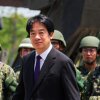
It comes as China steps up military exercises around the island, a democracy claimed by Beijing as its own territory, and the United States pressures Taiwan to spend billions on American weapons.
Speaking to reporters just before boarding a plane in Taipei, Cheng stressed the need for dialogue with Beijing.
“If you truly love Taiwan, you will seize every opportunity and every possibility to prevent Taiwan from being ravaged by war,” she said. “Preserving peace means preserving Taiwan.”
The Taiwan Affairs Office of China’s State Council said the visit would have a “significant” and “positive” impact on maintaining peace and stability across the Taiwan Strait, according to China’s official Xinhua News Agency.
Cheng and a delegation of other KMT officials will visit the eastern cities of Shanghai and Nanjing before arriving in Beijing, where Taiwanese media are widely reporting that she may meet Chinese President Xi Jinping.
This is the first visit by a sitting KMT leader to China in nearly a decade.
“I don’t think [the visit] “It’s a very good thing,” said Wen Wen-fu, a businessman from New Taipei City who was waiting to fly to Shanghai just after Cheng’s plane took off. “His party is of course closer to China and the ruling party is more pro-American… the most important thing is to take into account the wishes of Taiwan’s more than 23 million people.”
Another Taiwanese businessman, Lee Jen-hsing, based in Kunshan, eastern China, was more optimistic. “[Cheng’s visit] This is definitely a good thing because the two sides of the strait have always had very close ties,” he said.
Beijing suspended many of its exchanges with the KMT, as well as most state-level ties with Taipei, after the KMT lost power to Taiwan’s current ruling party, the Democratic Progressive Party (DPP), in 2016.
Beijing considers the DPP and current Taiwan President Lai Ching-te to be separatists, but “the KMT accepts that both sides of the Taiwan Strait belong to one China,” said Xin Qiang, director of the Center for Taiwan Studies at Fudan University in Shanghai.
However, each side has its own interpretation of what “one China” means.
In recent years, Beijing has stepped up its military exercises near Taiwan, even encircling the island by land, air and sea last year.
Taiwan’s parliament is engaged in a fierce debate over the DPP-led government’s demand for $40 billion in additional defense spending, which would be used in part to buy more weapons from the United States.
Beijing is signaling that deterrence is not the only way to manage tensions and that it is open to dialogue, according to Wen-ti Sung of the Atlantic Council’s Global China Hub.
“Beijing will use [the visit] to project the image that there are still many pro-Beijing voices in Taiwan,” he said.

Supporters of Kuomintang Chairwoman Cheng Li-wen gather at Songshan Airport in Taipei before her departure for mainland China on April 7, 2026.
Cheng Yu-chen/AFP via Getty Images
hide caption
toggle caption
Cheng Yu-chen/AFP via Getty Images
Meanwhile, President Trump, who plans to meet with Xi in May, has hinted that he would be open to discussing future U.S. arms sales to Taiwan with Xi.
Such statements have led to a decline in trust in the United States, says Yen Wei-ting, an assistant research fellow at Academia Sinica in Taipei, providing “a political window for Cheng” as she positions herself as a peacemaker between Beijing and Taipei.
But Chen Fang-yu, a political scientist at Soochow University in Taipei, worries about playing into Beijing’s “United Front” strategy, which includes hosting Taiwanese politicians on trips “to emphasize that Taiwan is an internal or internal China issue.”
The Taiwanese government doubts that the meeting will improve relations between the two sides of the strait. Chiu Chui-cheng, minister of Taiwan’s Mainland Affairs Council, reminded Cheng that she could visit China, but was not authorized to negotiate on behalf of Taiwan’s elected government. “Peace can be an ideal, but not a fantasy,” Chiu told reporters last week.
Valentine reports from Taiwan and Pak from Kunshan in eastern China.


