Tariffs Are Reducing Prices and Humiliating Economists


The Weekly Wrap: Trump Derangement Syndrome Visit the Supreme Court
Welcome to Friday! This week, the great poobahs of the American economy gathered in a memory of the friend on the ground to let everyone know They still don’t like what Trump does. The prices of goods allocated by the prices fell in August, crushing everyone’s hopes at the Cato Institute. And the Americans have once again indicated that they really don’t like, really democratic economic programs.
Here is the painless gathering of this week of economic news –No necessary tylenol.
An unconvincing memory of amicus
Each former living president of the Federal Reserve, former secretaries of the Treasury Robert Rubin, Larry Summers, Hank Paulson, Jack Lew and Timothy Geithner, and a group of prestigious economists signed to A breeze of Amicus written by Covington & Burling lawyers To be displayed – without proof – that “allowing the abolition of Governor Lisa D. Cook, while the challenge is underway would threaten that independence and eroding public confidence in the Fed”.
Although it seems scary, we do not expect it to gain a lot of weight with the court. FirstlyIt is not at all a legal argument. It is an argument for a policy to protect the governors of the Fed against the withdrawal of the President of the United States. This is something that Congress could do by writing it in a law. Instead, Congress wrote that a president can withdraw governors from the Fed as long as there are reasons for dismissal. Perhaps the greats of the American economy do not like this arrangement; But if it should be changed, it should fall to Congress and not to the Supreme Court.
Even the political argument, however, is weak. The great danger quoted by the memory is that the abolition of the cook raise doubts about the independence of the central bank And that, in turn, would not go beyond the expectations of inflation. These not anchored expectations, the brief affirmations, would then make higher inflation on the theory that real inflation is largely a question of expected inflation.
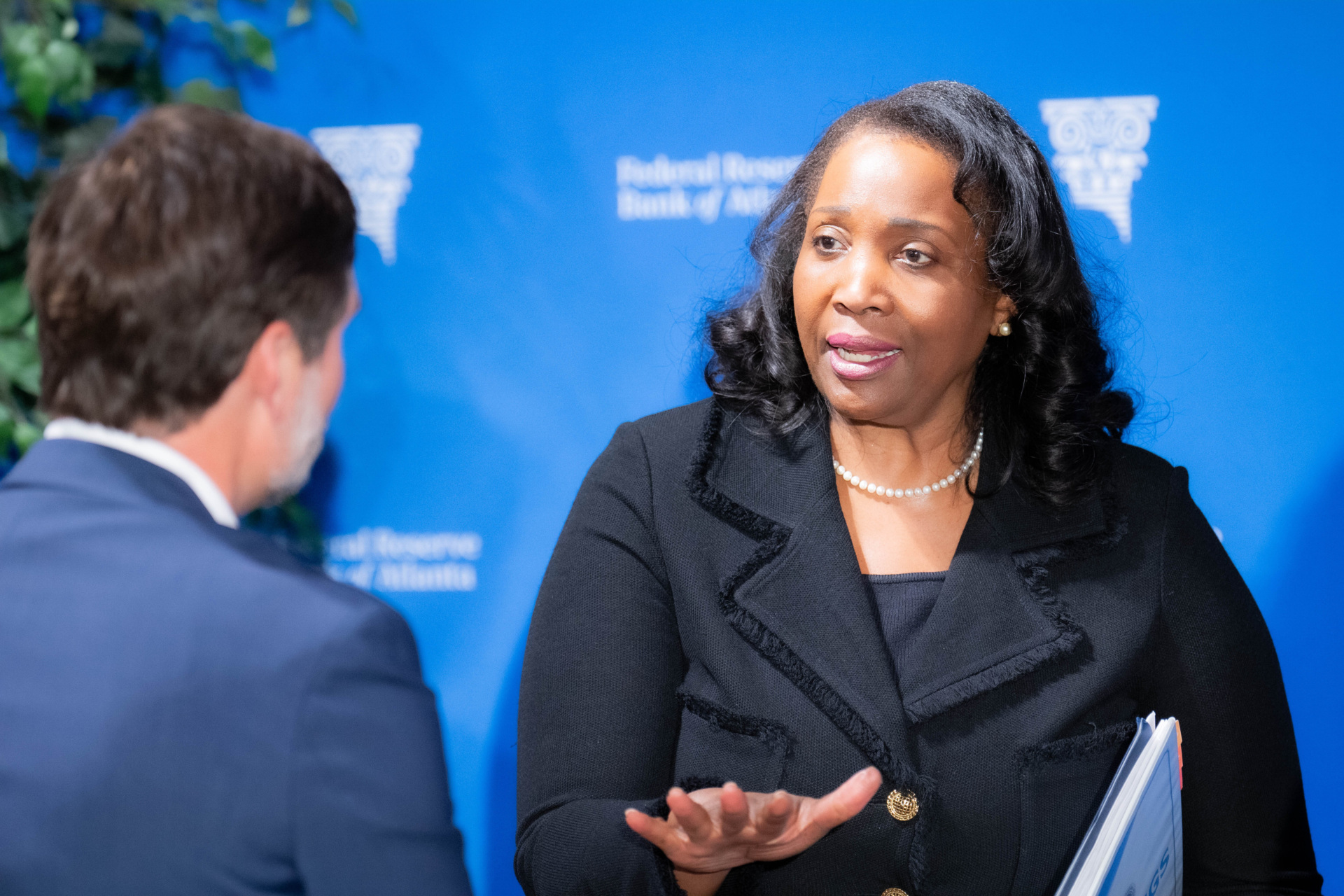
The Governor of the Federal Reserve Lisa Cook presents opening comments during an event listening to the Fed organized by the Federal Bank of Atlanta on June 4, 2025. (Federal reserve via Flickr)
Each of these steps is improbable. The independence of the Fed is above all secure by its complex structure. Monetary policy is established by the Federal Open Market Committee, made up of presidents of the Fed and governors of the Fed. Governors serve 14 years old conditions and must be confirmed by the US Senate. The elimination of a single governor for a cause hardly seems to cause a sudden collapse of trust.
Then there is the idea that Trump having more influence on the Fed during inflation expectations. It would be more plausible if it was Biden exercising an influence on the Fed, because Biden and his allies have constantly minimized the economic costs of inflation. It is more plausible than the president of the FED, Jerome Powell, remaining in power does not warn in inflation expectations, because it is his insistence to inflation which contributed to the worst 40 -year inflation. Trump won a re -election in part because The public thought he would do a better job on inflationSo why would the public suddenly decide that he would use his influence to soar him?
Finally, there is all this theory of expectations. His support among traditional economists is overwhelmed by supporting evidence. In fact, he has always rested on fairly trembling terrain. Basically, Expectations are a kind of holder of places To explain why inflation has remained low or increased when economic models would otherwise indicate the opposite. When economists could not explain why inflation behaved as it was, they decided that it should be due to expectations. Instead of assuming a box opening, they assumed a social-psychological lever.
In fact, it was not our last point on the memory. Our apologies. We thought we had finished, but we have one more thing that deserves attention: even if it was largely described as a “bipartite” group, None of the people whose names appear on the memory of Amicus are supporters of Trumpeconomic nationalism, or the broader vision of the American meeting again. In fact, they are all recorded according to Trump. Hank Paulson, former Goldman Sachs chief who was the secretary of the treasure of President George Bush in the years preceding the global financial crisis and one of the authors of the bailout of Wall Street, approved Hillary Clinton in 2016. Alan Greenspan called the “crazy” Trump prices and declared that he was deactivating his hearing aid when Trump talks about the economy.
In other words, They are all anti-Trump supportersEven if some of them have been associated in the past with republican politicians.
The price is not only MIA: prices reduce prices
Friday, the Ministry of Commerce published the last edition of the personal consumer price index. He has shown that inflation remains stubbornly above the two percent lens of the Fed, but not because of the prices. For the second consecutive month, The prices of sustainable goods – those most likely to be influenced by prices –.
Above all, this decrease does not come from a lack of demand for lasting goods. Things do not drop by price because people do not buy them. Actual consumption expenses – that is to say after the adjustment of inflation – on sustainable goods increased by 0.9%. People buy more sustainable products at cheaper prices.
It’s absolutely devastating for the idea that prices are a tax on consumers. However, even more devastating for this assertion, the evidence of a price rate of prices. The tariff tracker, which is short of the Harvard Business School price laboratory, shows that since the day of the release, when prices have been announced, the prices of goods imported into the categories affected by the prices are increasing less (only 1.13%) that the goods produced at the national level in non -affected categories (up 1.25%). In other words, Tips directly subject to prices have increased less that the prices of things that are not even indirectly subject to prices. If we cancel the gains, pricing imports increased by 2.41% and interior products not affected by the rate increased by 2.76%.
But wait. There is more. Or less, really. The prices of goods produced at the national level in the categories affected by the prices– That is to say that we have made goods in competition with imports- are down 0.67% since the day of the Liberation. This corresponds to an annualized decline of 1.42%.
If this kind of thing continues to happen, we would not be surprised to see Harvard simply close the tracker. It is too embarrassing for the price of pricing hatred.
Democrats slide into the economy
The latest Reuters / Ipsos survey numbers show that although the public is not exactly enthusiastic about the republican leaders of the economy, the GOP is ahead of the Democrats. Thirty-four percent of American adults say that Republicans have a better plan for the economy, which is stellar. But Just 24 percent say that Democrats have a better plan. In a bipartite system, it is the kind of track that wins the elections.
We suspect one of the reasons for the advantage is that No one knows what the Democratic Plan for the Economy could be. And that includes the leadership of the Democratic Party. They certainly clarified that they oppose Trump and the republican bill on tax reductions, but they did not articulate a positive vision of the economy. Even more, they did not really articulate their negative vision. Would they repeal Trump’s prices? Would they rearior taxes on retirees or persons with an income for essential? How exactly do they plan to reduce, for example, the prices of electricity or health care? The essential conclusion is that they do not have the vision of articulating or knowing that their vision would be so unpopular that they must be silent. So, publicly, it’s just fear and hate all along.
Unsurprisingly, the American public is not enthusiastic about this as a plan for the economy.