Teen builds ‘Bionic Underwater Robotic Turtle’ to detect ecological threats


Evan Budz, 15, was camping when he saw a snapping turtle that would become the powerhouse of an award-winning invention. As a lover of hiking, canoeing, and just being outside, this Canadian student from Burlington, Ontario, was actively looking for ways to get outside and help the planet.
“My parents raised me with the principle that every place I visit, I should leave it a little better than I found it,” he says. So when Budz noticed the turtle swimming in the nearby waters, he knew he had found his next passion project: a bionic robot turtle that could help protect underwater environments.
How a turtle inspired an award-winning science project
“When I saw the snapping turtle, it was so graceful, fluid and generally non-disruptive” to its environment, Budz says. “I thought it would be really interesting to try to replicate his natural swimming kinematics. [basically the study of how things move]» in a robot.
In addition to mimicking the fluid movements of a wild green turtle in water, its autonomous device uses AI to monitor underwater ecosystems for ecological threats, such as invasive species and coral bleaching.
“Most current underwater technologies can produce things like noise from their propellers or very high-pressure water jets,” which can erode the environment, he says.
However, by mimicking the movements of a sea turtle, Budz’s robot can move harmlessly through the water, collecting vital data without stressing marine life or damaging delicate habitats. “I don’t want to harm the various places I hope to protect.”
How to build a robot turtle
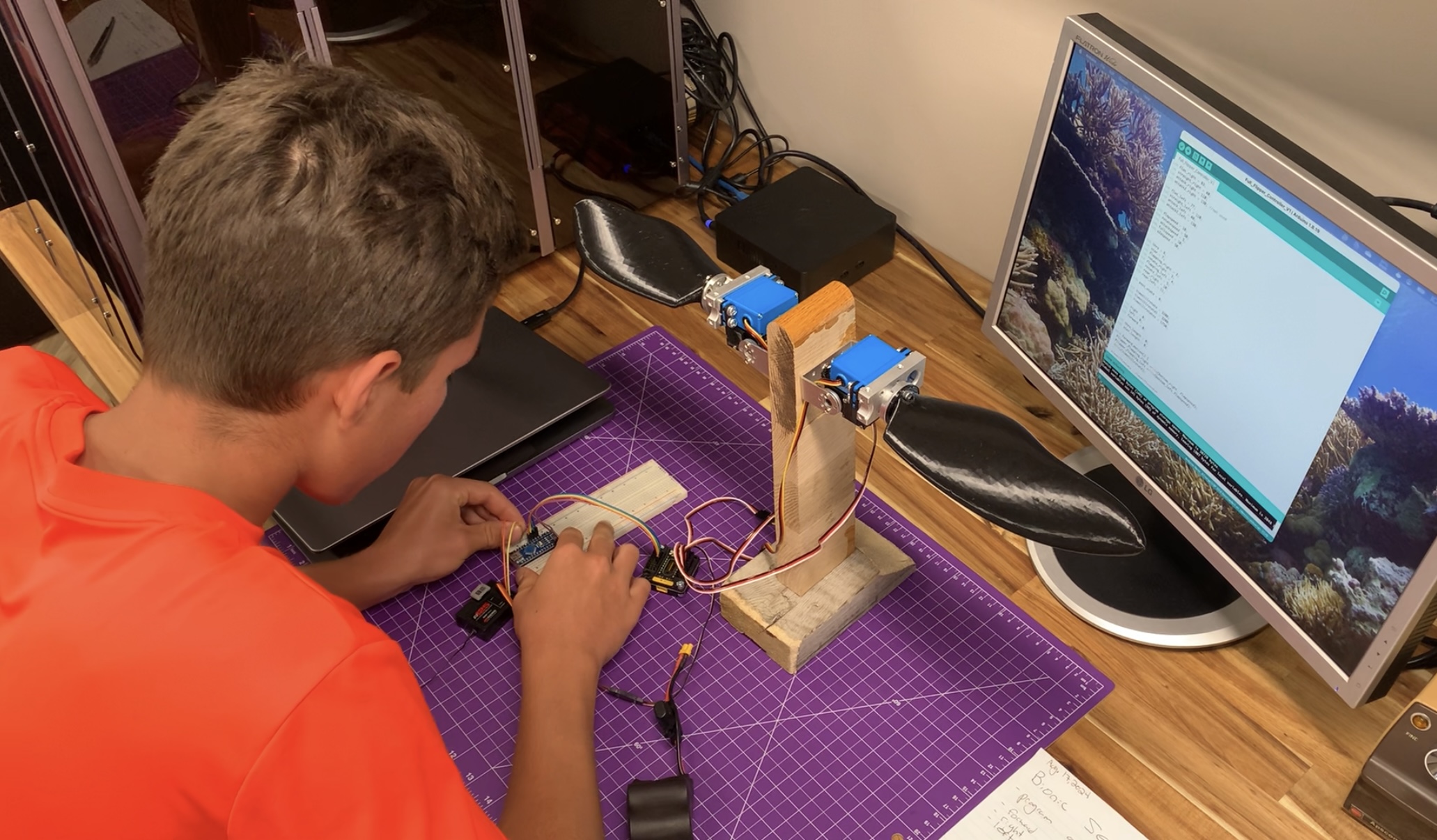
To create his bionic turtle, Budz got to work studying the reptile’s locomotion. He watched videos of sea turtles swimming and spoke with experts at his local aquarium, learning how the reptiles use their front flippers to propel themselves forward and their hind limbs to steer. He then used his 3D design and electronics know-how to plan a prototype in SolidWorks, a 3D computer-aided design (CAD) and engineering software. From there, the high school student began creating the 3D parts for his turtle robot.
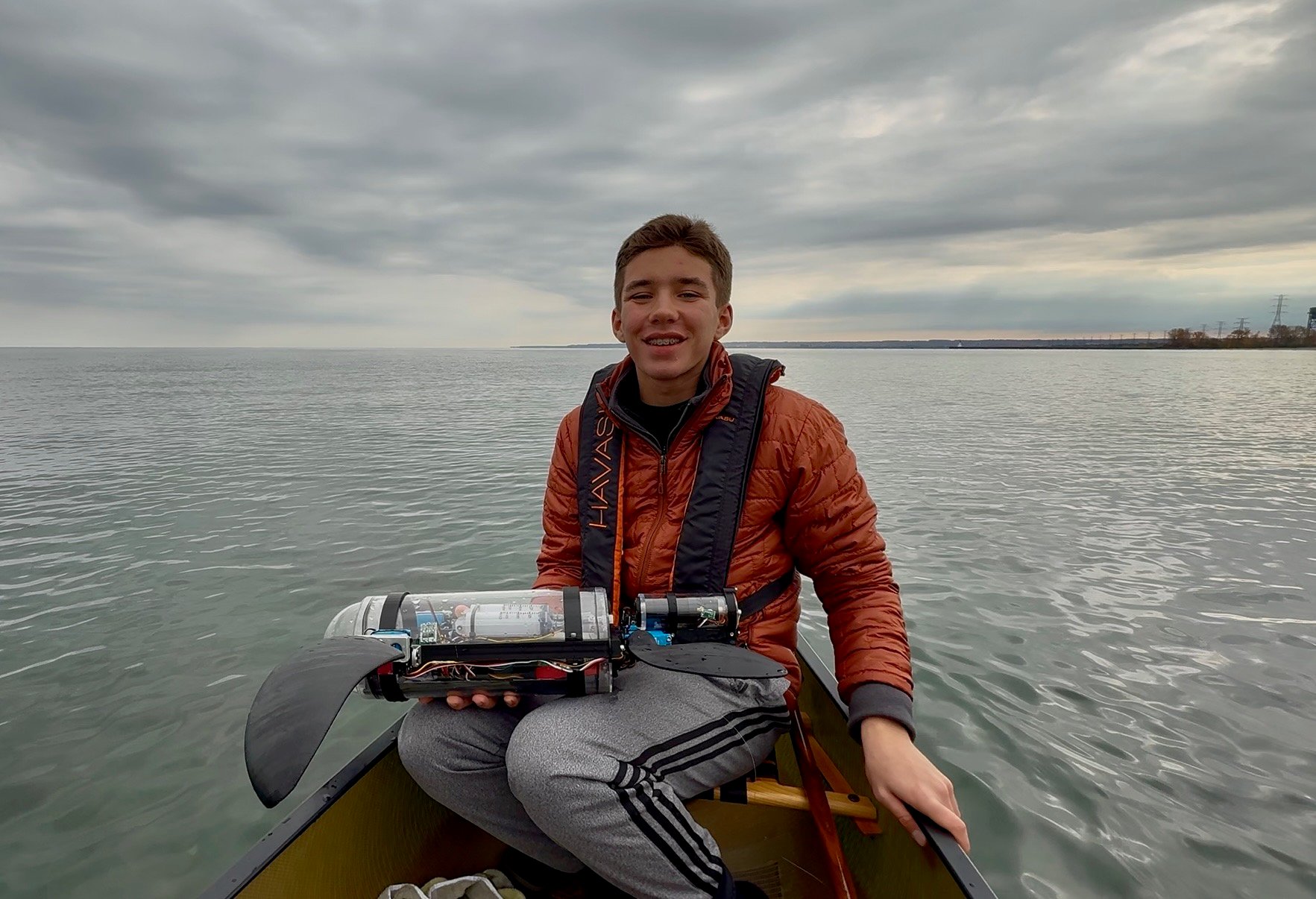
The robot has four fins in total: the larger front fins provide its main propulsion and the smaller rear fins are mainly used for stability and changing direction, just like a real turtle. It also has a main “body” made of acrylic tube to house its electronic components, which include a Raspberry Pi microcomputer. This runs AI models to detect environmental threats and records and transmits data. Additionally, the bionic turtle navigates in the water using various sensors. These include a GPS module for position tracking, allowing the robot to follow a predefined grid pattern.
Budz’s robot also has a front-facing camera to “see” its surroundings, as well as additional sensors on the exterior to help guide the autonomous reptile, offer depth control, and check for ecological hazards like microplastics and bleached corals.
Meet the Bionic Underwater Robotic Turtle, aka BURT
Although not an official name, Budz called his invention “BURT”, an acronym for “Bionic Underwater Robotic Turtle”. BURT maintains the same body and flipper size proportions as a real sea turtle, but is smaller overall, allowing it to move easily through different environments. It weighs about 11 pounds, although much of the robot’s weight is simply added metal that allows it to sink. This gives BURT the ability to monitor depths well below the water’s surface.
“To achieve neutral buoyancy in water,” Budz explains, “the turtle had to be fundamentally heavier than the buoyant force pushing it up.”
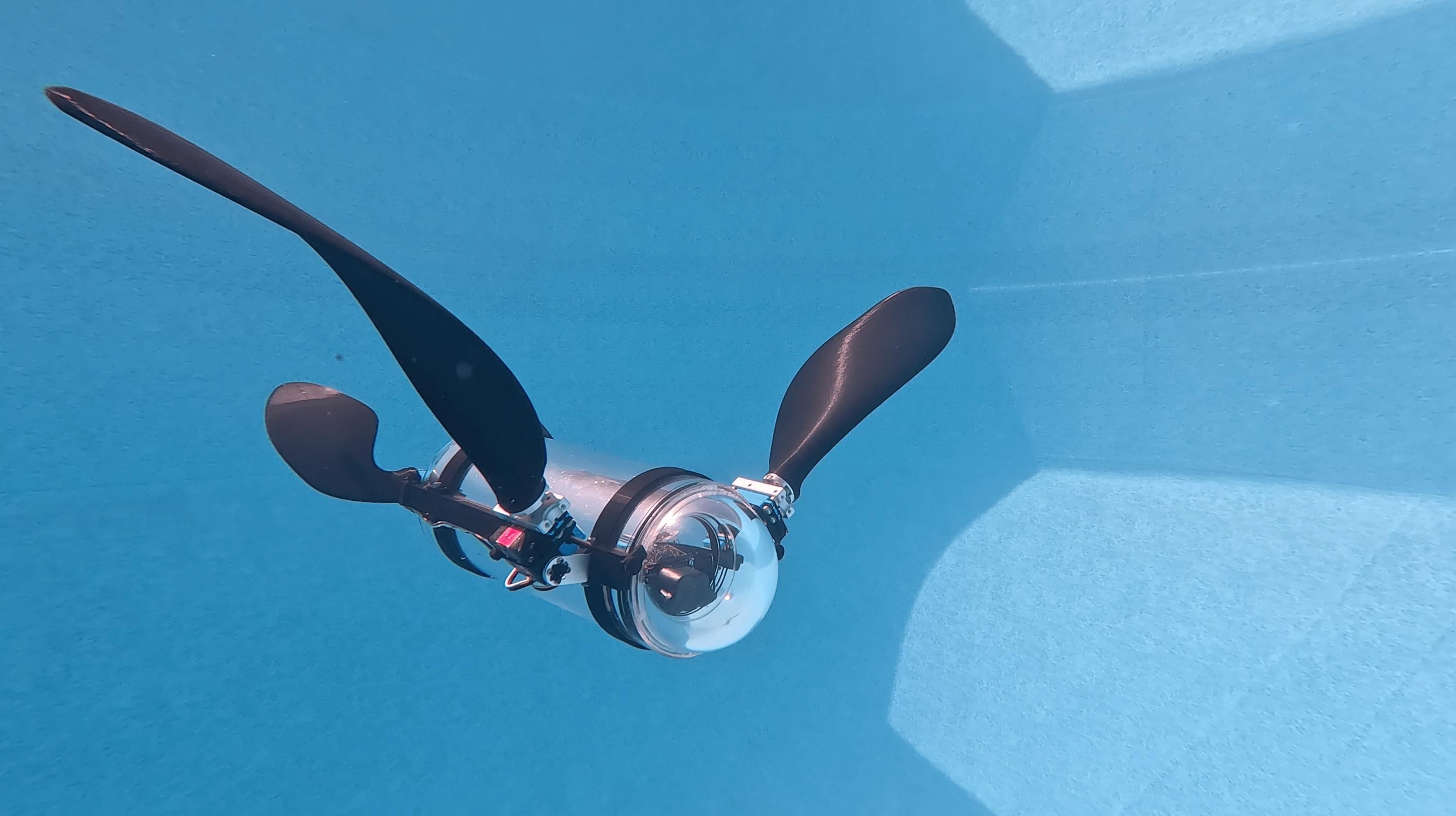
BURT can swim for up to eight hours per charge on a lithium battery, although it also has a solar panel that can run it for even longer periods. Currently, Budz has BURT set up to swim at typical turtle speeds (around 0.5 miles per hour). “If I want him to swim faster, I can simply change the oscillation frequency of his fins,” that is, the frequency of his fin strokes.
Most of BURT’s testing took place in Budz’s grandparents’ backyard pool, which is just over eight feet deep.
“Basically, I created a simulated coral reef setup using 3D models,” he explains, programming the turtle to understand what coral bleaching and invasive species actually look like. “And the turtle then swims around them to simulate what it would do in a real environment.”
BURT is also configured to follow a predetermined search pattern, “so there’s no need for any sort of tether like you might find on a traditional underwater drone.” The bionic turtle scans the surrounding waters with its front camera, with all recorded data then fed back into its Raspberry Pi microcomputer. According to Budz’s tests, BURT was able to detect replicated coral bleaching with 96% accuracy.
BURT, the turtle robot, is getting smarter and smarter
Budz’s next step is to take BURT into different environments to see how far the robot can actually go. To deal with particularly murky waters, he installed lights on the front of the robot and added an ultrasonic transducer that uses high-frequency sound waves to detect potential obstacles.
This year, he even developed a new holographic imaging device, which he uses to record the structural features and shapes of tiny particles in waterways. It then uses a custom neural network, which processes the data in a manner similar to that of a human brain, to determine whether each particle is a microplastic.
Although Budz built his robot with love, he has since won some major awards, including first prize in the European Union Competition for Young Scientists, held in Latvia in 2025, and at the Canada-Wide Science Fair, an annual science fair in which finalists qualify from among approximately 25,000 competitors.
Budz’s goal is to have a fleet of these sea turtles that can be deployed to detect ecological threats. “I’ve already studied coral bleaching, invasive species and microplastics,” he says, “but there are so many different places this can be used. »
In The WorkshopPopular Science highlights the ingenious, delightful, and often surprising projects people build in their spare time. If you or someone you know is working on a hobby project that meets your expectations, we’d love to hear about it…fill out this form to tell us more.
Stories related to “The Workshop”

The best new PopSci 2025 releases



:max_bytes(150000):strip_icc()/Health-GettyImages-2218414142-77b5bdafa17a45479ab36e90bd2a4f05.jpg?w=390&resize=390,220&ssl=1 "Should You Really Be Using Coconut Oil on Your Skin? What the Experts Say")