Thanks to the work of researchers, five Vietnam War MIAs come home


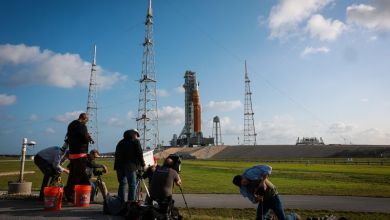
Archaeologist and member of the CRIM team Russell Quick and his collaborators installed GPS equipment as part of their work on the Lima 85 site. Credit: UIC Center for the Recovery and Identification of the Missing
In northeast Laos, near the mountainous border with Vietnam, there is a cliff almost four times taller than the Willis Tower. Known as Phou Pha Thi and considered sacred by local communities, it is where the largest number of United States Air Force soldiers were lost during the Vietnam War.
On March 10, 1968, a group of 19 Air Force technicians were operating a clandestine radar navigation system called Lima Site 85 atop the 5,600-foot cliff when they were attacked. North Vietnamese forces overran the radar installation and 11 Americans were killed during the fight. Their bodies could not be found.
But over the past year, the remains of five of those men have been returned to their families in the United States, thanks in part to the work of the UIC Center for Recovery and Identification of the Missing, or CRIM.
The Department of Anthropology and Office of Social Science Research program partners with the U.S. Army’s Defense POW/MIA Accounting Agency to search for service members missing in action from past conflicts. Their work led to the recovery and identification of the remains of Master Sgt. James Henry Calfee, Sgt. Henry G. Gish, Tech. Sgt. Willis R. Hall, Sgt. David S. Price and Tech. Sgt. Donald Kennebunk Springsteadah, bringing answers to their families 57 years after their disappearance.
“The cool thing about working on projects like this is that there’s always a level of very immediate human connection,” said Aldo Foe, an anthropology graduate student at UIC and an archaeologist at CRIM. “Family members waiting for their fathers, their uncles, their grandfathers to be brought home: the motivation starts and stops with the families.”
Bringing the missing home
The Defense POW/MIA Accounting Agency is leading efforts to account for missing service members, but the unique complexity of many cases has prompted the government to turn to outside organizations, including universities, for support.
UIC got involved in 2010, when Illinois Sen. Dick Durbin’s office contacted anthropology professor John Monaghan to ask if the university could help. The hope was that UIC researchers could apply interdisciplinary collaboration and innovative techniques to this solemn task.
“A university is a place that offers broad access to diverse thinking on diverse approaches,” said Keith Phillips, specialist researcher at CRIM.
Professors, students and staff of the CRIM team are involved at every stage of research, from archival research and technological development to field research. They searched for remains from World War II and the Vietnam War in countries including Cambodia, Italy, the Philippines and Palau.
From Mount Rushmore to Laos
Every case is different and Lima 85 presented a new set of challenges. In the decades following the war, joint American, Laotian and Vietnamese teams mounted several expeditions to search for the peak, recovering many of the men lost that day. But the dense vegetation, remote surroundings and the possibility of unexploded ordnance at the site, not to mention the size of the mountain, complicated the search for the missing airmen.
“The cliff is dynamic and dangerous,” Monaghan said. The Defense POW/MIA Accounting Agency asked CRIM to brainstorm and come up with creative solutions to locate the remains on the Rocky Mountain. The team thought, “Let’s think outside the box,” Monaghan said.
An aha moment came during a cross-country drive Monaghan took with her daughter. During a stop at Mount Rushmore, he noticed a group of tiny figures hanging from ropes draped around the presidents’ faces, working to keep Abe Lincoln and George Washington safe from the cracks.
Monaghan recruited these geoengineers, National Park Service contractors named Eric Krantz and Matt Hudson, to better understand how to access Phou Pha Thi’s steep spots.
Map the mountain
With the expertise of Russell Quick, a Ph.D. Graduates in anthropology from UIC and members of the CRIM team, the researchers scanned the mountain with drones to create a 3D digital model of the site. They used a remote sensing technology called LiDAR, which maps the terrain using laser beams aimed at the ground and measuring their reflection back to the aircraft.
“The cool thing about LiDAR is that it can pass through foliage, which is one of the three main problems at our site in Laos,” Foe said.
The team presented their numerical model to Faculty of Engineering professor Ahmet Enis Cetin and his master’s student Jake Zeisel, who had developed a computer program to detect anomalies in laser measurements.
The program, trained on images of tropical forests, pings when it detects an area that looks different from others.
“It won’t raise any alarms about rocks or trees or what you see in a rainforest. But if you have a belt or something like that, it’s an unusual object and it will create an alert,” Cetin said.
The researchers focused on several areas of interest and submitted their findings to the Defense POW/MIA Accounting Agency. The government and its international partners then undertook fieldwork and excavations of the site, recovering materials related to the 1968 battle as well as human remains.
These were taken to the organization’s laboratory in Hawaii, where scientists and specialists use DNA testing, dental records analysis and other methods to identify the remains and notify families.
“I can’t stress this enough, this project is a massive collaboration,” Foe said.
A legacy of service
The CRIM project continues to develop new strategies to recover the remains of those missing from other conflicts around the world. Its mission is deeply tied to UIC’s legacy of service to veterans, Monaghan and Phillips said.
After World War II, the university opened its Navy Pier campus to temporarily serve GI Bill students. The Navy Pier campus operated until 1965, when UIC became the full-fledged degree-granting institution it is today.
A spirit of practical service – of applying scientific rigor to such a large, human-centered mission – is at the heart of CRIM’s work, Phillips said. “The idea of trying to achieve something tangible is deep in the bones of UIC.”
Provided by University of Illinois at Chicago
Quote: Thanks to the work of researchers, five MIAs from the Vietnam War return home (November 11, 2025) retrieved November 11, 2025 from https://phys.org/news/2025-11-vietnam-war-mias-home.html
This document is subject to copyright. Except for fair use for private study or research purposes, no part may be reproduced without written permission. The content is provided for informational purposes only.