Beneath the undulating surface of the North Atlantic lies a geological structure so vast that it rivals the Grand Canyon. Known as the King’s Trough Complex, this enormous deep trench system extends approximately 300 miles across the ocean floor and is located off the coast of Portugal. At its eastern boundary is Peake Deep, one of the deepest known points in the Atlantic Ocean.
Unlike terrestrial canyons, carved over time by flowing water, the ocean does not have a comparable erosive force. This makes features like King’s Trough particularly confusing. How was such a colossal underwater canyon formed?
A new study published in Geochemistry, Geophysics, Geosystems offers the clearest explanation yet, linking the origins of the trough to a rare combination of shifting tectonic plates and heat rising from deep in the Earth’s mantle.
“Researchers have long suspected that tectonic processes, i.e. movements of the Earth’s crust, played a central role in the formation of the King’s Trench. Our results now explain for the first time why this remarkable structure developed precisely at this location,” said lead author Antje Dürkefälden in a press release.
Learn more: A hidden rock layer beneath Bermuda explains a mysterious swell in the ocean crust
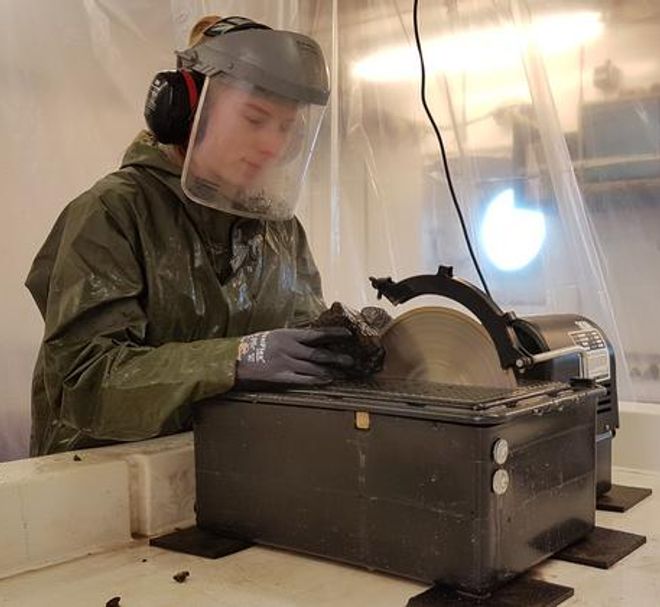
A researcher cuts a sample of volcanic rock recovered several thousand meters below King’s Trough.
(Image credit: Fabian Hampel, GEOMAR)
What is the king’s trough?
King’s Trough is not a single canyon but a complex network of parallel trenches and deep basins cut into the oceanic crust. Together, these features form one of the largest underwater canyon systems on the planet. Its scale alone sets it apart, but its location – far from typical continental margins and tectonic boundaries – has long made it difficult to explain.
For decades, scientists debated whether volcanism, faulting or an unknown erosion process was responsible. The new research suggests that the answer lies in a brief but dramatic episode in the tectonic history of the Atlantic, when the boundary between the African and European plates ran directly through this region.
How was the king’s trough formed?
According to the study, about 37 to 24 million years ago, a plate boundary temporarily crossed the North Atlantic, where the King’s Trench is today. As the plates separated, the crust stretched and fractured, gradually opening from east to west – a process that researchers liken to the closing of a zipper.
What made this area particularly vulnerable was what lay underneath. Long before the plate boundary appeared, hot material was rising from deep in the mantle, thickening and warming the oceanic crust from below.
“This thickened and heated crust may have mechanically weakened the region, so that the plate boundary moved preferentially here,” explained co-author Jörg Geldmacher. “When the plate boundary then moved further south toward the modern Azores, the formation of the King’s Trench also stopped.”
Why this discovery is important today
King’s Trough offers much more than a glimpse into the Atlantic’s past. It provides an example of how deep mantle processes and surface plate movements are intimately linked, and how ancient mantle activity can shape where future tectonic deformation will occur.
Today, in the Azores region, a similar trench system called the Terceira Rift is actively forming in unusually thick oceanic crust, echoing the conditions that once created the King’s Trench.
The team based their findings on data collected during a 2020 research expedition, during which they used high-resolution sonar to map the seafloor and dredged volcanic rocks from the trenches for chemical analysis. Together, the results help clarify how some of Earth’s most spectacular landscapes came to be.
Learn more: Colliding tectonic plates rotate the Iberian Peninsula clockwise
Article sources
Our Discovermagazine.com editors use peer-reviewed research and high-quality sources for our articles, and our editors review the articles for scientific accuracy and editorial standards. See the sources used below for this article: