The beginner’s guide to urban hiking in any city

My first job out of college was in Boulder, Colorado, a super Spandex and Subaru land. Like many of my neighbors and co-workers, I frequently spent my lunch breaks away from my desk, embarking on a short, steep midday hike with a brown bag lunch.
The rush of energy during the workday was exhilarating, so when I later moved to Denver—a busy city, sure, but with a downtown located a bit farther from the mountains—I learned to embrace the concept of “urban hiking.”
The definition of an urban hike is vague to say the least, but it generally describes a walk or dedicated nature trail carved out within the confines of a city. For example, in Denver’s City Park, there is a popular 3.2-mile loop that runs through the park and past a lake, located at exactly 5,280 feet above sea level (that’s a mile high). The park is bordered by a museum and zoo close to the city center, yet away from crowds and traffic. In other cities, these trails typically offer a refreshing stroll through the great outdoors, but views of skyscrapers can peek through the trees and ankle-supporting hiking shoes are rarely necessary.

City park with Ferril Lake in downtown Denver Colorado USA.
(benedek via Getty Images)
If this type of exercise (and relaxation) appeals to you, here’s everything you need to know about urban hiking and how to enjoy it in your own city.
Find your way
Urban hiking and walking may look similar on the surface, but the intention and experience set them apart. Walking typically involves getting from point A to point B or making light movements, often on sidewalks or familiar routes, while urban hiking is more deliberate and exploratory. It borrows from traditional hiking with an emphasis on time spent in nature, varied terrain, and mental resetting, even if that nature exists within city limits.
Urban hikes often follow greenways, park loops, river trails, or historic routes, encouraging walkers to slow down, notice their surroundings, and feel immersed, rather than simply recording steps.
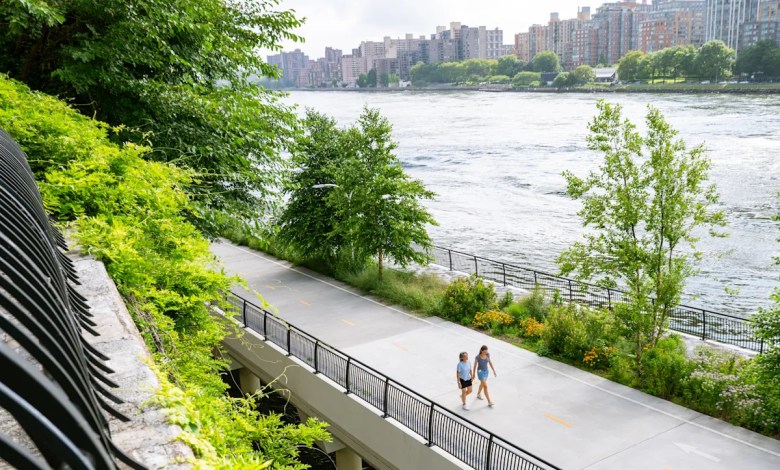
Look for “greenways” (also called bypasses), which are car-free corridors that often run alongside rivers, streams or protected nature reserves.
Recognizing the environmental and social benefits, major cities across the country have invested heavily in their public greenways in recent years, although the concept is not new: Legendary landscape architect Frederick Law Olmsted, who designed New York’s Central Park, also conceptualized the interconnected system in Buffalo, New York.
Other notable examples include the Atlanta BeltLine, which converted 22 miles of unused railroad tracks into pedestrian and bike paths that circle the heart of the city, or the 112 miles of greenways and trails in Knoxville, Tennessee, that allow residents to seamlessly escape into nature.
Another way to find an urban hiking route near you is to check the municipality’s website to find out about trail networks or local greenways. Maps and trail information are often highlighted on the parks and recreation department’s website, and sometimes on a city’s tourism page as well. Nonprofit organizations, like the Detroit Greenways Coalition, typically advocate for green spaces and share information on how to best explore those in your backyard.
Then there are the apps: I love browsing AllTrails, where contributors share helpful information about hiking, like which stretches are likely to be icy, why your kids might like a trail (ducks or an ADA-accessible playground at a connected park!), and whether or not there’s enough shade along the trails. GPSMyCity offers all kinds of self-guided tours in hundreds of cities so you can learn about a city’s history and architecture while walking.
Get the Right “Gear”
You probably won’t need boots or poles, but being prepared and creative with your routes can make the experience more enjoyable. Dress in layers, because even though the temperature variations aren’t as extreme as in the mountains, it’s always good to be prepared for the elements.
And make sure you wear suitable shoes: just like running or walking, urban hiking requires a good pair of sturdy and comfortable tennis shoes. Pro tip: Don’t buy new ones and break them in while hiking, which is a sure path to blisters. I always like to keep strips of Moleskin padding in my backpack just in case, and I’m a fan of Merrell’s Alpine 83 as it’s a nice, lightweight everyday shoe.
In my backpack I usually store a bottle of water (I’m part of the Owala Free Sip team), polarized sunglasses and sunscreen because even in winter the rays can be intense.
Also, before I leave, I apply a little sunscreen to my face or use one of my foundations (like this one from Tarte) that has a broad spectrum SPF.
Be creative

Austin’s Greetings to the South Congress Postcard Mural, Austin, Texas
(David Cameron via Getty Images)
After hiking the trails suggested by AllTrails and taking a few urban hikes in your local greenbelts, change your perspective and go for an art walk. I enjoy walking the blocks of Denver’s River North (RiNo) neighborhood, where the color-saturated murals serve as a sort of outdoor art gallery. Many cities like Austin, Chicago, and Oklahoma City have wall maps that can help you determine your route.
Another way to make an urban hike even more interesting is to explore the history of your city. Whenever I travel to a new city, I check the websites of historic preservation organizations or business districts, where free self-guided maps or even audio tours can often be found.
In Denver, for example, there is a Five Points Historic Walking Tour with historical monuments recounting African American history and culture.
Happy hiking!


