The best photos from NASA’s first moon mission in more than 50 years

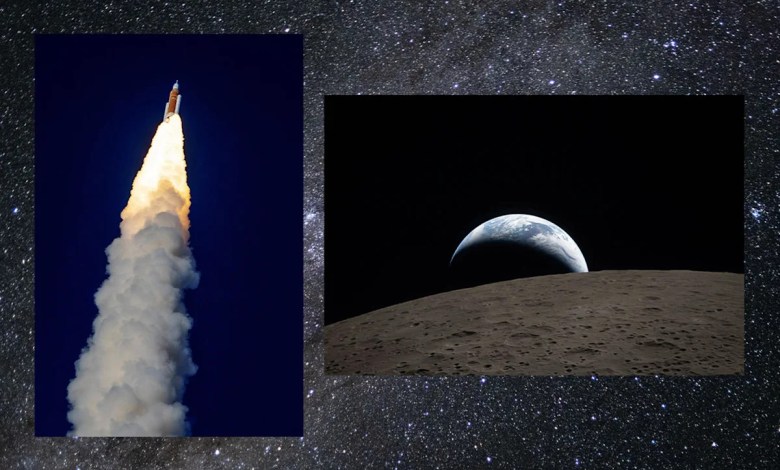
NASA’s Artemis II mission, the first crewed flight around the Moon in more than 50 years, was a feast for the eyes.
NASA astronauts Reid Wiseman, Christina Koch and Victor Glover and Canadian astronaut Jeremy Hansen concluded their 10-day mission Friday evening with a water splash landing in the Pacific Ocean.
The crew launched a 10-day journey on April 1 that took them to the far side of the Moon. They have traveled further from Earth than any human before, breaking the distance record set by the Apollo 13 crew in 1970.

NASA’s Artemis II Space Launch System rocket and Orion spacecraft inside the Vehicle Assembly Building at NASA’s Kennedy Space Center in Florida. (John Kraus/NASA)
(John Kraus)
Their photos from Monday’s lunar flyby — when they saw parts of the moon that no human had ever seen with their own eyes — captivated the public’s attention.
NASA plans to release many more images from the mission now that the crew can transmit its data, rather than sending it back from space. But for now, here are some of the best photos of Artemis II.

From left: CSA Mission Specialist Jeremy Hansen, Pilot Victor Glover, Commander Reid Wiseman and Mission Specialist Christina Koch walk out before the April 1 launch. (Chip Somodevilla/Getty Images)
(Somodevilla chip)
The mission launched from NASA’s Kennedy Space Center in Cape Canaveral, Florida. The crew of Artemis II were the first people that NASA’s Orion spacecraft and Space Launch System rocket had ever carried into space.
Artemis II was one of the most anticipated space events in recent years, as it was the first time humans headed to the Moon since Apollo 17 in 1972.

The Artemis II mission lifts off from the Kennedy Space Center in Cape Canaveral, Florida (Jim Watson/AFP via Getty Images)
(Jim Watson)

The launch was delayed several times earlier this year for repairs to the rocket, but when the day finally arrived, local officials on the “Space Coast” of central Florida estimated that hundreds of thousands of people had flocked to the area to watch Artemis II lift off.

NASA/Getty Images
(NASA/Getty Images)

Jim Watson/AFP via Getty Images
(Jim Watson)

Two solid rocket boosters separate and fall toward Earth. (Jim Watson/AFP via Getty Images)
(Jim Watson)
Although Wiseman, Koch, Glover and Hansen did not land on the lunar surface, their mission was intended to test the rocket and capsule before a planned moon landing in 2028. After that, NASA hopes to build a base on the Moon and establish a long-term presence there.
On the second day of flight, the Orion capsule performed a key engine burn to put it on track to the Moon. The maneuver, known as a translunar injection burn, increased the spacecraft’s speed enough to send it out of Earth’s orbit.

The astronauts then spent three days traveling to the Moon. On Monday morning, their Orion capsule entered a region of space known as the lunar sphere of influence, where the Moon’s gravitational pull is stronger than Earth’s.

Before going to sleep on the fifth day of the mission, the Artemis II crew took a photo of the moon as it approached the window of the Orion spacecraft. (NASA)
(NASA)
The most anticipated moment of the mission came Monday, when the crew spent seven hours taking close-up photos of the lunar surface and observing specific sites on the Moon, including impact craters, ridges and vast volcanic plains.
During their flyby around the far side of the Moon, the astronauts reached a distance of 252,756 miles from Earth, more than 4,100 miles further than the Apollo 13 record.

Astronaut Christina Koch is illuminated by a screen inside the Orion spacecraft on the third day of the agency’s Artemis II mission. (NASA)
(NASA)
One of the first publicly released photos of the flyby showed the Artemis II crew’s view of “Earth” as the Earth disappeared behind the Moon.
The photo was a nod to the iconic “Earthrise” image taken during the Apollo 8 mission in 1968, when astronauts Bill Anders, Frank Borman and Jim Lovell circled the Moon. This archive image, however, shows Earth re-emerging beyond the edge of the Moon, rather than diving below.

Other photos showed surprisingly rugged topography along the moon’s terminator, the dividing line between its illuminated side and its dark side.
“There’s so much magic in the terminator – the islands of light, the valleys that look like black holes,” Glover said by radio to the mission control center at NASA’s Johnson Space Center in Houston. “You would fall straight into the center of the moon if you walked into it. It’s so visually captivating.”
The astronauts focused some of their observations on the Orientale Basin, a nearly 600-mile-wide crater that straddles the near and far sides of the Moon. This 3.8 billion year old basin was formed when a large object impacted the surface of the Moon.
The high-resolution photos taken by the crew of features located in and around the Moon’s impact craters could help scientists understand how the Moon formed and how its topography has changed over time.

The sunlit Orion spacecraft near the moon. The Orientale Basin, a 600-mile-wide mountain-ringed crater, lies on the lower half of the Moon. (NASA)
(NASA)
Astronauts even captured spectacular images of the Moon’s crater-filled south polar region, where NASA wants to land astronauts for future Artemis missions.
The Moon’s south pole is riddled with craters thought to be filled with water ice. But the area is significantly more difficult to navigate than those near the lunar equator, where the Apollo astronauts landed. NASA said observations made during the Artemis II mission could be used to identify possible landing sites for future missions.
Towards the end of their lunar flyby, the astronauts became the first to witness a solar eclipse from space. They made detailed observations for about an hour, as the sun slipped behind the moon and reappeared on the other side.
At the start of the eclipse, astronauts had to wear special glasses (much like those worn by people on Earth to observe solar eclipses) to protect their eyes until the sunlight was completely blocked by the moon.

The Artemis II crew uses eclipse observers to protect their eyes at key moments of the solar eclipse during their lunar flyby. (NASA)
(NASA)
Photos of the eclipse show a dark moon with the sun’s outermost atmosphere, the corona, glowing at the edges. In one of the images, bright points of light are visible at the edges of the moon. These places turned out to be planets, including Saturn, Mars and Venus.
Wiseman called the eclipse “an absolutely spectacular and beautiful experience.”
During the eclipse, when the Moon was shrouded in darkness, crew members spotted flashes of light from meteoroids hitting the lunar surface.

The moon, backlit by the sun, and the Orion spacecraft departed Monday. (NASA)
(NASA)
Although this phenomenon is rarely observed, such impacts are common on the Moon because it does not have an atmosphere to protect it from incoming debris. Studying these cosmic collisions can help scientists understand the evolutionary history of the Moon.
Kelsey Young, science lead for the Artemis II mission to the Moon, said members of the mission’s science team were “literally jumping” after the crew reported seeing six impact flashes.
After the flyby, the astronauts began their three-day journey back to Earth. Tuesday afternoon, the Orion capsule left the lunar sphere of influence.
During its high-stakes re-entry into Earth’s atmosphere, the Orion capsule faced extreme temperatures near 5,000 degrees Fahrenheit.

NASA’s Orion spacecraft lands in the Pacific Ocean off the coast of California on Friday. (Bill Ingalls/NASA via Getty Images)
(Bill Ingalls)
After a fiery dive into the atmosphere, the capsule deployed its parachutes, then crashed into the Pacific Ocean off the coast of San Diego.
This article was originally published on NBCNews.com


