The Division Between Liberal Supreme Court Justices Could Damage the Institution’s Credibility – RedState


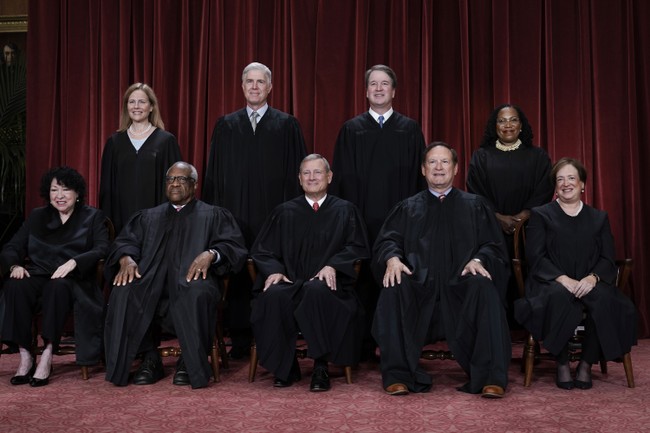
A few interesting articles were published last week detailing the problems the liberal faction of the Supreme Court encountered in working together to accomplish much. We on the right often wonder how Chief Justice John Roberts, Justice Neil Gorsuch, and Justice Amy Coney Barrett will disappoint in various crucial cases, and we assume liberals will vote at the same time. It turns out that the three liberals seem to have very different ideas about how they should proceed as a minority. The articles are At the Supreme Court, Liberal Justices Are Divided – The New York Times, which The New York Times has linked to the debate that divides liberal Supreme Court justices – The New York Times. One is an in-depth analysis of reporting on the Supreme Court and the other is an internal interview with this reporter.
That’s how Jodi Kantor of the New York Times describes the dynamic.
Justice Kagan, appointed diplomat and strategist in 2010, is capable of hitting hard, but she only shows her frustration in flashes. When the court rejected President Biden’s 2023 student loan forgiveness, it suppressed the most passionate elements of his dissent, I learned in my reporting. Justice Jackson takes direct aim at the right side of the court, accusing it of being ignorant of racism, favoring “financial interests” and enabling “our collective demise.”
This led to tensions – between Jackson and the two senior liberals, and between Jackson and the rest of the court.
…
[Sotomayor] is now the leading liberal, attributing the dissents and keeping many of the more important ones to herself. On these points, Sotomayor disagrees forcefully, but she also values her long court connections, those close to her say, and remains primarily focused on legal judgments.
Kagan, according to the report, is an intellectual and a negotiator. Her defender on the Court was the late Justice Antonin Scalia, who disagreed with her but respected her intellect and work ethic. When a conservative leans toward the liberal side of a decision, the person who lured them there is most likely Kagan.
Sotomayor is results-oriented justice. She doesn’t care so much about law and precedent as about impact. But she believes in the institution and has close personal relationships with some conservative judges.
The hero of the story is Judge Ketanji Brown Jackson.
The lawyer who got the job had two degrees from Harvard, but also had a history of challenging power. In 1990, when Justice Jackson was a student, she wore black instead of crimson to the Harvard-Yale football game to take a stand against the lack of full-time faculty in the African American Studies department. “We can embarrass the university in front of alumni,” she told the Boston Globe at the time.
As a clerk, she worked in a Supreme Court with many black construction workers, but where only a handful of black lawyers had achieved elite legal learning. Later, she worked as a public defender – representing the accused and the excluded.
Her appointment as the first black female judge was “a refutation of past ignominies, a long-awaited and highly celebrated national achievement,” she wrote in her memoir. But inside the court, she was the junior judge, charged with duties such as serving on the cafeteria committee and answering the door to the judges’ private conference room in case of a knock. At these meetings, Justice Jackson spoke only after others, meaning that unless there was a tie, she had the least influence.
The interview makes it clear that the young judge still has the duties outlined in the last paragraph, but the article associates her with the nonsense of “refuting past ignominies” to almost make it seem like she is being singled out for humiliating tasks.
It is the clash between Barrett and Jackson that crystallizes the difference between Brown, his liberal colleagues and the majority of the Court.
This all came to a head in one case in June. In Trump v. Casa, the court limited the power of lower court judges to issue rulings nationwide, thereby diminishing the power of the judiciary to challenge Mr. Trump. Justice Barrett wrote the 6-3 majority opinion. Justice Sotomayor responded with a sharp dissent: “The court’s decision is nothing less than an open invitation to the government to circumvent the Constitution,” she wrote. Justice Jackson joined in this opinion.
But she added even more disastrous solo dissent. “Ultimately, executive power will become totally out of control and our beloved Constitutional Republic will no longer exist,” she wrote, before concluding “with deep disillusionment, I disagree.” It sounded like a message: I’m losing faith in the Supreme Court.
Judge Barrett hit back harshly, calling her argument “contrary to more than two centuries of precedent, not to mention the Constitution itself.”
Defenders argue that Brown insists on writing individual opinions that irritate his colleagues and do nothing to advance the law, thereby engaging in “public education from the bench.”
Empirical data confirms its verbosity.
Words spoken by the new Supreme Court justices:
– Female judges spoke more than male judges.
– KBJ spoke more than all the male judges combined. pic.twitter.com/u9kWpPy6rN– The Rabbit Hole (@TheRabbitHole84) June 25, 2025
I have two parallel theories. First, it attracts attention. The emphasis on “me, me, me” is evident from his Harvard degree to his lengthy and somewhat deranged opinions. Its interest is not to educate the public about the law; it’s about educating the press about who they are and why they’re important. She is not interested in building a voting bloc because then she would not be able to promote herself and collect “brave and bold” opinion pieces.
My second theory is the one I fear the most. Court can be a rude, loud, attention-seeking person. What he can’t survive is someone hostile to the institution. For all the criticism we level at Chief Justice Roberts, he is keenly aware that the Supreme Court only functions because the two true branches of government and the people respect it. Otherwise, we are in the realm of “John Marshall has made up his mind; now let him implement it.”
I think Brown’s self-appointed role on the Supreme Court stems directly from Saul Alinsky’s rules for radicals. She is not interested in a collegial relationship with other judges. She wants to demean them (see her “let them eat cake” comment in Harvard vs. Students for Fair Admissions; BREAKING: Supreme Court Rejects Race-Based College Admissions – RedState) because people hurt, not institutions. She discredits the Court as a rubber stamp of the administration (see “Calvinball Has Only One Rule: There Are No Fixed Rules. We Seem to Have Two: This One, and This Administration Always Wins,” from APHA v. NIH; A Supreme Court Justice Found Himself Out of Place; Can You Guess Who? – RedState). She knows that her opinions cannot obtain a majority of five or even three votes, and so she attacks the motivations of the other judges and the fairness of the process. Winning is not as important as discrediting the winning decision.
Unfortunately, there is no way to eliminate this kind of poisonous force from the Supreme Court. We are stuck with this. We can only hope that other judges become aware of his game.
Schumer’s closure is here. Rather than putting the American people first, Chuck Schumer and radical Democrats forced a government shutdown on health care for illegal immigrants. They own that. Help us continue reporting the truth about Schumer’s shutdown. To use promo code POTUS47 to get 74% off your VIP membership.


