The Frankensteined Feminism of The Bride!


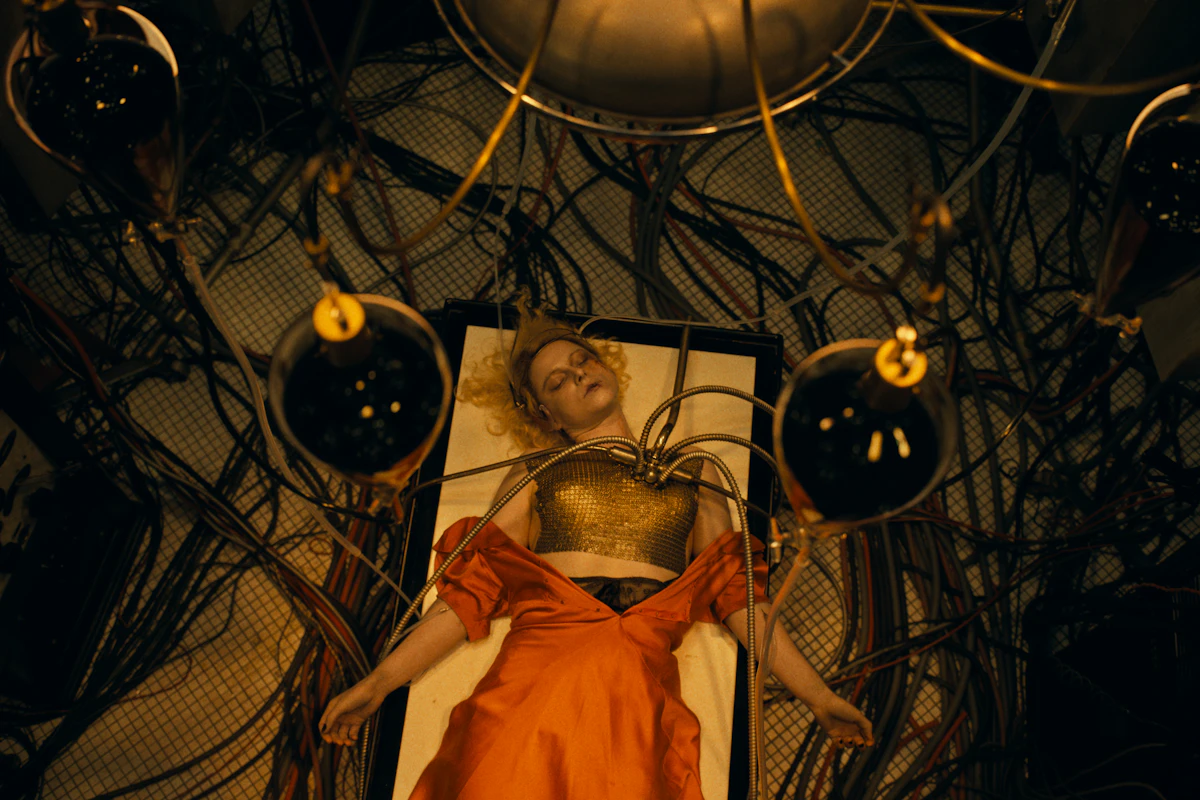
Even before Ida (Jessie Buckley) became a black bile-spewing revenant, you wouldn’t call her a real lady. In a shady Chicago restaurant in 1936, she looks blank, struggles and wobbles in her seat as she launches into a tirade against the local mafia.. The gangsters tolerate her until she stands up and vomits all over their king (Zlatko Buric), a toad-faced godfather who promptly orders his minions to give her a beating. And that’s what they do, in this opening scene of Maggie Gyllenhaal’s film. The bride!, a vibrant reimagining of Bride of Frankenstein (1935) with a post-#Me Too version. In this noisy, fleeting vision, wicked women are ideal monsters to address issues of power, consent, and narrative control.
At the end of Shelley’s novel, Frankenstein’s monster longed for companionship, begging his master to make him not just a friend but a “wife,” whose equally abominable build would allow him to sympathize with him and tolerate his presence. In Gyllenhaal’s film, Dr. Cornelia Euphronious (Annette Bening) grants the monster “Frank” (Christian Bale) this wish when she brings Ida to life. The resurrected Ida has a new look: a shock of platinum blonde hair etched with finger waves and a touch of black ink on the side of her mouth. She doesn’t remember her name, who she is or where she’s from, but otherwise Ida is the same giggling debauchee we saw at the bar. Frank is delighted. Chivalrous, prudish and naive, he at least has the intelligence to tell Ida that they were a couple before her “accident” and to pretend to admire her intelligence. “You have an incredible vocabulary,” he observes adoringly.
However, Frank becomes fiery after a few drinks and brutally kills two thugs who tried to force themselves on Ida. These actions make headlines, transforming The Bride! in an outlaw drama that unfolds in frenetic directions that span genres: two wry detectives, Jake (Peter Sarsgaard) and Myrna (Penelope Cruz), are hot on the monsters’ heels; the same goes for one of the mob boss’ cronies (John Magaro), who has been tasked with getting rid of Ida once and for all; Ida is sometimes plunged into the depths of her unconscious, where she herself consults Mary Shelley (Buckley, again, in gothic attire).
This meeting between Ida and Shelley reminds us that Frankenstein’s monster – for all its iterations throughout the last century of pop culture – derives from the mind of a woman. It is therefore curious that there are so few female versions of the Creature in the dozens of films and series in which she appears, including, more recently, that of Guillermo Del Toro (relatively faithful but sleepy adaptation). Frankenstein (2025). Yorgos Lanthimos Poor things (2023) depicts the moral and intellectual awakening of a woman created by man, and that of Diablo Cody. Lisa Frankenstein (2024) follows a teenage girl who reanimates a corpse and attempts to “transform” him into the man of her dreams. Yet Gyllenhaal’s feminist Frankenstein seems to want to rewrite the myth itself – or at least reinvent the Hollywood version of it.
Frank claims to have been born in 1819, the following year FrankensteinIt is therefore telling that he meets Ida more than a hundred years later, around the time when the iconography of Frankenstein had started to appear on the big screen. At the end of the 1935 film, Frankenstein’s wife rejects the monster’s hand, seemingly preferring death to a life of subordination. Gyllenhaal asks his wife to signal her independence in a very different way: Ida not only evades convention as a club-going, heavy-drinking, sex-loving vigilante, she is also presented with the capacity to love and be loved by Frank on her own terms, although their love story—its authenticity and its fraudulence—also explores the limits of heterosexual coupling in a patriarchal world. When a woman dares to upend gender dynamics, she’s a monster, that’s the film’s spirited proposition, even if, in Gyllenhaal’s hands, it lands with a thud.
One of the film’s smartest traits is its metacinematic approach to Hollywood history. Ida quickly discovers that Frank is a rabid fan of fictional song-and-dance star Ronnie Reed (Jake Gyllenhaal), whose films he rewatches obsessively. Dark cinema, any brooding movie buff will tell you, is an extraordinary comfort to sad and lonely people, so it makes sense that poor Frank would find solace on screen. Ida and Frank plan their trips around Ronnie Reed screenings taking place on the East Coast, and Frank regularly projects himself and Ida onto the film’s footage: in a Busby Berkeley-style dance number, he appears as one of the tuxedoed chorus singers, and in a shipboard romance, Frank and Ida’s faces replace those of the lead couple.
Perverting these cinematic models, while drawing attention to the illusions and desires that motivate Frank’s displacement, constitutes a productive and ambivalent homage to this era.The film’s spectacular period settings, particularly when the action shifts to Manhattan with its glittering marquees and packed houses, may speak to a certain nostalgia for a time when film culture was capable of meaningfully organizing public life; Still, Frank’s parasocial relationship with Reed is a reminder that movies don’t love back, and that they’ve historically reserved very little room for people like Frank and Ida—literal monsters, here, being a convenient catch-all for all manner of underdogs.
Gyllenhaal, in part, seeks to rework this story, giving the Bride its spotlight, certainly, but also by placing women in professions that the films themselves have reinforced as male domains. Myrna proves to be a much more talented detective than Jake, even though she continually faces skepticism from her male colleagues; and even Frank is surprised to learn that Dr. Euphronious is actually a woman.
But if Frank’s assimilation fantasies prove pathetic, Ida, the provocateur, takes advantage of her status as a foreigner to spark social unrest. Midway through the film, Ida and Frank throw a glitzy party downtown, posing as waiters while feasting on shrimp cocktail, the outlaw life having left them penniless and hungry. This masquerade transforms into a choreographed dance sequence with intentionally strange and irregular movements at odds with ballroom proprieties. Here, Jake and Myrna catch up with them, along with dozens of cops ready to lock them up, only for Ida to grab a gun and start threatening the crowd, even threatening to kill Ronnie to take advantage of her and Frank. The scene is total nonsense, a jumble of provocations without stakes or dramatic effect. Ida takes this opportunity to monologue about corruption and abuse of the marginalized in front of the crowd of partygoers and police officers, even though she lacks the power and seriousness she seeks to convey. When the press features Ida on the front page, she sparks a feminist revolution, in which other women adopt her style and pursue their own forms of vigilante justice, a fictionalized rebellion that shrinks into grating content.
As shown in a number of films from the last decade (Birds of prey, 2020; Cruella, 2021; Joker: Folie à deux, 2024), there is something plastic about backstories and redemption plots released as correctives to past minimizations and/or simplifications of female characters, particularly when the good intentions that might motivate such “inclusive” storytelling almost always seem secondary to capitalizing on pre-existing intellectual property. To Gyllenhaal’s credit, the film’s message of empowerment seems sincere; it’s just as obvious and ridiculous, no thanks to Buckley’s bumbling performance, a caricature of female madness that’s hard to be believed. (She offers a similar gloopy maximalism in Hamnet, for which she won an Oscar.)
Following Ida’s anti-authoritarian theater, Ida and Frank realize the full extent of their revulsion toward society and victoriously decide to throw caution to the wind and truly “live.” Their sex life improves, or rather begins accordingly; and the film meanders disjointedly toward their eventual capture. Liberation transforms the couple into pleasure-seeking lovers on the run. In this sense, the second act of the film, more flexible, evokes the free future of cinema and the dismantling of the moral framework of the studio system by the arrival of the new Hollywood and films like Bonnie and Clyde (1967).
It’s a shame that this dimension remains largely theoretical, just like the emotional upheavals of the film. When Jake, for example, is revealed to be one of Ida’s lovers from her past life, during a late-night confrontation in Niagara Falls, the moment, despite all the screaming and gunfire, unfolds without enthusiasm. Likewise in the film’s most intentionally disturbing scene: when a dirty cop pulls them over and assaults Ida while patting her down, his eventual grisly retaliation—which ends with him biting his tongue out of his mouth—is an artificial way of signaling his burgeoning monstrosity and unapologetic lack of remorse.
This awkward, indifferent tone plagues the film’s most crucial scenes, making The Bride! feels more like a collection of strange, sometimes amusing scenarios than a coherent narrative with any real dramatic weight. The chemistry between Buckley and Bale has the appeal of a wet blanket and explains what I think is the film’s biggest missed opportunity: building and complicating the parallels between creating an artificial being and conceiving your own partner in a world of sexist expectations. Despite Ida’s assertions of autonomy, she was born of Frank’s desire, her past replaced by Frank’s invented stories about their shared history. He basically lights it up throughout the movie. It feels more striking precisely because we never really buy into their love story — it’s drowned out, diminished by the film’s many moving parts.
The Bride! is broad, confusing, and erratically designed, but as much as I lamented its inadequacies, I was also fascinated by them and by Gyllenhaal’s unwavering commitment to the concept, his choices clearly born from a desire to experiment. With its niche references and bizarre, if oddly jarring, genre shifts, it’s a unicorn among other expensive studio offerings (it reportedly had a budget of $90 million). Ambition, oddly enough, can be seen as a monstrous trait in women in particular; although being difficult to love, the film argues, might very well be a virtue.


