The Grue Jay Is a Harbinger of Our Future


Explore
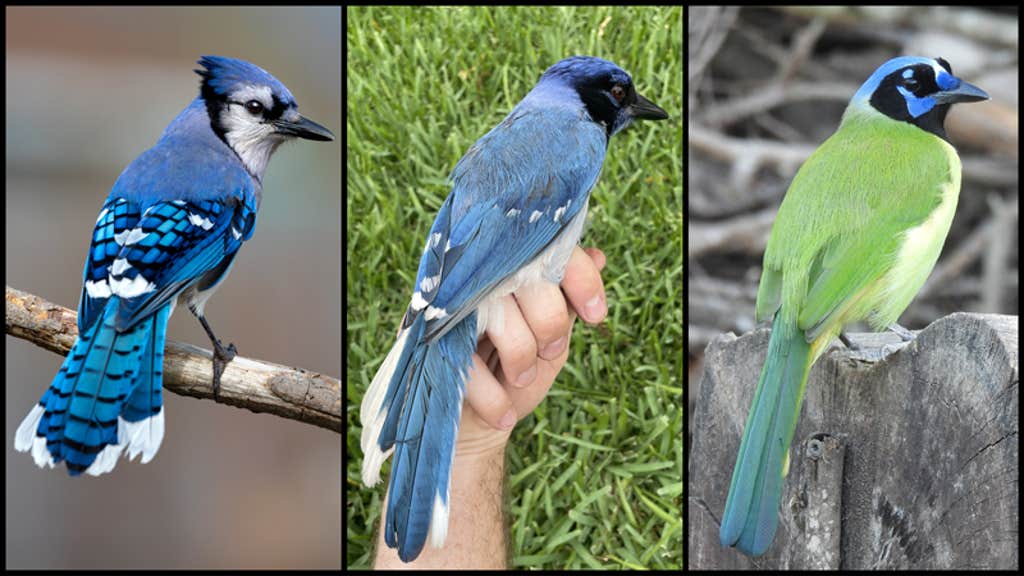
HHybrid species have long awakened the human imagination: tiger-lions, horses-zebras, minotaurs. Today we have a brand new chimera to admire: the “crane jay,” a dazzling bird that’s part blue jay, part green jay. It’s a harbinger of our future in the face of climate change.
Graduate student Brian Stokes discovered the crane jay while completing his doctoral studies at the University of Texas. It followed the tropical green jay, whose range had shifted nearly 124 miles north in previous decades, due to climate change. One day, while monitoring bird posts on Facebook about green jays, he noticed that a birder named Donna had posted a mysterious photo.
“She posted this strange bird and was asking what it was,” Stokes recalled. “She had thought maybe it was a blue jay that had, like, some kind of genetic mutation or something.”
ADVERTISEMENT
Nautilus members enjoy an ad-free experience. Log in or register now.
Stokes and his advisor, ecologist Tim Keitt, traveled to the woman’s home near San Antonio and captured the strange bird with a mist net in 2023. They noted that the bird hung out with blue jays and emitted their calls, but also the vocalizations associated with green jays. They took blood for analysis, attached a metal band to the legs and let the animal go. Back in the lab, DNA analysis showed that the hybrid bird had a green jay mother and a blue jay father, the first time such a thing had been observed in non-captive populations. The results were published earlier this month in the journal Ecology and evolution.
Hybrid species are surprisingly common in the plant kingdom, but less so among animals, with about 10 to 15 percent of bird species known to hybridize. But as animal ranges shift due to changes in the global climate, the likelihood of encounters between species that have never interacted before increases, which could lead to new ecological communities. “It’s an interesting sign of what could happen in terms of climate change and changes in biodiversity,” says Stokes.
Just because two species come into contact does not necessarily mean they will make babies together. Stokes was surprised that the different jays had mated, as both species live in small groups and are quite territorial and aggressive. “We had thought they would be really hostile to each other,” he says, “so we were really, really surprised to see that happen.” So far, only one hybrid crane jay has been observed.
“She posted this weird bird and was asking what it was.”
ADVERTISEMENT
Nautilus members enjoy an ad-free experience. Log in or register now.
Scientists have documented other climate-related hybrids in the wild, such as the pizzly bear, where the grizzly bear and polar bear meet, and the narlugas, the offspring of narwhals and belugas. There are also other cases where the ranges of distinct species have begun to overlap due to changes in temperatures: the southern flying squirrel and southern flying squirrel or the black-capped and Carolina chickadees.
“We expect climate to shift the range of species, leading to hybridization,” says Scott Taylor, a biologist at the University of Colorado who was not involved in the crane jay study. “We see this all over the world.” Of course, many hybrids are sterile and therefore do not create new species.
Taylor says the Grue Jay hybrid is a really interesting find. “It’s always surprising to find a new type of hybrid bird and very interesting in this case, because it is between a subtropical species and a temperate species,” he says. He cautions, however, that it is not a new species, as it is likely sterile and also reproductively isolated from other hybrids. This means that the new bird could have little or no influence on the future evolution of blue jays or green jays. “We need time to find out,” he said.
David Toews, a biologist at Pennsylvania State University who has previously described other new hybrid birds, says climate-induced hybridization is just one of many dangers wild birds face. “While I think in some cases it might be important, most species face a multitude of other threats, the biggest being habitat loss. Hybridization seems pretty far down the list for many species,” he says. “For example, hybridization between the spotted owl and the barred owl is a problem for the endangered spotted owl; however, the primary driver of conservation concern has been significant habitat loss and modification.”
ADVERTISEMENT
Nautilus members enjoy an ad-free experience. Log in or register now.
For Stokes, discovering the strange bird on Facebook was, to say the least, amusing and strange. “They’re just two really charismatic species and one awesome little bird in the end.”
More than Nautilus about hybrid animals:
“A strange new animal gene pool is brewing in the Arctic» Scientists have seen the future and they are the “grolar bears”
“New bird species arise from hybrids, scientists observe» The rapid and unorthodox emergence of a new finch in the Galapagos suggests that speciation is not uncommon. New hybrid species can appear and disappear quietly without anyone noticing.
ADVERTISEMENT
Nautilus members enjoy an ad-free experience. Log in or register now.
“It’s time to create chimpanzee-human hybrids» Humanzee is both scientifically possible and morally defensible
Enjoy Nautilus? Subscribe for free to our newsletter.
Main image: Brian Stokes