The hidden potential of Trump’s critical minerals stockpile


Last year, the Trump administration seemed to completely abandon the future of renewable energy. He launched an all-out war on offshore wind; erected byzantine regulatory hurdles to block renewable energy on public lands; and effectively gutted the Biden administration’s inflation reduction law, consigning the law’s historic tax credits for solar power, wind power, and electric vehicles to the dustbin of history. Last month, the administration went further by repealing the Endangerment Finding — a 2009 rule that served as the basis for most emissions regulations. Meanwhile, China’s rapid transition to renewable energy has continued apace, and reports indicate the country’s emissions may have peaked in 2024. Much of the world appears to be following China, as the United States has retreated to reviving the coal industry, ramping up natural gas production to power a wave of data centers, and scaring off investors with erratic behavior.
But even as the Trump administration goes after emerging clean energy technologies, it has rushed to procure critical minerals — the raw materials essential to renewable energy and emerging military technologies — and the United States has spearheaded a number of actions intended to break China’s grip on the critical minerals supply chain. Some experts say the administration’s focus on national security is likely the reason for its rush for critical minerals. But if the Trump administration stockpiles more minerals than the Pentagon uses, or if the mining industries don’t come together during Trump’s second term, others believe the president’s efforts could ultimately support renewable energy under a future administration.
“Currently, [critical mineral policy is] “Which is clearly in opposition to a just energy transition.”
The year the United States doubled its consumption of essential minerals
On February 2, President Trump and the US Export-Import Bank, or EXIM, announced an initiative called Project Vault – a $12 billion public-private partnership to store critical minerals, intended to protect the United States from supply shocks. It will consist of $2 billion in private capital and a $10 billion EXIM loan: Companies like Boeing, General Motors and Alphabet are expected to participate in the program and will be able to draw on inventories, provided they replenish the equipment they use.
“In theory, the project can already be used for clean energy,” said Bryan Bille, director of policy and geopolitics at Benchmark Minerals. Even though the current administration is focused on directing a large portion of the stockpile to the military, Bille explained, it will still focus on increasing U.S. battery capacity to accommodate the data center boom.
Days after the stockpile announcement, the administration held a “Critical Minerals Ministerial” in Washington with representatives from more than 50 countries, during which Vice President JD Vance proposed a special trade zone that would use tariffs to determine price floors and allow participating countries more stable access to critical minerals. The administration recently announced that it would also use AI to set price floors in some cases, including when it comes to minerals like gallium – 95% of which the US imports from China. Because the market is currently heavily distorted by its single supplier, said Peter Cook, a climate and energy analyst at the Breakthrough Institute, AI could help determine the true cost of producing gallium, which is essential to semiconductors and other electronic products.
But making all of this sustainable depends on codifying critical minerals policy into legislation, Cook said, pointing to the Securing America’s Critical Minerals Supply Act, which is currently in the Senate. “The key is whether something like Project Vault is going to be sustainable beyond a single administration,” Cook said. “I think there is certainly an opportunity for [clean energy and national security stockpiling] complement each other, instead of cannibalizing each other.
Wu Changqing/VCG via Getty Images
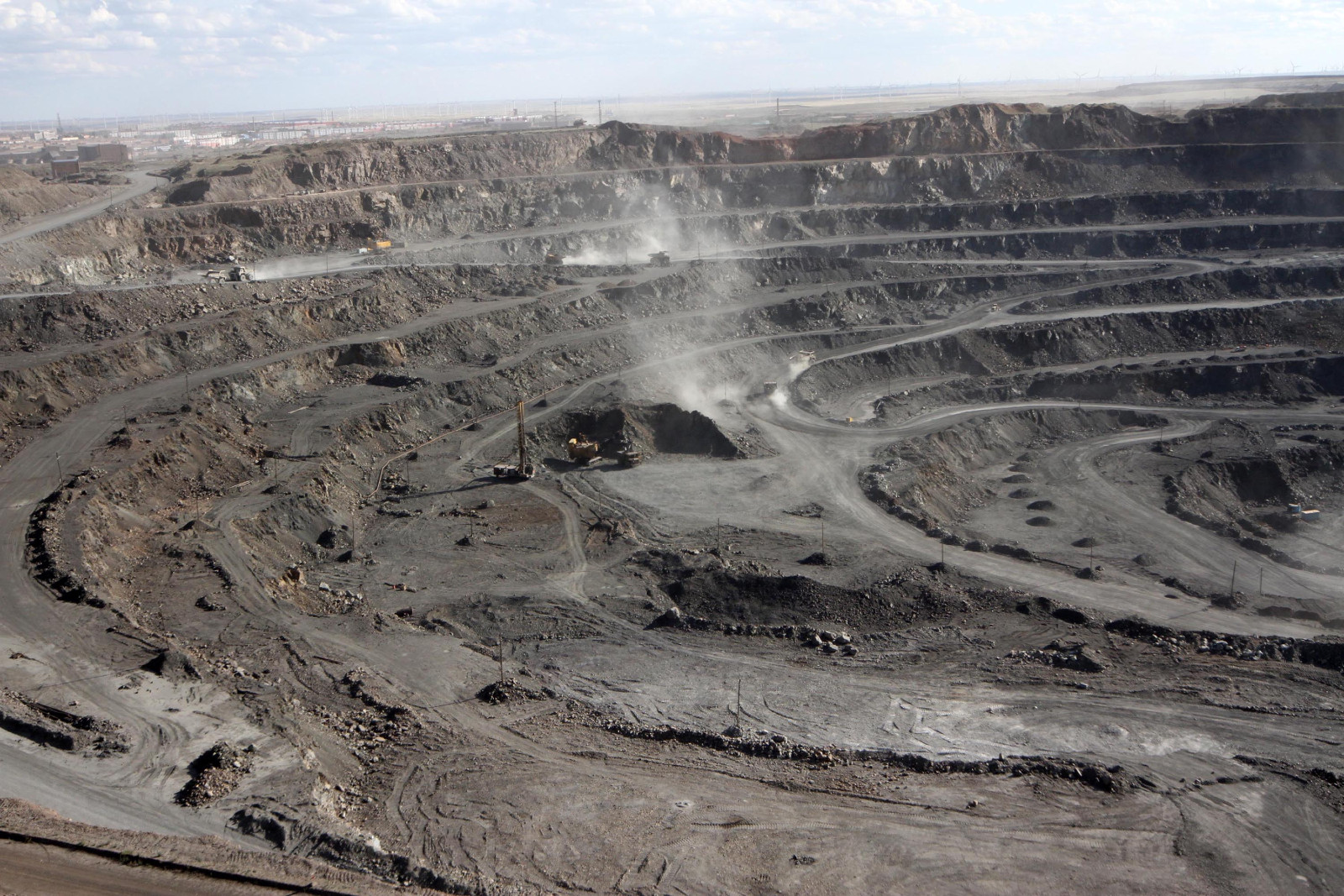
The actions are just the latest in Trump’s year-long effort to break China’s dominance in the critical market for minerals and rare earths. Currently, approximately 80% of rare earth imports into the United States came from China, and the Trump administration has worked aggressively to break this market stranglehold through trade deals, taking stakes in several mining companies (which have been questioned by House Democrats), hosting a summit to secure the AI supply chain, and even defying international law by exploring deep-sea mining in international waters.
But securing minerals alone is not enough to oust China from the global heavyweight in rare earths and critical minerals. The United States still lacks the processing capacity to fashion these minerals from raw materials, and the removal of IRA subsidies has wiped out a flow of demand, making it difficult to diversify the mineral supply chain, said Tom Moerenhout, a Columbia University professor who directs the Critical Materials Initiative at Columbia’s Center for Global Energy Policy.
“The short-term bottleneck is getting these [processing facilities built]”, Cook said. “But the real bottleneck will simply be the overall supply from a geological perspective.” In other words, even if the mines were operational tomorrow, the United States may not have access to a sufficient supply of essential minerals.
To complicate matters, there is no absolute overlap between the minerals needed for green energy and those needed for defense production. Antimony, for example, which the administration has made a point of researching, is used in military technology, but not in solar panels or electric vehicle batteries. And, in recent weeks, conservatives appear to have made an about-face on clean technology, likely spurred by the extreme energy demands of data centers. It is unclear how this will play out in the long term.
Experts agree that building resilient supply chains and infrastructure could help if a future administration shifts the country’s focus back to a clean transition. But a strong national mining and mineral processing network will require a fundamental shift in how we think about and plan for mining and mining areas too.
“Everyone criticizes China for this dominance, but it was created by the West,” said Raphaël Deberdt, a postdoctoral researcher at Copenhagen Business School who studies mining anthropology. “We have outsourced industries that we thought were too polluting. China’s dominance in terms of processing is the result of 40 years during which the West did not want this to happen in its country.”
Still, effective green industrial policy, says Steichen of the Transition Security Project, is not just about reducing risks in the supply chain or providing the right incentives, but also about minimizing the volume of extraction. “None of this is possible as long as critical mining strategy relies on national security and military mining expansion,” she said. The explosion of data centers has highlighted the need for increased mineral recycling because the chips and servers needed to run them need to be replaced every few years, creating tons and tons of e-waste, much of which isn’t recycled.
A 2024 report in Nature Computational Science estimates that the rapid adoption of large language models will generate 2.5 million tons of e-waste per year by 2030. “If we use public money, we also need to pay attention to labor, environmental and community standards,” Steichen said. “As well as some of the potential problems with strengthening American nationalism when it comes to resources. » The United States disposes of a huge amount of critical minerals in mining wastewater, and the Department of Energy’s research agency, ARPA-E, is currently working on ways to recover usable materials from these wastes. But regardless of how many solar panels the United States is capable of building at home, Steichen stressed that a Really Effective green industrial policy will require global climate cooperation.