The Mists of Sichuan Reveal Vibrant New Pit Viper Species Hidden for Decades

The post Sichuan Mists Reveal Vibrant New Viper Species Hidden for Decades appeared first on AZ Animals.
Westerners probably know Sichuan for its cuisine. Indeed, this province in southwest China is famous around the world for its bold and spicy cuisine. If you like dishes like Kung Pao Chicken, for example, you can thank Sichuan Province for the recipe. Although less known for its wildlife, Sichuan is home to creatures like Tibetan wolves, giant flying squirrels and golden snub-nosed monkeys. It also features several types of snakes. Recently, scientists discovered a new species of viper hidden in the province’s obscure mountain ranges.
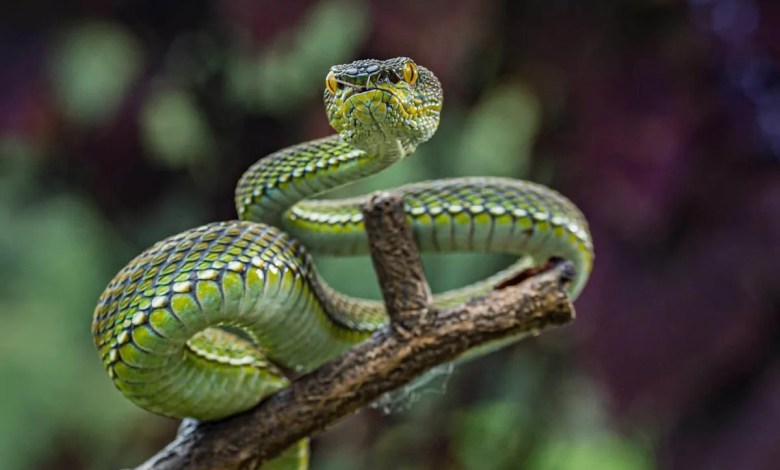
It seems that even the most experienced scientist can overlook a new species, because this newly classified viper was assumed to be a common species already known. It was only after scientists carried out a DNA analysis of one specimen that they discovered an entirely new species of viper. Named after an ancient Chinese philosopher, the snake features a bright green color and striking sexual dimorphism (differences between males and females) in terms of eye color and scale markings.
Pit Viper Background

The name Pit Viper represents at least over 100 distinct species of venomous snakes.
©Agus_Gatam/Shutterstock.com
The viper refers to a subfamily of vipers that live in Asia and the Americas. They get their name from a pair of heat-sensing organs located in a hollow between their eyes and nostrils. Vipers belong to at least 155 species, all of them venomous. While some, like the hump-nosed viper, are only about a foot and a half long, the bushmaster viper can reach up to twelve feet in length. Since vipers include a wide range of species, from Asian variations to North American rattlesnake species, the classification is quite diverse.
That being said, all vipers contain this unique pit between the eyes and nostrils, which contains a finely tuned infrared sensing organ. This organ gives them a remarkable ability to detect prey. Another feature that sets vipers apart is a specialized muscle between their venom gland and a bone in their skull called the ectopterygoid. Contraction of this muscle allows vipers to inject venom.
Right under their noses
With the abundance of viper species, it is not entirely surprising that at least one species has gone unnoticed. Scientists recently discovered a new viper from Sichuan province: Trimeresurus lior the Huaxi green viper. Researchers were carrying out field work around tropical western China to study wildlife when they encountered a green snake. At first they thought it was just another common species. Upon closer inspection, researchers from the Chengdu Institute of Biology and the Giant Panda National Park realized that they had an entirely new species on their hands.
The snake’s physical characteristics, including the smooth head scales, were enough to require more detailed DNA testing, which proved that the snake was actually a distinct species. Researchers named it Trimeresurus lia tribute to Li Er or Laozi, the ancient Chinese philosopher. As researcher Bo Cai explains to Science Daily, “his teachings emphasize harmonious coexistence between humans and nature, a principle that aligns perfectly with the conservation mission of Giant Panda National Park where this species was discovered.” »
The snake had gone unnoticed for decades, or at most, confused with the bamboo viper, which also has a green coloring. Now scientists can safely say that the green snake they found is distinct. In fact, it is the 58th species of the Trimeresurus genus and the second of its subgenus in Sichuan.
Curious features

Researchers found that female Huaxi green vipers have a single yellow stripe that runs down the sides of their bodies.
©Pepew Fegley/Shutterstock.com
The researchers published their results in the journal Zoosystematics and evolutionhighlighting the unique characteristics that distinguish the Huaxi green viper. On the one hand, this species exhibits distinct sexual dimorphism. Males have a red and white stripe down the sides of their body and amber-colored eyes, while females have a single yellow stripe and more orange-yellow eyes. These pit vipers grow to around 30 inches in length and are typically found in the forests of Mt. Emei and Xiling Snow Mountain. Like other vipers, they are venomous.
Biodiversity gold mine
The chance discovery of a new species of snake by researchers in the rainy zone of western China highlights the diversity of species present in the region. Humid and filled with jungles, the region is a hotbed of biodiversity, largely understudied. Indeed, many species in this region remain poorly known, or even completely unknown to scientists.
The team behind the discovery made this point when speaking to Science Daily. They said: “This discovery highlights the importance of continuing field studies in biodiversity hotspots. » Since the team mistook a new species of viper for a common snake, it is unclear how many unique creatures live in the rain zone and have gone unnoticed and overlooked.
The post Sichuan Mists Reveal Vibrant New Viper Species Hidden for Decades appeared first on AZ Animals.

:max_bytes(150000):strip_icc()/Health-GettyImages-2206163700-9368cd4c43394e21bca39e83da7dbb18.jpg?w=390&resize=390,220&ssl=1 "8 High-Protein Snacks Our Health Editors Reach For When They Need To Fuel")


