The Oil Era Is Ending


Environment
/
May 21, 2026
Does the war in Iran sound the death knell for American oil hegemony?
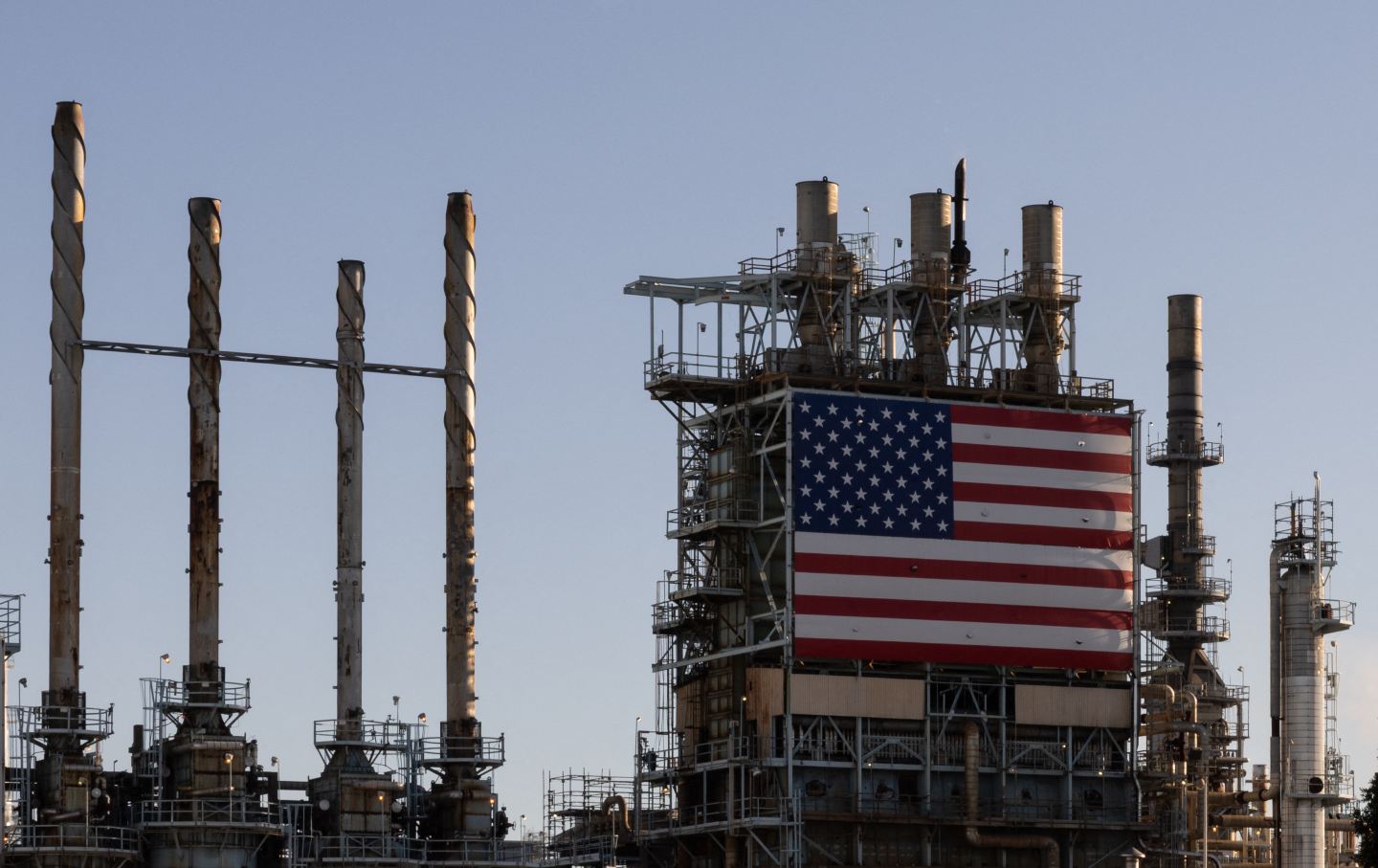
The ConocoPhillips oil refinery is seen in Wilmington, California on April 11, 2026.
(Étienne Laurent / AFP / Getty Images)
“Future historians may well view the Iran War as the moment when the United States unwittingly ceded its leadership to China” as the world’s superpower, writes Jonathan Watts in an essay published in The guardian released earlier this week. The article came out just after Donald Trump left Beijing following his summit with Chinese President Xi Jinping.
Analysts in Washington have debated for decades what to do about China’s rise as a global power, but the debate has focused on questions of economic strength and military might. Watts, who spent years in China as a correspondent for The guardian and is now the journal’s global environment editor, his focus instead is on energy: the life force that drives these economies and militaries. “One of the cornerstones of geostrategic thinking since the start of the industrial revolution 250 years ago is that the country that controls the energy supply controls the world,” he emphasizes. “For most of the last century, it was focused on oil. »
But the age of oil is coming to an end, Watts says, as the global economy “shifts from molecules to electrons” – or from burning oil, gas and coal to producing solar, wind and other forms of renewable energy. The implications are profound, particularly regarding the chances of limiting global temperature rise to a sustainable level.
Watts presents his argument across a broad intellectual canvas, from Britain’s opium wars with China in the 1850s to the gargantuan short-term riches that oil companies gobble up as the Strait of Hormuz remains blocked to the plummeting costs of clean energy, all of which illustrate that the struggle to preserve a livable planet cannot be understood outside of its social contexts. For journalists, this essay is a reminder that the stories we report, for example on the war in Iran or extreme weather events fueled by climate change, do not occur in isolation. They are part of a larger narrative, one that makes them all the more interesting as news.
The heart of Watt’s argument is that history demonstrates that when “humanity exploits new sources of energy, new empires rise and old ones fall.” Today, “Beijing’s bet on renewable energy and electric vehicles over the past two decades is paying huge dividends… buffer[ing] its economy from shocks to gas prices caused by the Middle East conflict, while opening up huge new export markets for solar panels, wind turbines, smart grids and electric vehicles. China’s clean energy sector is now worth a whopping $2.2 trillion, more than all but seven of the world’s economies.
Yes, Watts notes, China still burns more coal than any other country. But its embrace of renewable energy (China has more wind turbines than the next 18 countries combined) means its annual greenhouse gas emissions have remained stable, or even falling, over the past two years. Just as important, he says, is the fact that “the scale of its renewable industry means Beijing has a growing stake in the success of global climate negotiations. Not just because it’s good for the planet, but because it makes perfect business sense.”
Current number

Meanwhile, Trump is determined to revive the fossil fuels that fueled America’s rise to power in the 20th century.th century. The United States’ possession of vast oil reserves was one of the main reasons why it emerged from World War II not only victorious, but incomparably more powerful than its rivals in Europe and Asia. This oil also enabled the postwar construction of suburbs, interstate highways, and car culture that fueled the greatest economic boom in history, cementing U.S. global supremacy.
But things have changed. Solar and wind technologies now generate “the cheapest electricity in history,” according to the International Energy Agency, and economies of scale and technological learning curves make it ever cheaper. Watts is not alone in arguing that the war in Iran has put another nail in oil’s coffin. IEA Executive Director Fatih Birol recently said that price spikes and supply disruptions resulting from the war have forever changed countries’ risk calculus, permanently turning them away from oil and gas and toward safer, cheaper renewable energy.
China’s intentions are not necessarily “more benign” than those of other empires, Watts warns, and “oil interests always have political, military and financial power on their side, and they are using it to try to turn back the clock on the energy clock.” On the other hand, the devastating impacts of climate change are increasingly evident; Clean energy is “the fastest-growing, most job-creating part of the global economy” and “across the world, a vast majority of people want their governments to take stronger action on the climate crisis,” as CCNow’s 89% Project reports.
However it plays out, it’s a very dramatic story, with immense stakes and an abundance of villains and heroes. In other words, a great story, both for journalists and for the public we serve.
From the illegal war against Iran to the inhumane fuel blockade against Cuba, from AI weapons to crypto corruption, we live in a time of staggering chaos, cruelty and violence.
Unlike other publications that reproduce the opinions of authoritarians, billionaires and corporations, The nation publishes stories that hold the powerful accountable and center communities too often denied voice in national media – stories like the one you just read.
Every day, our journalism weeds out lies and distortions, contextualizes developments that are reshaping politics around the world, and advances progressive ideas that fuel our movements and incite change in the halls of power.
This independent journalism is only possible with the support of our readers. If you would like more urgent coverage like this, please donate to The nation Today.


