The Olympic wit and wisdom of an African skeleton racer : NPR

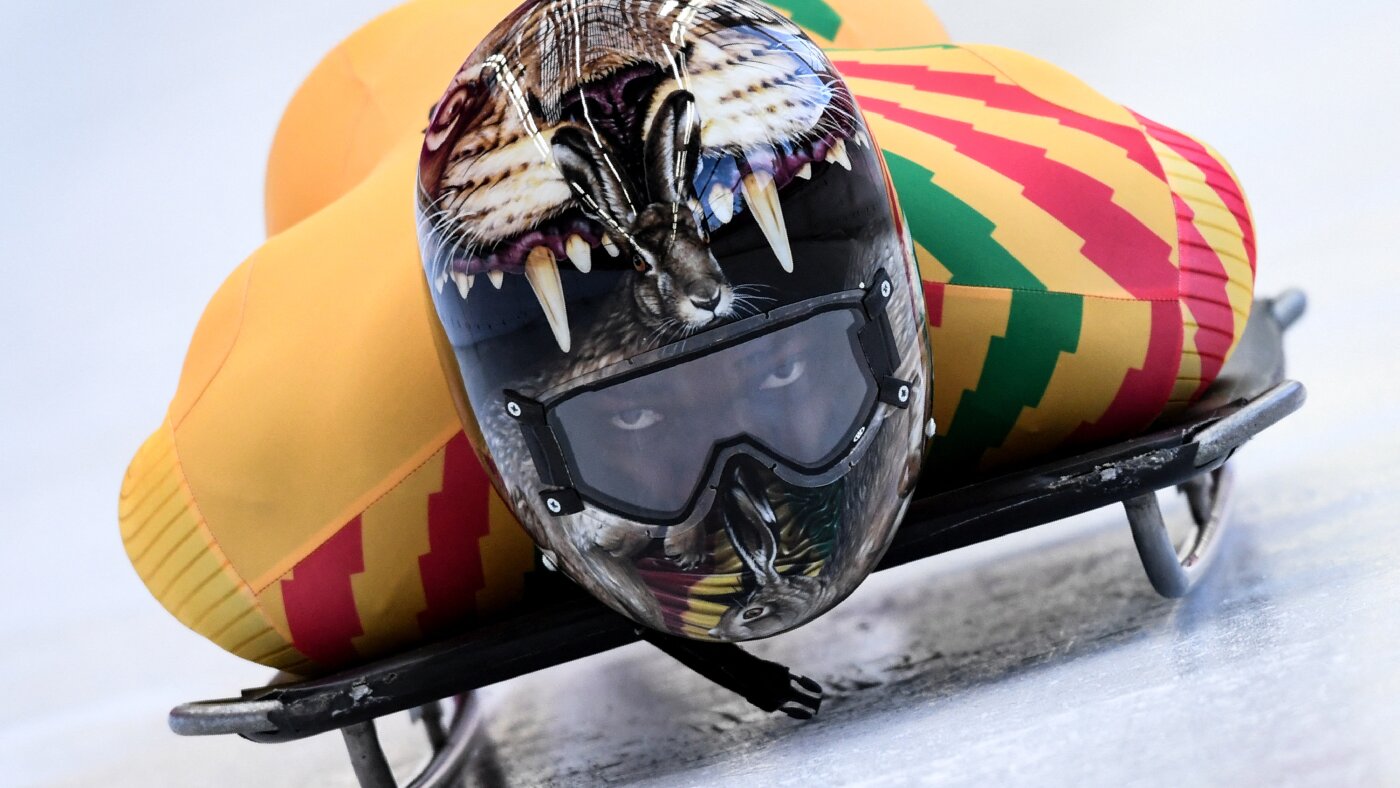

Akwasi Frimpong of Ghana takes part in a training session for the men’s skeleton event at the 2018 Olympic Games.
Kirill KudryavtsevAFP/via Getty Images
hide caption
toggle caption
Kirill KudryavtsevAFP/via Getty Images
For those unfamiliar with the sport of skeleton, where the lone luger lies face down, head first, Akwasi Frimpong sums it up: “You’re on a cookie sheet sled and it’s like ‘dude, good luck.’
Skeleton was actually the third sport Frimpong pursued to achieve his dream of becoming an Olympian.
Born in Ghana, Frimpong moved to the Netherlands at the age of 8 as an undocumented immigrant. He eventually obtained Dutch citizenship. He also learned about athletics in the Netherlands, then bobsleigh, then skeleton. In 2018, he became the first black African skeleton racer to compete in the Olympics. (The same year, Simidele Adeagbo became the first black African female skeleton athlete at the Olympics, competing as part of the Nigerian team.)
NPR spoke with Frimpong about the challenges of being an African athlete in a predominantly white sport, called his foundation The hope of a billion and why not qualifying for the Olympics this year may have saved his life.

Akwasi Frimpong from Ghana moved from sprinting to bobsleigh to skeleton. reacts in the finish zone during the men’s skeleton heats at the Olympic Sliding Center on February 16, 2018 in Pyeongchang-gun, South Korea. (
Richard Heathcote/Getty Images
hide caption
toggle caption
Richard Heathcote/Getty Images
This interview has been edited for length and clarity.
On being a bobsleigh brakeman: “The guy who makes sure at the end he breaks so no one dies”
Can you tell me a little about your journey into the skeleton? How does someone from Ghana get into this sport?
When I was 15, I was recruited into track and field by a coach who had competed in the Summer Olympics twice. He truly believed that one day I could become an Olympian. [in sprinting]. And because he believed in me, I started believing in myself and worked hard to achieve my dream of going to the Summer Olympics.
I made it as far as being part of the Netherlands’ pre-Olympic 4×100 meter relay team for the 2012 London Olympics, but due to a tendon injury I was unable to qualify for the final team.
After that, I was recruited by the Dutch bobsleigh team because of my sprinting speed, to become a brakeman – the guy who makes sure that at the end he breaks so that no one dies. I was the second alternate for the Sochi 2014 Olympics, which meant I had to wait at home to find out if anyone was injured. Luckily, no one did, which also meant that, for the second time, my dream didn’t come true.
That must have been disappointing. What did you do next?
I finished university. But I didn’t find a job right away, so I went to sell Kirby vacuum cleaners door to door. After a few years, I remember in the summer of 2015, my wife looked at me and said “something isn’t bothering you” and I was like, “I still have this thing on my to-do list, besides being married to you – you should remember to tell your wife.” And she said, “Akwasi, I don’t want you to be 99 years old and still complaining about your Olympic dream.”
I was then recruited to try skeleton head first. At first I was like, “Hell, no, no, please.” The bobsleigh was already crazy. Long story short, I tried Skeleton. At first it was like, “Oh my God, this is scary.” But as I descended, I wanted to get back to the top and do it again.
Why did you decide to compete for Ghana rather than the Netherlands?
My “why” had to be bigger than me. I could compete for the Netherlands, where I would get more resources, more support, but I decided to compete for Ghana to do something that had never been done before, to really teach people to step out of their comfort zone.
I wanted to represent the 30 million people in my country, sending a message home about what is possible when you work hard, believe in yourself and never give up.
Has this decision affected the ease of training?
We don’t have our own skeleton track in Ghana and I don’t have as easy access to Western tracks as a Ghanaian athlete. There are only 17 titles [for bobsled and skeleton] around the world, so there was a lot of traveling to do. I trained in Utah, but have also traveled to Lake Placid, Canada, Europe and Asia for additional training.
On what it takes to do skeleton: “Fear is a big part of it, you have to learn to accept it.”
How do you train for skeleton? I imagine it’s different from track and even bobsleigh?
Being a fast sprinter helps, [because of the running start] and I did a lot of sprint training. But there are still so many skills and techniques to learn, even just for getting started. After that, you’re on a cookie sled and it’s like “dude, good luck.”
Fear is a big part of it, you have to learn to accept it.
What was it like going into a sport dominated by wealthier, whiter countries?
At first, people definitely look at you a little differently – big eyes and like “oh my God, where are you from, what are you doing here?”
The athletes really like you when you come because they say “oh there’s a kid from Africa I can beat” until you start beating them. Then the dynamic changes a little. But it’s a great community, that’s for sure.
You ended up qualifying and competing in the 2018 Games. What was that like?
A dream come true. Being the first black man from Africa to compete in skeleton, representing 1.4 billion people, was like gold.
I was also very proud to wave my country’s flag and send a message to all the children who go barefoot or anyone who thinks they have nothing to do for themselves, to hopefully inspire and empower them.
The reception has been incredible all over the world, not just in Africa. We have received messages from people wanting to try the sport, from Mexico, Malaysia, Nigeria, Togo and Ivory Coast.
You continued to run even after the games. What motivated you?
I never wanted to be the African athlete who just made the headlines, I wanted to be competitive. After 2018, I knew I could improve, but I needed resources and support to improve. Funding was a difficult thing to do, finding new sponsors, new partners. You have a family, a mortgage, it’s expensive.
But I succeeded in this sport. That doesn’t mean you’ll always be at the Olympics, but I’ve been to five World Championships, I’ve become the first African to win an elite skeleton race in Park City, Utah.
You ultimately couldn’t qualify for the 2026 Games. What happened?
I feel like I did really well in terms of execution and sliding, but unfortunately it wasn’t good enough to get there. This was partly due to an equipment challenge, but the sport is also becoming more competitive.
Fast forward a few weeks later, and [I] I realized maybe it was for a good reason. I just had surgery last week for a ruptured appendix. The pain started on February 6 [the day of] the opening ceremony. If I had been in Italy, I probably would have ignored the pain and might not have been here to talk right now.
On being selfless: “When you can help a child find your passion, they move through the world differently.”
What’s next?
My wife and I have a foundation, called the Hope of a Billion Foundation. We travel the world teaching children resilience and cultivating their inherent power to pursue their goals and dreams. We go to schools and teach them the principles I learned about pursuing my goals and dreams. You know, believe in yourself, work hard, never give up.
It’s really, really about helping these kids show that they have something special in them and helping them find their passion. When you can help a child find their passion, they move through the world differently. They present themselves differently at school. They wake up a little earlier. They do totally different things.
Are you hanging up the sled now?
I turned 40 a few days ago, it was my last hurray. Maybe I’ll take my sled every once in a while for fun, but I’m at peace with that. Now I hope to mentor, coach and help others in countries that are underrepresented in this sport. I’m not done getting involved in inspiration.


