There Will Be No Post-Presidential Peace for Donald Trump


There is an ideal recent precedent for such a case: last year, former Philippine President Rodrigo Duterte was arrested by the Philippine government and transferred to The Hague. Duterte had publicly bragged about personally killing drug suspects while mayor of Davao City and overseeing other extrajudicial killings during his presidential term in the 2010s. His trial is expected to begin later this year.
It is not surprising that, given the Trump administration’s apparent opposition to the very concept of international law, it has been extremely hostile toward the ICC, even by American standards. Trump first imposed a broad range of financial sanctions against the court, its judges and prosecutors last February. The sanctions, which are typically reserved for rogue nations and terrorist groups, have effectively cut off ICC employees from much of the global financial system and many digital goods and services. Targeted judges can’t even have Gmail accounts or conduct basic financial transactions with major banks.
The purported reasons for the sanctions were the court’s past investigations into US military actions in Afghanistan – the brief investigation ended in 2021 – as well as the ICC’s investigations into Netanyahu’s government, which is closely allied with the Trump administration. But the Trump administration wants to do without multinational courts for a deeper reason: they clash with its vision of a power that operates solely through brute force.
“We live in a world in which you can talk all you want about international niceties and everything else,” Stephen Miller, a top Trump adviser, proclaimed in a January interview with CNN’s Jake Tapper, “but we live in a world – in the real world, Jake – that is ruled by force, that is ruled by force, that is ruled by power. These are the iron laws of the world that have existed since the dawn of time.”
This reasoning also applies to countries that wish to respect international law. Even if Trump administration officials avoid ICC scrutiny, they could still face prosecution from foreign governments. In most countries, courts and prosecutors are bound by their jurisdiction: they can only charge and try defendants for offenses committed within their territory. However, under international law, some offenses are considered so serious that they can be prosecuted by any country.
This concept, known as “universal jurisdiction,” could make post-presidential life difficult for Trump and his associates if other countries are willing to use it. German prosecutors, for example, successfully brought charges against participants in Syria’s destructive decade-long civil war. In 2022, after hearing testimonies from dozens of survivors, a German court convicted two former Syrian intelligence agents of crimes against humanity for their role in overseeing the Bashar Al Assad regime’s torture camps. One of the accused was sentenced to life imprisonment and the other to four and a half years in prison.
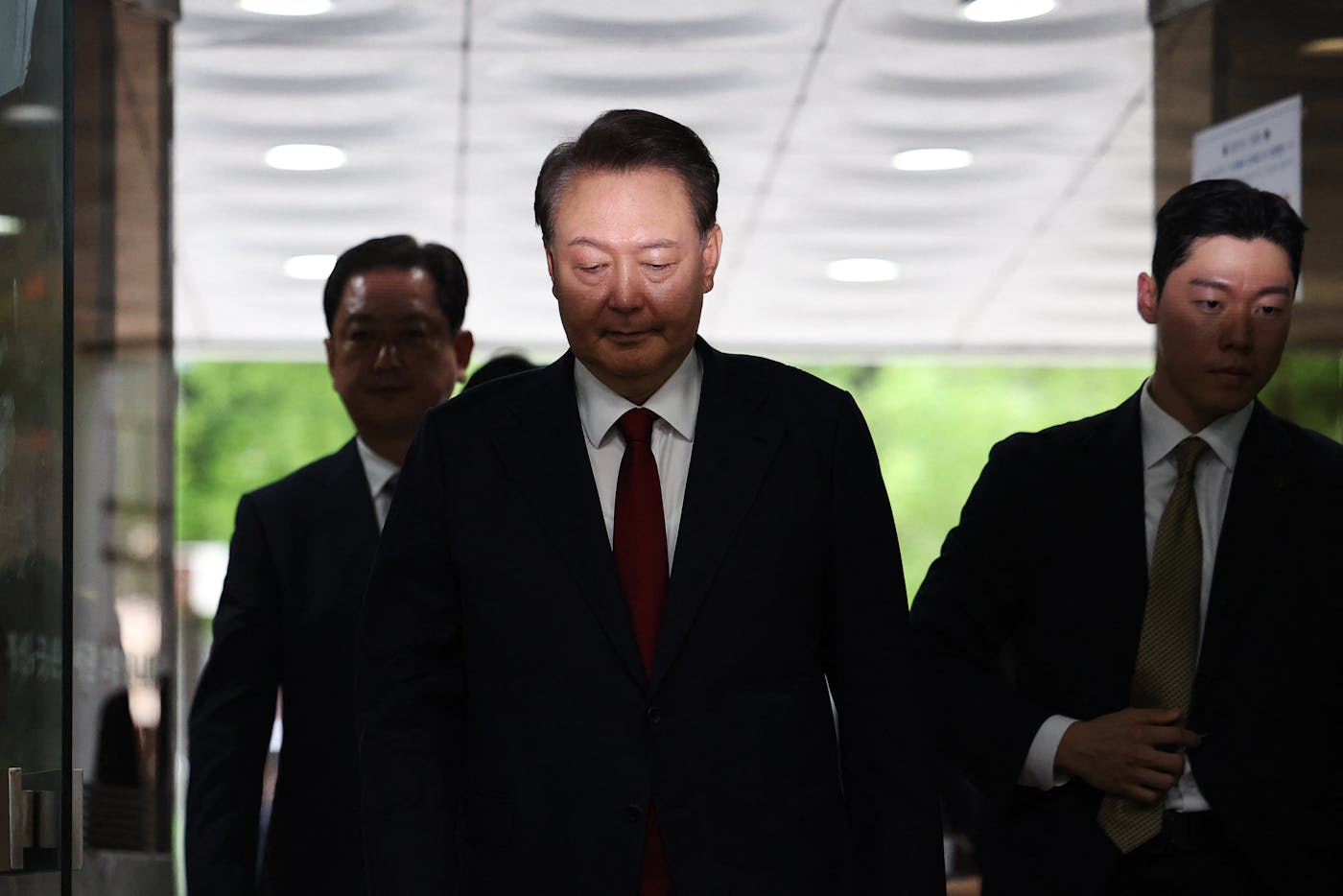
In December 2024, South Korean President Yoon Suk-yeol was impeached for attempting to impose martial law in the country. In February this year, the Seoul Central District Court sentenced him to life in prison for insurrection and related charges. He is pictured in July 2025, arriving at a Seoul court to attend a hearing on his arrest warrant.
KIM HONG-JI/POOL/AFP/GETTY
Even the threat of legal action abroad could have a chilling effect on Trump administration officials. A post-presidential Trump might be more reluctant to visit his golf course in Scotland or his seaside resort in Ireland if he fears the British or Irish governments will arrest him and transfer him to The Hague. (A 2002 law prohibits the federal government itself from extraditing Americans to ICC custody.)
Trumbull warned that prosecutions under international law can often face a significant time lag. “Quite often, accountability for international crimes takes a long time to materialize,” he stressed. “We will see prosecutions for crimes committed 10 or 20 years ago. So the fact that there may not be accountability in the next few years doesn’t mean there won’t be accountability later.” In short, what Trump administration officials do over the next three years could haunt them for the rest of their lives.
The accountability of politicians can be a changing concept. Impeachment is the appropriate tool for this. When the framers wrote the Constitution, they deliberated over how to properly structure it in a truly republican society. They knew that impeachments in Britain were often long, complicated affairs – the indictment, trial and eventual acquittal of colonial official Warren Hastings for alleged abuses in India lasted from 1788 to 1795 – and had much higher stakes. Had Hastings been found guilty, the House of Lords could have ordered his imprisonment.
American impeachments are less punitive and more direct. Any federal official can be indicted for “treason, corruption or other high crimes and misdemeanors”. This last sentence is as broad as Congress wants it to be. “They are of a nature which may justly be described as POLITICAL,” wrote Alexander Hamilton in Federalist No. 65, “because they mainly concern the damage caused immediately to society itself. Or, as Gerald Ford once said in more modern language: “An impeachable offense is whatever a majority of the House of Representatives considers to be at any given time in history.” »
While accountability mechanisms are important, the spirit that drives them is just as vital. A prison cell may not wait for Trump. But after four more years of tainting the republic, there will be no post-presidential peace for him or his top aides. There will be no light vacation in Europe, for fear of a trial beyond the reach of the Supreme Court. There will be no side job at a university or quiet retirement on a farm or ranch. There will be investigations. There will be depositions. There will be hearings. There will be such other measure of legal justice as can be provided. The fears Trump expressed at the Kennedy Center in January were well-founded. Dictatorships are always more fragile than they appear. On the contrary, the president profoundly underestimated his legal and political peril.

