These drones drop burning balls in the forest to control wildfires


On the fourth July, in the midst of a cacophony of fireworks and propane gates launched by the flame, an apparently ordinary shot of lightning struck somewhere in the Grand Canyon National Park. The resulting spark triggered the surrounding dry vegetation and the strong winds quickly distribute the flames over kilometers. In several weeks, this initial spark has become a fire swallowing more than 100,000 acres, officially classifying it as a “megafire” and the largest forest fire of 2025 … so far. To date, “The Dragon Bravo Fire” has already destroyed 70 buildings, including the great historic canyon lodge.
It is impossible to completely prevent forest fires like this, but one of the most effective mitigation strategies is also one of the oldest. For centuries, firefighters from around the world have used controlled burns, sometimes called fire prescribed, to eliminate the preventive from the leaves, dead branches and other dry materials that can be used as fuel fuel on the rail of unleashed forest fires. The elimination of this fuel goes the idea, should help prevent forest fire from becoming even greater and more dangerous.
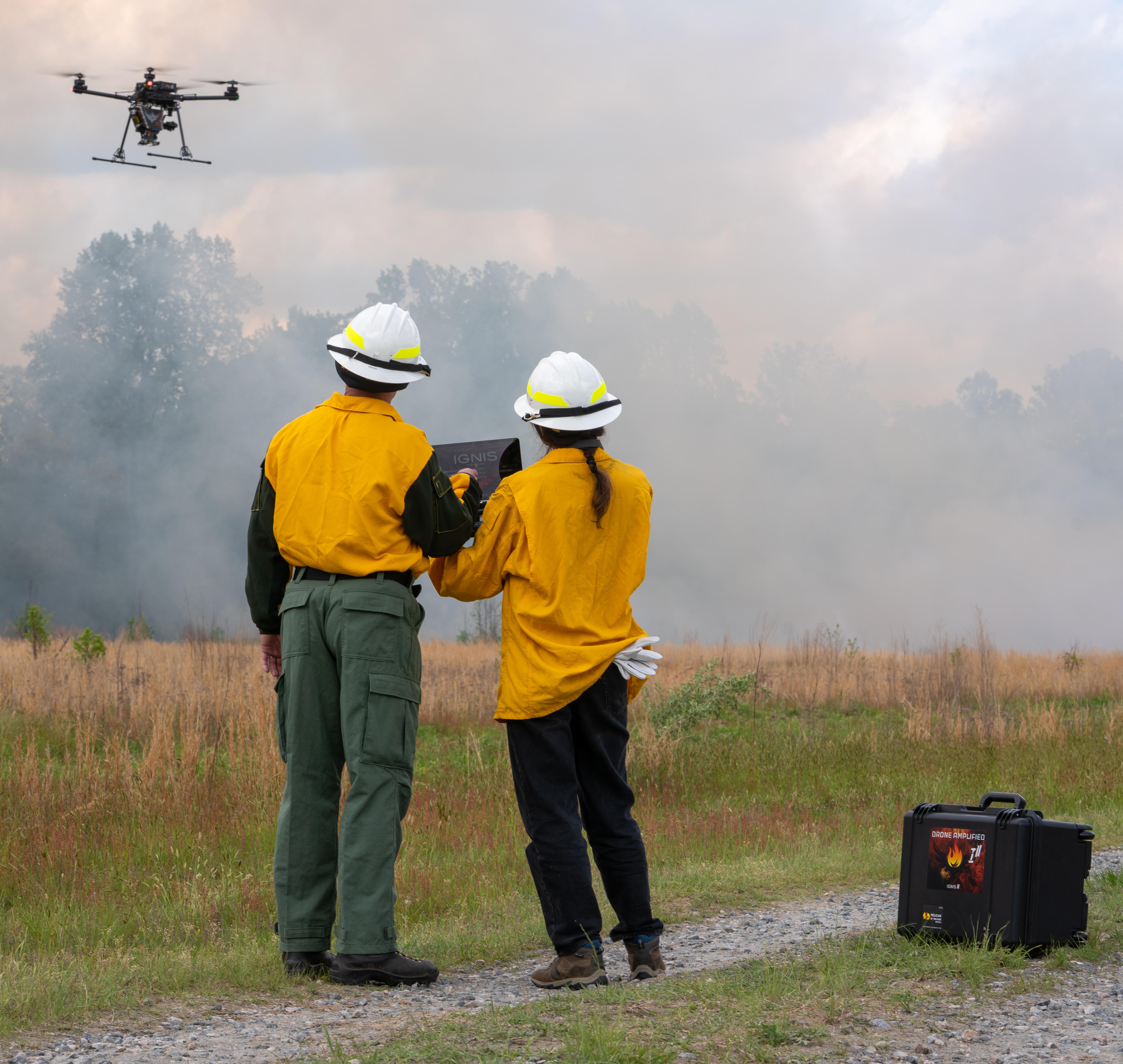
Increasingly, these controlled burns are not initiated by people on the ground or from aircraft managed above the head, but by small quadcopter drones carrying hundreds of “dragon eggs” the size of a ping-pong ball. These combustible eggs cause small lights, traceable and content when they are released.
Drone Amplified, a startup based in Nebraska, launched this system, which he called “Ignis” in 2017 with the contribution of the American department of the interior and the US Forest Service. Now, eight years later, the vice-president of business development of drone amplified dan justa said Popular science That company drones are currently operating more than 200 systems in at least 30 US states, as well as Canada, Germany and Australia.
“This [system] Allows you to cover a huge amount of terrain and set fire to your eyes for a consciousness of the situation during forest fires, “said Justa.” This also allows you to fly at night. “”
Go from Recon to the intervention
Firefighters have been using drones for a certain measure for more than a decade. Around 2011, state and federal agencies began to deploy drones equipped with cameras to capture photos and videos, either for early surveillance, or to assess damage after a forest fire. From the start, unmanned small drones were considered to be more affordable alternatives to helicopters for the monitoring of fauna and data collection in real time. Their compact size also allows them to access areas that can be inaccessible by larger and piloted planes.
The Western Fire Chiefs Association estimates that around 200 fire services across the United States used drones by 2018. This number has tripled in just two years. The amplified drone represents a more recent change towards the use of these drones for the active attenuation of forest fires, moving a step beyond the basic surveillance and documentation. Drone -focused drone companies have also increased after the adoption of a 2019 bipartite bill which encouraged greater use of drones by federal agencies in forest fire management operations.
“One of our northern stars does nice things with drones that have an impact on the world rather than simple images,” said Justa. “Many drones are just cameras or flying sensors.”
Fight fire with fire
The IGNIS amplified IGNIS system, which has gestation of the research carried out by a pair of professors from the University of Nebraska – Lincoln, consists of four main subsystems. According to Justa, the drone itself is a strongly modified version of the Alta X model of American manufacturing freefly. Attached is a large hopper which contains up to 450 (or around 13 pounds) of “Dragon Egg” balls. These small plastic spheres are filled with potassium permanganate. During a controlled burn, each ball is deposited in a separate puncture mechanism where it is injected with glycol ethylene, a compound commonly found in the antifreeze. The resulting chemical reaction produces a regular, relatively cool and controlled flame.
Once pierced, dragon eggs take around 30 to 45 seconds to light, during which they are launched from the drone to their preprogrammed targets. This process can be repeated up to 120 times per minute until the hopper is empty. Firefighters can adjust the number of eggs abandoned depending on the desired intensity of the burn. Each payload is also scheduled to release incendiary balls only in a specific geographic area.
The firefighters control the drone using a companion application. The drone is equipped with thermal cameras, allowing operators to see targets clearly even in smoke conditions and to monitor the progress of the burns prescribed once they have started. According to Justa, the drone, its support software and the necessary training combined cost around $ 100,000.

It looks like a lot of money, but it is often a more affordable option than deploying a helicopter with a full team of firefighters. It is also more sure. Drones are not affected by smoke inhalation or the risk of carbon monoxide poisoning, allowing them to operate in more dangerous environments. There is also the additional advantage that crushes a drone, although expensive, does not put life in danger. The CDC estimates that around 25% of all the deaths of fire fighting is linked to aviation.
“It is extremely dangerous to control helicopters on forest fires because you have thermal, you have smoke, you can’t see anything,” said Justa. “The drones you can put anywhere.”
All this gives firefighters equipped with greater capacity and flexibility of drones to make prescribed burns, tools that can make a significant difference. A study in 2024 published in the Ecology and forest management found that the prescribed combustion, when combined with slimming trees, has reduced the severity of forest fires by more than 60% compared to areas which have not received a similar treatment.
Make sure that dragon eggs are used for good
But there is also the concern to ensure that a drone capable of starting a forest fire only does it where it is supposed to do it. To this end, just said that the company has designed its system with integrated safety and mitigation tools from zero. While the pilots are free to navigate the drone as needed, the hopper only exempts the dragon eggs in a predetermined and geofized area – the designated controlled burn area. The sensors on board can detect if the drone or its payload undergoes damage. If this happens, the system automatically deactivates the drop-down mechanism and triggers a small fire at low temperature designed to burn safely.
And as for the risk that hackers have access to the device and use it to wreak havoc, just said that drones attenuate the risk using radio encryption. He also underlines that anyone determined to start a forest fire almost certainly has easier methods available to them. Buying a pack of cigarettes in a service station is much cheaper and simpler than hacking a drone.
Although its most notable impacts have so far been in the management of forest fires, the breathtaking mechanism of Drone Amplified is not limited to the distribution of dragon eggs. Last month, the company joined the American Bird Conservancy to drop dozens of biodegradable and cultivated laboratory mosquitoes on Hawaiian forests in order to limit the population of invasive mosquitoes in the region, which is a serious threat to certain species of native birds. Justa said Popular science that the company also works with the Alaska Ministry of Transport to deploy controlled explosive costs to trigger managed avalanches.

More offers, reviews and purchasing guides


