These Martian Caves Might Point to Life



Explore
CConditions on Mars make it quite inhospitable to life. Temperatures can drop below minus 100 degrees Fahrenheit, high-energy UV rays shake the planet, and “dust devils” can strafe the surface with 99 mile-per-hour winds. So if creatures live on the Red Planet, or have ever lived there, it would be best for them to shelter in caves.
Now, Chinese and Italian scientists say they have discovered a new category of Martian caves formed by liquid water dissolving rocks. The majority of caves discovered on Mars were formed by volcanic or tectonic processes. But these potential new formations, called karst caves, have different origins. And since their formation may have involved water in its liquid form, they could serve as targets to search for traces of life.
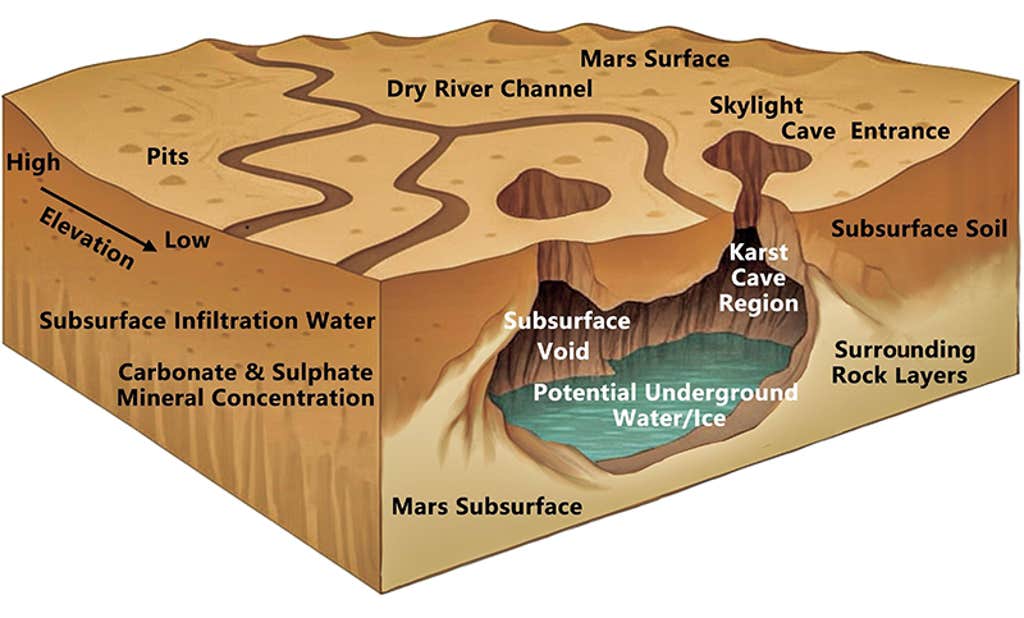
There are also karst caves on Earth, where slightly acidic groundwater breaks down soluble rocks such as gypsum or limestone. This creates fractures that can expand into caves. On Mars, ancient water flows may have dissolved sulfate- and carbonate-rich rocks on the planet’s crust to form the newly discovered caves.
ADVERTISEMENT
Nautilus members enjoy an ad-free experience. Log in or register now.
Researchers have spotted holes called skylights that could lead to karst caves on Mars, in the Hebrus Valles region of the planet. This area contains scars from ancient floods – a phenomenon believed to have occurred throughout the Red Planet – such as troughs and channels. NASA spacecraft, including Mars Global Surveyor and Mars Odyssey, have collected detailed analyzes and images in this fascinating region.
Read more: »The race to colonize Mars perpetuates a dangerous religion»
Armed with this information, scientists took a closer look at eight pits in Hebrus Valles. They found that, unlike impact craters, these are deep, mostly circular depressions. They also noticed that the rocks surrounding these pits contain a lot of carbonates and sulfates, highly soluble minerals. They recently published their findings in Letters from the astrophysical journal.
“These skylights represent promising subterranean refuges,” the authors wrote, suggesting that future visits by robotic and human missions could encounter hints of past aquatic activity and even preserved signs of life. Additionally, notes a press release, they could give astronauts a place to rest their heads and escape the harsh Martian climate.
ADVERTISEMENT
Nautilus members enjoy an ad-free experience. Log in or register now.
Enjoy Nautilus? Subscribe for free to our newsletter.
Main image: ESA and MPS for the OSIRIS MPS/UPD/LAM/IAA/RSSD/INTA/UPM/DASP/IDA team


