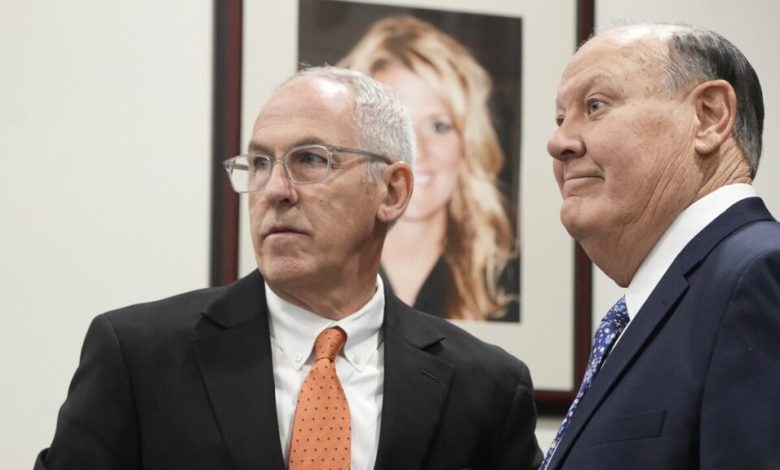
Defendants Michael Dowling and Chuck Jones wait for the start of their trial in Summit County Court of Common Pleas Judge Susan Baker Ross’s courtroom on Feb. 3, 2026. (Photo by Mike Cardew- Pool/Akron Beacon Journal)
During opening statements on Tuesday, tensions ran high as the state argued that utility giant FirstEnergy’s former executives defrauded Ohioans by bribing a public official to help their struggling company. The defense is blaming a dead man for any wrongdoing.
In a packed courtroom in Summit County, jurors were told the next six weeks would unfold like a movie.
“It’s about greed,” Assistant Attorney General Matthew Meyer said. “It’s about corporate greed, and it’s about personal greed.”
Former FirstEnergy CEO Chuck Jones and Vice President Michael Dowling allegedly paid former Public Utilities Commission of Ohio (PUCO) Chair Sam Randazzo $4.3 million in bribes, along with $61 million spent to create and pass Ohio House Bill 6. H.B. 6 was legislation to provide a billion-dollar bailout.
Back in 2019, former Ohio House Speaker Larry Householder took that $61 million bribe in exchange for H.B. 6, all at the expense of the taxpayers.
Jones and Dowling face nearly a dozen state charges each, ranging from bribery to corrupt activity. In January 2025, a federal grand jury indicted them for racketeering.
In March 2023, a jury found that Householder and former GOP leader Matt Borges participated in the racketeering scheme that left four men guilty and one dead. Neil Clark, a lobbyist accused of bribery, died by suicide after pleading not guilty in 2021. Householder has been in prison for two years, while Borges is out after serving half of his five-year sentence.
“What does $4,333,333 buy you from the man who’s about to become the most powerful regulator in the state of Ohio, the man in charge of an organization, a government organization, that can make or break your business?” Meyer asked the jury. “It turns out — a lot.”
The state argued that the men should be convicted of a slew of charges, including bribery, as they paid to play, paying off the top regulator so FirstEnergy could raise its prices.
“The reason they rigged the game is to juice the stock price,” he said.
Jones and Dowling were “smart” and methodical, Meyer added. They knew exactly what they were doing and understood the risks. Risking illegal behavior was warranted for the men because they were “obsessed” with the stock price, the state said.
More than 85% of Jones’ compensation came from the company’s stock price.
Although the pair originally attempted to lobby both Gov. Mike DeWine and then-Lt. Gov. Jon Husted for a different PUCO chair; they learned that the team favored Randazzo.
“Plan B was ‘Plan Bribe,’” Meyer said. “They bought people, and that’s what the evidence is going to show, when they needed something from a person — they bought the person.”
Randazzo’s price was $4.3 million, he said.
“Mr. Jones and Mr. Dowling knew that that train was leaving the station, and the ticket they paid was $4,333,333 to make sure that they had a seat on the train,” Meyer said. “An ‘I owe you’ — or an ‘I own you.’”
One of the benefits that FirstEnergy received was not having to file a new rate case before the PUCO, due to the 2024 numbers. Meyer explained that the company was seemingly over-earning through their current electricity rates, and the PUCO would likely have ordered it to lower the costs.
Dead man’s fault
The defense started with a slip-up.
“There was a bribe here,” Dowling’s attorney Steven Grimes said. “Pardon me, there was not a bribe here.”
Randazzo was the corrupt one, not the defendants, both Grimes and Jones’ attorney Carole Rendon said.
Randazzo, facing dozens of charges in federal and state court, became the second defendant in this scheme to kill himself. He committed suicide in 2024, after his joint arraignment with Jones and Dowling, and after pleading not guilty.

Former Public Utilities of Ohio Chair Sam Randazzo. (Photo by WEWS.)
Before Randazzo was the top regulator, he was a consultant for clients who worked with FirstEnergy and wanted to get a better deal from them (he was a consultant for FirstEnergy, as well). Randazzo ran the books for the Industrial Energy Users-Ohio, a legitimate trade group.
The defense said that FirstEnergy was simply paying Randazzo settlement funds owed to IEU-Ohio clients, but he stole that money from them.
“He put 30 cents of every dollar of that in his pocket and stole it from his clients every month, every year, for over a decade,” Grimes said.
While it is true that Randazzo was a “thief,” both sides agreed, Meyer argued that the former chair was able to access this money by FirstEnergy’s “magic” consulting agreement, as he called it.
The sham document “designed to confuse and conceal” allowed for money to flow from FirstEnergy to Randazzo’s shell companies since it was a relatively blank document that no one had signed, the prosecution said.
“What’s a settlement where nobody knows exactly what the terms are, and it’s secret, and it’s concealed?” Meyer said. “The evidence is going to show that that document, because it was ‘magic,’ was whatever they needed it to be in the instant, whatever they needed it to be when people were asking questions.”
That’s not true, the defense argued. The money was never intended for Randazzo, Grimes said, and the men never knew about the alleged bribe.
“If they didn’t intend to pay him money, then it’s not a bribe,” Grimes said. “Asking him for stuff, not a bribe. That’s lobbying.”
Grimes made it known that Dowling and Jones never wanted Randazzo to be the chair. In an attempt to make an argument that they were above board and not bribing Randazzo, the attorney mentioned an anecdote of Dowling reaching out to then-Lt Gov. Jon Husted and telling him they wanted another candidate to be the PUCO chair.
In 2024, WEWS records requests showed that Husted was allegedly very close with Jones and Dowling, and helped lead FirstEnergy’s push for H.B. 6.
Rendon, in her opening, made it clear that the jury was to judge Jones and Dowling separately.
“Chuck Jones was not involved at all in the negotiations of that 2015 settlement agreement,” Rendon said, referencing the “magic” document.
As the new CEO, Jones couldn’t possibly be in all the meetings, finding out what the settlement was or authorizing it, she added.
“The state criticized how it was written, they criticized how it was executed, but he had no reason to question how that was done,” Rendon said. “He never saw it, and the state does not claim that he did.”
She added that some messages that will be shown in the trial were childish, but not evidence of bribery.
Meyer begged to differ.
“Chuck Jones texts Sam Randazzo, and he texts him, with a picture of the FirstEnergy stock price going up. And he says, ‘My mother taught me to say, thank you,’” Meyer said.
Unfortunately for the prosecution, jurors will not be made aware that FirstEnergy, as a company, has already admitted to this bribery.
All the way to the top?
For years, WEWS has gone back and forth with Gov. DeWine about his alleged involvement in the scheme.
Not only were texts discovered linking DeWine and FirstEnergy, but also that the administration had been wrapped up with Randazzo.
DeWine defended his top advisor, Laurel Dawson, after a criminal indictment alleged she knew about millions going to Randazzo from FirstEnergy right before he was appointed to power by the governor. She helped vet the former chair of the Public Utilities Commission, the supposed watchdog of utilities, after her family had already received a $10,000 loan from him.
The governor’s team insists she didn’t know the millions was a bribe payment.
In 2024, DeWine was asked why anyone should believe that he wasn’t involved with the corruption scheme or didn’t remember the conversations with executives.
He argued that his reputation should give people faith in him.
Now, DeWine is listed as a witness for the defense. WEWS asked him on Friday how he was preparing for the trial and if he was ready to testify.
“I have not been preparing for trial next week, but we’ll see if they want me to testify,” he responded.
Asked to elaborate, DeWine said he’s “got a lot to do as governor.”
“I’m pretty focused on that, as you can see, and so I’m going to stay focused on that,” he said.
He was asked if he was prepared to defend Chuck Jones in court.
“I’m not prepared to defend anybody,” the governor replied. “I’m prepared to — if they want me to testify and the court wants me to testify, I’ll go ahead and testify and tell whatever I remember.”
Follow WEWS statehouse reporter Morgan Trau on X and Facebook.
This article was originally published on News5Cleveland.com and is published in the Ohio Capital Journal under a content-sharing agreement. Unlike other OCJ articles, it is not available for free republication by other news outlets as it is owned by WEWS in Cleveland.
SUBSCRIBE: GET THE MORNING HEADLINES DELIVERED TO YOUR INBOX
SUPPORT: YOU MAKE OUR WORK POSSIBLE


