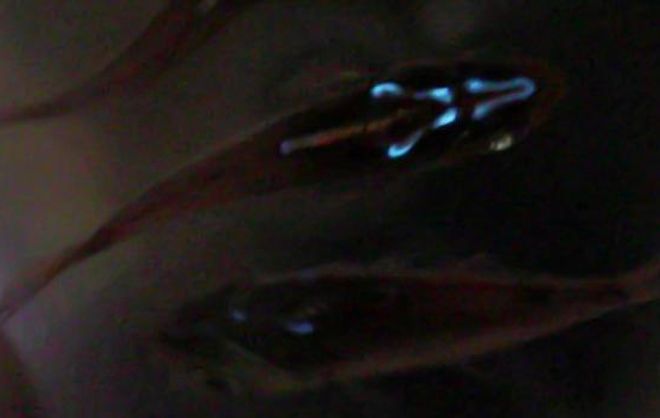
There are many examples of members of the animal kingdom stealing from each other, whether it be prey, shelter or nutrients. A species of fish – known as the golden sweeper – has added an unexpected new item to the list: the ability to glow.
New research, published in Scientific reportsconfirmed that the golden sweeper fish does not produce its own bioluminescence at all, but steals this ability from other organisms.
The discovery is the clearest evidence yet of a rare biological strategy called “kleptoproteinism,” and it could reshape the way scientists think about how life works at the genetic level.
A golden sweeper fish emits light using stolen bioluminescent proteins.
(Image credit: Government Park (Ocean Expo Park)/Okinawa Churaumi Aquarium)
What is kleptoproteinism?
In most living organisms, biological functions are tightly controlled by genes. If an animal glows, it is because its DNA codes the machinery that makes this possible. This principle constitutes one of the pillars of modern biology.
But the golden sweeper fish (Parapriacanthus ransonneti) breaks this form.
Instead of producing its own light-generating enzyme, known as luciferase, the fish acquires it directly from its prey. Specifically, it feeds on tiny bioluminescent crustaceans called ostracods or “marine fireflies” and reuses their luminous proteins for its own use.
This phenomenon falls under a broader category known as kleptobiology, in which organisms borrow useful biological components from others. But kleptoproteinism, in which organisms steal and use fully functional proteins, is particularly rare.
Learn more: Deer may leave bright scent marks to find a potential mate
How Scientists Identified Kleptoproteinism in Fish
For years, the research team was unsure whether the fish actually lacked the luciferase gene or had somehow acquired it through horizontal gene transfer. To resolve the question, scientists carried out high-resolution sequencing of the genome of P. Ransonetti with the aim of either finding the gene responsible for producing luciferase, or confirming that it wasn’t there at all.
After analyzing the fish’s genome, the researchers found no trace of luciferase genes or any evidence that genetic material had been transferred from its prey. In other words, the fish has no internal design for producing light.
“These results provide compelling and conclusive evidence that this fish does not have the genetic blueprint necessary for bioluminescence,” Manabu Bessho-Uehara, associate professor at Tohoku University, said in a press release. “Instead, it relies entirely on proteins obtained from its prey, representing a truly unique form of biological adaptation.”
To eliminate any risk of contamination, the team used live specimens initially collected by fishermen in Okinawa in July 2021. For 15 months, the fish were fed non-luminous foods, ensuring that any genetic material detected came only from the fish itself.
How this discovery could shape the future of medicine
This discovery opens new questions about how fish preserve and use foreign proteins without breaking them down.
In most animals, ingested proteins are quickly digested into amino acids. But P. ransonneti appears to protect these proteins, transport them intact, and deploy them for biological purposes – a mechanism that could have major real-world applications.
If researchers can understand how these proteins survive digestion and remain active, it could inform new strategies for drug delivery, one of the long-standing challenges of modern medicine.
Learn more: Meet the cannibalistic caterpillar that dresses itself in the bones of its prey
Article sources
Our Discovermagazine.com editors use peer-reviewed research and high-quality sources for our articles, and our editors review the articles for scientific accuracy and editorial standards. See the sources used below for this article: