This Japanese hybrid sedan makes the Honda Accord look overpriced


Hybrid sedans have become increasingly expensive, with many automakers charging thousands of dollars extra for better fuel economy. That’s what makes Toyota’s midsize sedan so impressive. Although it’s now offered exclusively as a hybrid, it’s still competitively priced while still offering the kind of efficiency that many competitors simply can’t match without a much higher price tag.
Starting at less than $30,000, Toyota hybrid The sedan costs only slightly more than the base non-hybrid version of its biggest rival, while offering significantly better fuel economy and more standard horsepower. With up to 51 MPG combined, available all-wheel drive, and Toyota’s proven hybrid system, it offers a level of value that’s becoming increasingly rare in the midsize sedan segment.
Beyond the numbers, this sedan continues to excel as a comfortable and practical daily driver. It may not have the flashiest interior in its class, but it offers a roomy cabin, simple technology and the kind of long-term reliability buyers have come to expect from Toyota. For buyers looking to maximize value, efficiency and low ownership costs, this is a very compelling argument.
To provide you with the most current and accurate information possible, the data used to compile this article comes from various manufacturers’ websites, including the EPA.
Avoid the Porsche Macan EV: This plush German rival is cheaper and has more range
Why spend more when this German rival goes further for less?
The Toyota Camry has become more expensive, but it has also become a better deal
Rivals struggle to compete with Toyota’s thrifty hybrid
When Toyota redesigned its hybrid for the 2025 model year, the brand made it a hybrid-only affair. This meant they had to increase the starting price to compensate for the additional components. However, while the new Camry is more expensive than the old non-hybrid model, it’s actually quite a bit cheaper than the old hybrid. Its value is only more evident when compared to non-hybrid versions of its rivals, such as the Honda Accord.
Versions and prices of the 2026 Toyota Camry
|
Model |
Starting MSRP |
|---|---|
|
THE |
$29,300 |
|
SE |
$31,800 |
|
Black nightshade |
$32,800 |
|
XLE |
$34,500 |
|
XSE |
$35,700 |
Starting at just under $30,000, the Camry’s price remains extremely competitive in the mid-size sedan segment, despite its gradual price increase. By comparison, the non-hybrid version of the Honda Accord starts at $28,395, meaning the Camry Hybrid costs less than $1,000 more. If you want an Accord Hybrid, you’ll have to pay $33,795 to start. This means that if you opt for the Camry, you get a thrifty hybrid without the usual price premium.
We also don’t think you need to particularly climb the trim ladder to find the best value Camry model. The SE isn’t much more expensive than the base model and comes with a sportier suspension setting that gives the sedan a much more balanced feel. You also get leatherette upholstery and have access to some of the most sought-after optional extras. We’d add the multimedia package at $735, which gives you a larger infotainment screen.
Considering a Toyota Crown? This top-of-the-line Honda version offers similar luxury at a lower cost
Similar refinement, smarter pricing: that’s the real appeal here.
For $1,000 more, the Camry is more powerful and more efficient than the Accord
They share the same engine options

Despite being relatively close in price, the performance and efficiency gap between the Camry and Accord is quite significant. If you compare the base models to each other, you will get the impression that there is very little competition. You have to step up to the Accord Hybrid to compete with the Camry, and even then, Toyota’s sedan still edges out the efficiency win.
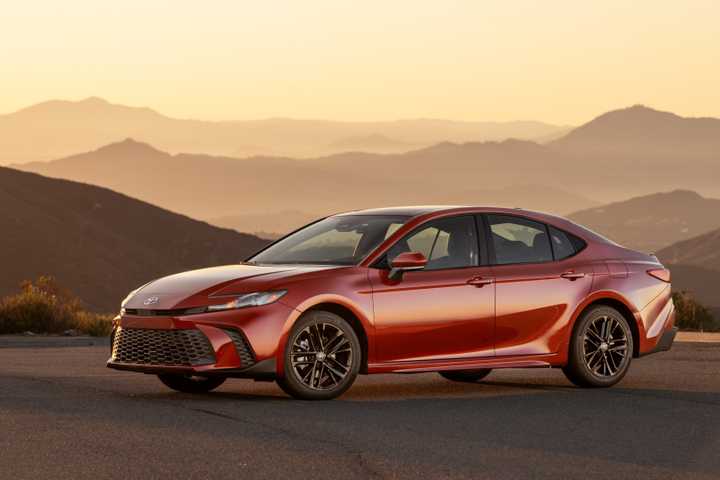
2026 Toyota Camry Performance Specs

- Base trim motor
-
2.5-liter four-cylinder hybrid
- Base Trim Transmission
-
CVTi-S CVT
- Basic transmission
-
Front wheel drive
- Basic power
-
184 hp at 6,000 rpm
- Basic trim torque
-
163 lb-ft. @ 5200 rpm
- Do
-
Toyota
- Model
-
Camry
- Segment
-
Mid-size sedan
The Toyota Camry comes standard with a proven and durable four-cylinder engine. You can get a Camry with front-wheel drive or all-wheel drive. Front-wheel drive models are equipped with two electric motors and develop 225 horsepower. All-wheel-drive models get a third motor that drives the rear wheels, increasing output up to 232 horsepower. Whichever solution you choose, you get an eCVT.
The standard Accord comes with a 192-horsepower four-cylinder under the hood, with the hybrid model producing 204 horsepower instead. Honda doesn’t offer all-wheel drive on either version of the Accord. While Honda’s sedan feels a bit livelier through corners, the Camry is quicker off the ground than both the hybrid and non-hybrid.
Fuel economy
|
Model |
City |
Highway |
Combined |
|---|---|---|---|
|
Camry TA |
52 mpg |
49 mpg |
51 mpg |
|
Camry AWD |
50 mpg |
49 mpg |
50 mpg |
|
Front-wheel drive accord (hybrid) |
51 mpg |
41 mpg |
44 mpg |
|
FWD (non-hybrid) agreement |
29 mpg |
37 mpg |
31 mpg |
There’s only a $1,000 price difference between the hybrid Camry and the non-hybrid Accord. With the fuel savings you get by opting for the Toyota, you’ll make up that difference in very little time. It doesn’t get any better when comparing the Accord Hybrid to the Camry, as the Toyota is still a bit more efficient in most cases.
This Mazda SUV looks surprisingly close to a lower-cost BMW X5
This Mazda SUV gives BMW X5 buyers a lot to think about for a lot less money.
It may not be as refined, but the Camry is just as practical
A family sedan with practical features
At their core, the main goal of both of these cars is to be able to transport passengers comfortably from point A to point B. While the Accord certainly has the more interesting cabin design and seems a bit more refined overall, the Camry’s interior is still a pleasant place to be. There’s plenty of space available and Toyota includes a ton of niceties as standard.
Interior dimensions and comfort
|
Headroom in the first row |
38.3 inches |
|---|---|
|
Front row legroom |
42.1 inches |
|
Second row headroom |
37.6 inches |
|
Second row legroom |
38 inches |
|
Loading capacity |
15.1 cubes |
Both the Camry and Accord are exceptionally comfortable sedans, with plenty of passenger space inside. The difference in rear seat space between these two is pretty negligible. The Accord certainly has a slightly more spacious trunk, but Toyota’s sedan remains competitive.
Toyota has definitely opted for a simplistic interior in the Camry, as is their wont. While this means the Accord is a bit more visually interesting, everything about the Toyota seems well put together and user-friendly. Both are also very well equipped, and you won’t be disappointed by the technology or comfort offerings of either. The Accord’s only advantage is its slightly larger standard nine-inch infotainment screen, but both models can be had with an optional 12.3-inch screen instead.
The price difference is small, but the Camry looks like the better-equipped sedan
We really like the Accord and think both the hybrid and non-hybrid models are well-built, comfortable, and incredibly fun to drive. However, if you’re on a budget and trying to get the most bang for your buck, it’s really hard to argue against the Camry. It’s just as comfortable inside, offers more power and is a bit more efficient, and it doesn’t cost much more. To the average buyer, this seems almost a no-brainer.


