This museum makes art out of plastic waste that washes ashore : NPR

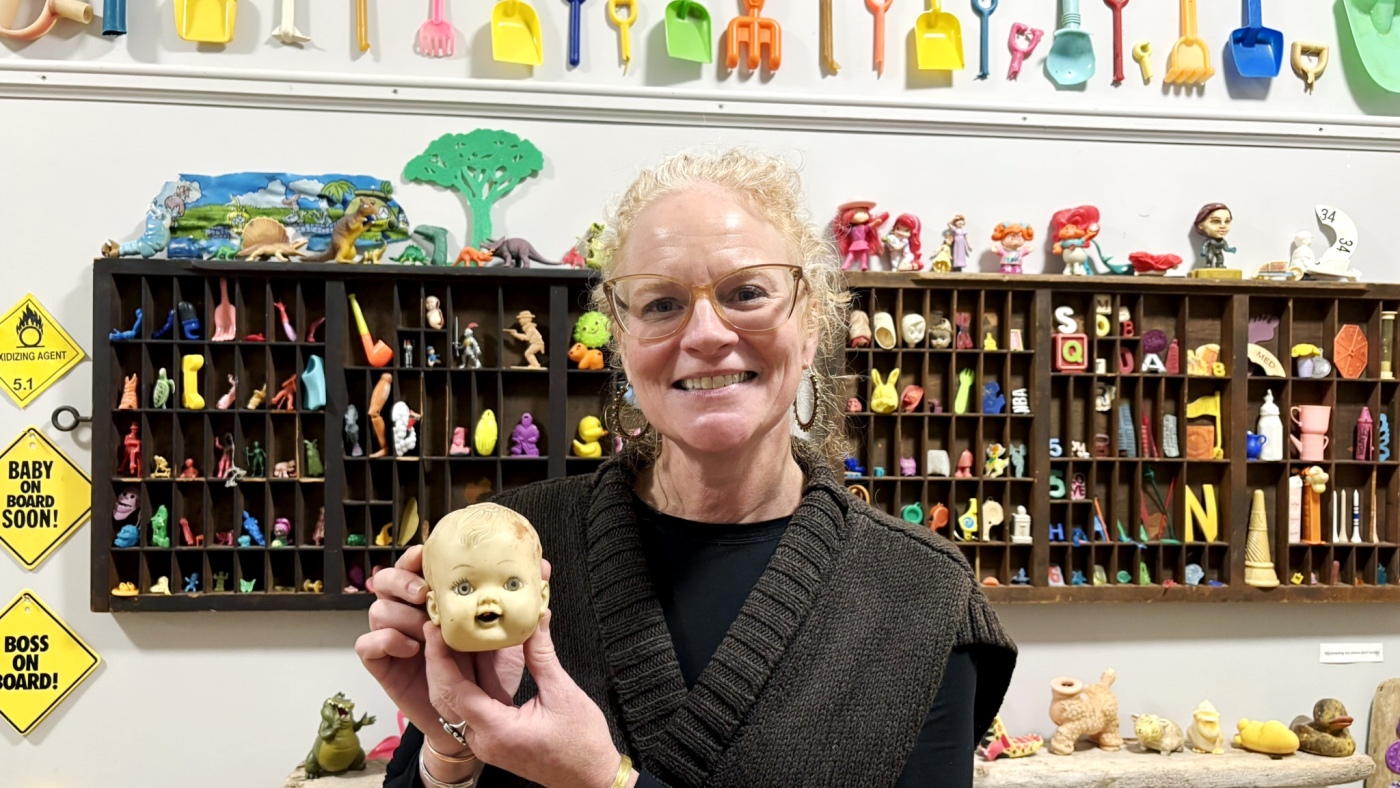

Corinn Flaherty holds the first doll head she found washed up on shore in 2015. It propelled her “descent down the shipwreck rabbit hole” and was her inspiration for the Plum Island Museum of Lost Toys and Curiosities.
Tovia Smith/NPR
hide caption
toggle caption
Tovia Smith/NPR
Warning: This story may make you think twice about your holiday shopping and how the shiny new gifts you buy might outlast the joy they bring. Or at least that’s what a museum near the Massachusetts coast hopes.
This is not your typical exhibition space. A colorful explosion of thing covers every inch of the walls: little green army guys, broken rusty knives, blindfolds and hard hats. Tons more aren’t even recognizable.
“Yes, it’s a lot!” laughs the museum’s founder, Corinn Flaherty, “because things keep getting washed.”
Washing dishes — specifically — on the quarter-mile beach of Plum Island, about an hour north of Boston, where Flaherty walks her dog. She made her first discovery there during the “Snowmageddon” winter of 2015, when she spotted the head of a 1940s doll on the deserted beach.
“The beach was a complete sheet of ice,” she remembers. “There was nothing on it except this doll’s head that was standing in the sand. Frozen. And alone.”

Pez containers, golf tees, leftover printer blocks and an hourglass are among the items collected from the beach and displayed at the Plum Island Museum of Lost Toys and Curiosities.
Tovia Smith/NPR
hide caption
toggle caption
Tovia Smith/NPR
Flaherty says she carefully “took him off the ice and took him home.” Ten years later, she still doesn’t know why.
“It spoke to me,” she shrugs, holding that same doll head tenderly and readily admitting that it is indeed a little scary.
“Yes,” she laughed. It may “haunt you a little.”
Yet that first rescue would lead to countless others, propelling Flaherty “down the wreck rabbit hole.”
What started as a “hot mess” of stuff piling up in his house, eventually moved to a studio in Amesbury, Massachusetts, and officially opened in 2021 as Plum Island Museum of Lost Toys and Curiosities.
Flaherty calls it a “graveyard” of sorts for ancient treasures turned into trash, which she hopes will be a sober reminder of human consumption and the eternal life of plastic waste.
What the tide brought
Recently, a dozen residents came to visit the museum. Murmurs of “wow” floated through the room as they took in the sheer quantity of it all: water guns, kazoos, 1950s hair curlers, a McDonald’s Happy Meal toy, which a young visitor explained to Flaherty was also a 1980s Transformer, as he flipped the creature’s hidden limbs.
Countless headless and limbless dolls are also destined for eternity, each with an untold story. Flaherty is particularly intrigued by the Hulk and Ariel, the Little Mermaid figurines.
“What happened with those two?” Flaherty wonders out loud. “There are endless stories behind these things.”

Elayne Byrne (pointing) and Sharon Wintner (right) were among the visitors who recently explored the Plum Island Museum of Lost Toys and Curiosities.
Tovia Smith/NPR
hide caption
toggle caption
Tovia Smith/NPR
Flaherty doesn’t seem to worry that she’ll never know these stories – whether items were lost or thrown away, or by whom and why – before they are swept into a river or sewer, carried into the ocean and finally washed up on her beach.
“For me, I just like to imagine things, so I can make up a story,” she laughs. (The way she decided to show Ariel lying in Hulk’s arms offers some insight into the story she landed on.)
A few retirees in the group were particularly impressed by the display of cracked clay pipes, probably smoked in colonial times, as well as shoe lasts and broken high heels, probably from the shoe factories upriver in the early 19th century.
Others were drawn to newer relics, ghosts of bygone technology, including VHS tapes, flip phones, the dial of a rotary phone, and a first-generation Nintendo Game Boy. Nearby are remnants of low-tech games like Monopoly houses and Lego bricks.
One piece in particular enchanted 21-year-old Sam Nathan.
“A Lego shark,” he exclaimed, brimming with memories of the one he had himself. “It’s a bit like my childhood. I recognize the exact room.”

Sam Nathan, 21, is having a nostalgic moment when he finds the same kind of Lego shark he played with as a child. “It’s a bit like my childhood,” he says. ; Spotting this record delighted a visiting reporter who recognized it as part of a 1970s label maker like the one she once cherished. It was gold for a child with an unusual name, who was excited to finally have something personalized.
Tovia Smith/NPR
hide caption
toggle caption
Tovia Smith/NPR
I had my own nostalgic moment, after spotting a small plastic disc with letters and numbers around the edge. I immediately understood what was a mystery to Flaherty. She deliberately does not search Google for images of unknown objects, preferring to learn by chance from a visitor who can identify it.
“What is this?” she insisted.
It’s a 1970s label maker, I explained, the kind that turns the dial on a letter, presses and embosses a piece of plastic tape to use for labeling toys or school items. (This was gold for a kid with a name like “Tovia” – who had never had the opportunity to buy something personalized off the shelf.)
“Ohhh!” Flaherty exclaimed, delighted to have solved another mystery.
A carefully crafted message
A librarian by day, Flaherty is also a weaver, and the Plum Island Museum of Lost Toys and Curiosities is adjacent to her workshop in a converted 19th-century carriage factory.
Her artistic talent is as much on display as all the trash she’s collected. The place is a kaleidoscope of colors, with exhibits carefully curated on driftwood shelves, also rescued from the same stretch of beach. Other objects, from lobster rings to plastic forks and spoons, are woven into wall hangings.
Perhaps never has junk been arranged more artfully, nor has a lesson been so carefully crafted.
Although each stranded doll head and twisted toy ukulele here may have its own story, for Flaherty they all constitute a cautionary tale – one that seems to resonate with visitors.

Among the detritus on display at the Plum Island Museum of Lost Toys and Curiosities are colonial-era pipes (far left) and driftwood paddles that are the remains of scrub brushes and hairbrushes (right), which contrast with the brightly colored plastic brushes (lower left) that remain entirely intact.
Tovia Smith/NPR
hide caption
toggle caption
Tovia Smith/NPR
When a woman questions a collection of colored cylinders, Flaherty explains that they are shotgun shells, probably from duck hunting in the swamps along a nearby river. This is the object she finds most frequently.
“Even more so than bottle caps,” Flaherty says.
This immediately makes the woman wonder why the shells aren’t made from a biodegradable material.
“That’s a good question,” Flaherty says. “Maybe we should write letters to the makers of these things and ask them, ‘Why is plastic the material of choice for this thing?'”
Several visitors say the exhibit made them think about their own choices, including Alex Matthews, a local rabbi who was organizing a Hanukkah party for children.
“I hand out glow sticks,” Matthews says. “I know they’ll glow for two hours. And I hope they don’t end up in the ocean, but I know they’re not durable goods that a child will cherish forever.”
As he left the museum, Matthews thanked Flaherty for making the point in a compelling way without being preachy.
“I’m happy that it’s kind of a bright, colorful, happy space to communicate that message and not a depressing one,” he said. “It would make you want to hang your head and go home in shame.”