This Pterosaur Lived Over 200 Million Years Ago in Arizona and Was the Size of a Sea Gull


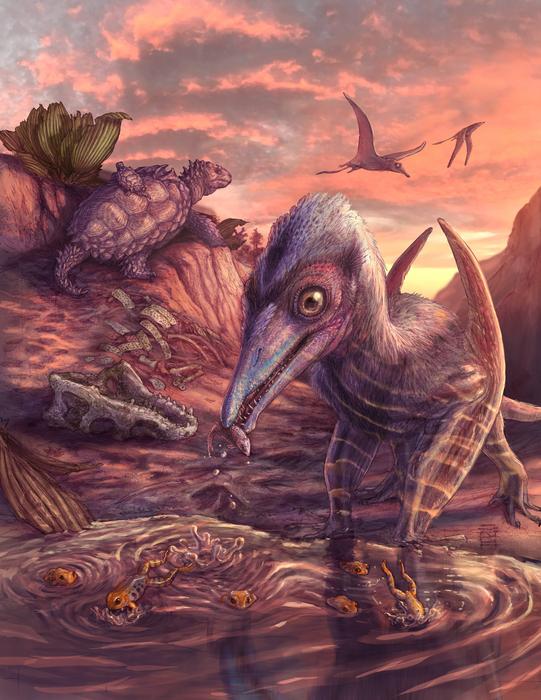
The oldest known Pterosaurian in North America – a creature roughly the size of a modern seagull – would have slipped on tropical forests and braided rivers of equatorial pangea, probably eating on fish and mixing with six -foot amphibians.
This former flying reptile was appointed Eotephradactylus mcintiae, This means “goddess of the wing dawn of ash” – a reference to its place near the base of the family tree of Pterosaur. The species has been described in Proceedings of the National Academy of Sciences After the discovery of a fossilized jaw buried in the volcanic ashes of the petrified forest national park in Arizona.
Pterosaurs: flying reptiles from the late Triassic
Pterosaurs were a clade of flying reptiles which appeared in the late period of the Triassic. They were the first vertebrates known for having evolved the engine flight and would have ordered the sky of tens of millions of years before the birds. These winged animals lived alongside the tastes of the tyrannosaurus and triceratops, but (unlike birds) were not themselves dinosaurs. Instead, they are better described as cousins with a common common ancestor.
There are currently more than 200 species of known pterosaurs of science – some not bigger than a blue Jay, others almost as large as a giraffe. In addition to varying considerably, they have occupied a wide range of habitats and enjoyed a range of different regimes. In this case, the tips of the teeth on the fossil belonging to the Eotephradactylus mcintiae were worn, which suggests that it is very likely that it was fed on fish with hard scaly – prey which would have been abundance at the time.
Learn more:: The new species of pterosaurs lived 100 million years ago with a wingspan of 15 feet
A pterosaur frozen in time
The pterosaurus bone was hidden from a horde of fossilized treasures which contained more than 1,200 individual samples of the late period of the Triassic. This included bones, teeth, scales and even fossilized poop.
The collection offers a fascinating overview of a world in transition, when previous animals, such as armed herbivores and crocodile type carnivores, coexisted with (relatively) more modern creatures, such as early frogs, pterosaurs and turtles.
In total, the fossil bed contains evidence of 16 groups of vertebrate animals, including amphibian 6 feet long and freshwater sharks.
“The site captures the transition to communities of more modern terrestrial vertebrates where we are starting to see groups that later prosper in the mesozoic living alongside these older animals that do not exceed the Triassic,” said Ben Kligman, paleontologist of the Smithsonian National Museum of Natural History, in a press release.
“Fossil beds like these allow us to establish that all these animals lived together,” added Kligman in the press release.
The Fossil collection dates back approximately 209 million years, when northeast Arizona – including what is now the petrified forest park – was part of Pangea. The site would have been in the middle of the continent, somewhere just above the equator.
The researchers say that the discovery helps to fill a gap in the historic file just before the extinction of the final trias, a catastrophic event which occurred about 201.5 million years ago and destroyed 75% of species living at the time.
An old turtle with a thorny armor
The Pterosaurian bone was not the only exciting discovery. The paleontologists discovered the fossilized remains of an old turtle, which would have sported a point -shaped armor and put on a shell no longer than a shoe box. What is particularly interesting is his age. According to the authors of the study, the animal would have lived roughly at the same time as the oldest known turtle, found in Germany.
“This suggests that turtles quickly dispersed through pangea, which is surprising for an animal that is not very large and probably walks at a slow pace,” Kligman said in a press release.
Learn more:: The old footprints reveal when giant flying reptiles have taken on the ground
Article Sources
Our writers at Discovermagazine.com Use studies evaluated by high quality peers and sources for our articles, and our publishers examine scientific precision and editorial standards. Review the sources used below for this article:
Rosie McCall is an independent writer living in London. She has covered scientific and health subjects for publications, including Iflscience, Newsweek and Health.