This wristband makes you a robot puppeteer


Robots are already better than humans at many tasks. Try to outperform an AI-based system at chess or survive a robot working in radiation-filled rooms and you’ll probably fail. But even with all this progress, machines still struggle to perform many seemingly basic tasks, especially those involving delicate hand movements. Something as simple as peeling a banana without mashing it is still considered a challenge for robotic systems, largely because researchers haven’t found a way to accurately capture the complexity of our own human hands. A new wearable bracelet could change that.
This week, a team of engineers from the Massachusetts Institute of Technology (MIT) demonstrated a bracelet that uses ultrasound imaging to continuously monitor the inside of a person’s wrist. It takes ultrasound images that produce a constant series of images showing how the muscles, tendons and ligaments in a wearer’s wrist interact with each other to produce hand gestures. This stream of images is then linked to an AI algorithm capable of interpreting the images in real time and transmitting them to a robotic hand.
Thanks to this system, the robotic hand reflects in real time the slightest gestures of the wearer of the bracelet. Volunteers wearing the device could ask the robotic hand to grab tennis balls, make hand signals and even play notes on a piano. The engineers behind the bracelet believe it may be the most advanced tool yet for training robots to use their hands more like humans. This same technique can also be applied to digital environments, meaning future users will be able to control a phone’s screen without ever touching it, or interact with virtual reality in a more immersive way. The team published their findings in the journal Natural electronics.
“We believe this work has an immediate impact by potentially replacing hand tracking techniques with wearable ultrasound bands in virtual and augmented reality,” Xuanhe Zhao, a professor of mechanical engineering at MIT and co-author of the study, said in a statement. “It could also provide huge amounts of training data for dexterous humanoid robots.”
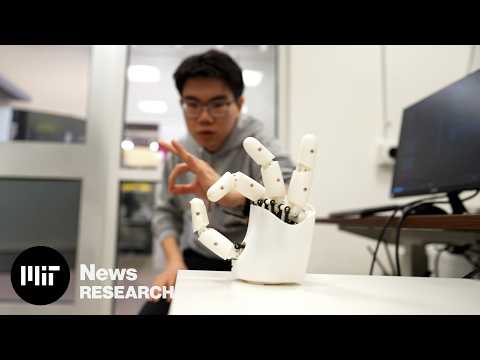
A real-time hand tracker
https://www.youtube.com/watch?v=F2HaSoladegM
Fingers are like a puppet on a string
The wearable uses an “ultrasonic sticker” the size of a smartwatch placed on a person’s wrist, which peeks beneath the surface. By imagining the micro-movements of the muscles and tendons below, the engineers were able to infer how these movements correspond to specific finger positions. They say tendons and muscles are like strings pulling on a puppet. In this case, the puppet consists of the wearer’s fingers and thumb. Each image taken of these “strings” corresponds to a particular state of the hand. Using this approach, the team was able to identify the muscle and tendon movements corresponding to the 22 degrees of freedom that the human hand is capable of.
But manually matching each of these images to the position of a hand is simply not feasible. To solve this problem, the team developed an AI algorithm trained on ultrasound images carefully labeled by humans. This AI can quickly analyze incoming images and determine the position of the hands they depict. Using this method, engineers can take gestures decoded by AI and apply them to robots and digital environments. The system was found to be accurate enough to accurately differentiate between the 26 letters of American Sign Language. It could also interpret the pinching movement made by a wearer and translate that gesture into a zoom command on a screen.
“We believe these wearable ultrasound bands can provide intuitive and versatile controls for virtual reality and robotic hands,” Zhao added.
Looking ahead, the team wants to reduce the size of the device. Although they call it a wearable bracelet, the electronics that come with it currently make it look more like a cyberpunk glove than an Apple Watch. They also plan to train their AI on even more gestures from a wider variety of volunteers with different hand sizes and shapes. Eventually, they hope to finalize a wearable device that almost anyone can use to control robots remotely.

The best new PopSci 2025 releases


