Three Lessons From Hungary on How to Beat Competitive Authoritarianism


This article is part of the TPM Café, the TPM opinion and news analysis site.
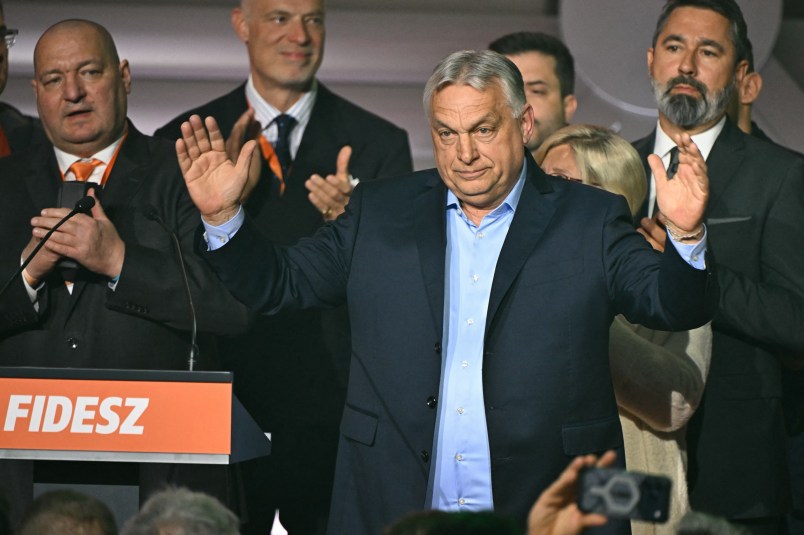
Sunday April 12 brought a long-awaited political change to Hungary. After 16 years in power, Prime Minister Orbán and his Fidesz party were soundly defeated in the elections. Tisza, a new party led by Péter Magyar – a former member of the Fidesz government who began to openly oppose the Orbán regime after a pardon scandal rocked the government in 2024, leading to the resignation of the president and the justice minister – won the elections with an overwhelming majority.
This success came after more than a decade of Hungary’s slide toward authoritarianism, as Orbán’s government restricted media freedoms, undermined the independence of the judiciary, eroded the rule of law, restricted civil liberties and tilted the electoral playing field in his favor, among other things. Right-wing leaders across Europe and US President Donald Trump’s MAGA movement have drawn inspiration from his model.
Tisza won a clear majority in the votes, which was projected to translate into a constitutional majority in Parliament. Even though the Magyars were ahead in the polls on Sunday, few opponents of Orbán’s government thought this result was assured. Thanks to this qualified majority, the party will now be able to implement fundamental reforms and dismantle part of the authoritarian system that Orbán built during the last 16 years in power.
Contrary to most experts, who suspected that the incumbent Fidesz party would resist, or even challenge, a rapid transfer of power, Prime Minister Viktor Orbán had conceded the race to Péter Magyar even before 50% of the votes were counted. Most likely, Fidesz realized that the opposing party’s margins of victory were too wide in all constituencies, thereby undermining its ability to credibly challenge them.
Even though the Hungarian context differs fundamentally from that of the United States—and even though Hungary’s elections are, ultimately, primarily about Hungary—it offers some lessons about how far-right competitive authoritarianism can be defeated at the ballot box.
1) Campaigns are important, but where you campaign is also important
The victory of the Magyars did not come out of nowhere. In fact, it was the result of a nearly two-year arduous campaign across the country, involving hundreds of volunteers and individuals who sought change and supported the party.
Moreover, his landslide victory was also the result of intense campaigning in smaller constituencies. Hungarian elections are mostly decided in small towns and rural areas, which are traditionally Fidesz strongholds. Magyar learned lessons from previous years and campaigned not only in big cities but also, mainly, in rural constituencies. Traveling the country and visiting smaller towns to spread his message helped him gain notoriety outside of government propaganda media who attempted to misinterpret his message and portray him as a pro-Ukrainian, pro-war stooge supported by the European establishment. Additionally, Magyar used his presence on social media and recent independent online media to communicate with potential voters, once again allowing him to build momentum against the regime.
If there is a lesson for America’s Democrats and Democrats, it is to focus not only on big cities but also to establish a notable presence in rural areas and invest in personal contact with voters.
2) A unified message behind a candidate
Although Magyar is a rather right-wing figure, coming from a politically conservative family tradition, his party’s electoral base is predominantly left-wing and liberal in tendency. And yet, he managed to rally people behind him, create a large organization and mobilize voters. This proved crucial in an electoral system in which Fidesz, the incumbent president, can only be defeated with a strong and unified opposition party. Previous attempts to create a coalition of parties to oppose Fidesz through Hungary’s parliamentary system have notably failed. This time, however, Magyar managed to build a movement riding a wave of public discontent with government performance and uniting voters from different ideological backgrounds behind a simple, unified message: no more status quo; things must change. “Now or never” became the central slogan of the Tisza party, with “or never” taking hold, underscoring the urgency of overthrowing the Orbán government, which had held a tight grip on the country for 16 years and was likely to double down on its authoritarianism, while the living standards of ordinary Hungarians deteriorated further.
Although Hungary shows that competitive authoritarianism can be defeated, it is not a given. On the contrary, the Hungarian elections show that authoritarians do not “just lose.”
“Now or never” is also a line from one of Hungary’s best-known poems by a prominent national hero and revolutionary, Sándor Petöfi, whom virtually every Hungarian knows. The message therefore found a wide resonance while also appealing to national pride, unifying Hungarians in their struggle not only against but also For something: their homeland.
The lesson for other countries is also to rely on what unites rather than what divides. A divided opposition – or, in the American context, a divided opposition party campaigning on different issues – is unlikely to effectively oppose authoritarian rule.
3) Sow hope
Notably, although Magyar’s key message was to oppose the Orbán regime and the rise of kleptocracy and corruption that it allowed and encouraged, resulting in low standards of living, it also offered a strong message of hope. By repeatedly appealing to Hungarians, reminding them that their future is in their hands, that they do not have to live this way and that they have an opportunity for change, they have motivated voters, keeping them engaged in an environment that seeks to disillusion and disenchant them politically. As such, he campaigned not only against something but also, clearly, against For something, based on hope and confidence in the country, namely: a better future and a better Hungary.

This lesson is crucial, also for other contexts facing competitive authoritarianism. Authoritarians want people to feel a sense of helplessness and hopelessness, to demobilize them and suppress dissent. Offering messages of hope, allowing voters to dream of a better future, and reminding them that everything is in their hands helps maintain morale, especially in competitive authoritarian regimes with mostly free but unfair elections.
There is no universal solution
Obviously, every election is context dependent and opposition strategies depend on local circumstances, salient issues, electoral systems and rules. There is therefore no universal solution to overcoming authoritarianism, and the lessons learned from Hungary, as a distinct case, are limited.
Although Hungary shows that competitive authoritarianism can be defeated, it is not a given. On the contrary, the Hungarian elections show that authoritarians do not “just lose.” Rather, Hungary represented the perfect storm for defeating authoritarian rule: a weak economy, scandal after scandal from the ruling party, and an emerging opposition figure who rose to the occasion with the skill to lead a movement, highlight the government’s many failures, and raise the salience of issues that matter to the majority of voters.
Defeating a party firmly in power requires not only a good strategy, but also the right conditions and someone capable of taking advantage of them. This involves building a strong, unified opposition that focuses on local mobilization and campaigning on important issues that affect and resonate with ordinary people at all levels.


:max_bytes(150000):strip_icc()/Health-brown-egg-recall-0b7932ea15b84c0a8b5ce4fc503ccc91.png?w=390&resize=390,220&ssl=1 "FDA Announces Egg Recall Due to Salmonella Contamination—Check Your Fridge Now")
