Tiny bump on 7 million-year-old fossil suggests ancient ape walked upright — and might even be a human ancestor


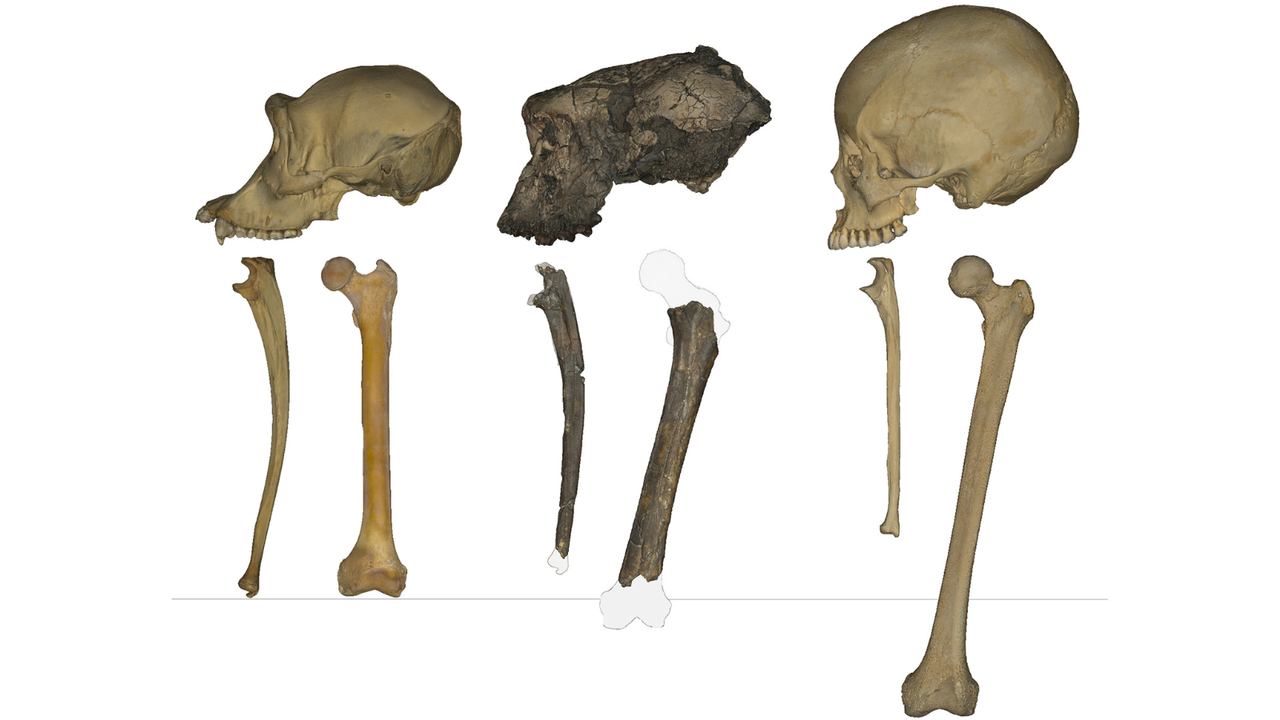
The discovery of a never-before-seen bump on the leg bone of a 7-million-year-old fossil ape shows it walked upright on two legs while on the ground, a new study suggests.
Only members of the human lineage have this bump, called the femoral tubercle. This makes the species, Sahelanthropus tchadensisthe oldest known hominid, according to the study published January 2 in the journal Scientific advances. (Hominids are a group of species, including humans, that existed after separation chimpanzees and bonobos. Walking upright on two legs is a defining characteristic of hominids.)
The reanalysis of S. chadensisThe femur also confirmed two other human-like anatomical features. First, the bone twisted inward, placing the knees closer together than the hips, as in modern humans. Second, there was a distinct bump on the side of the fossil, where the largest gluteal muscle attaches, which is not the case in living non-human apes.
S. chadesis“The curved bones of the arms suggest that, as today chimpanzees and bonobos, the species was suitable for climbing trees. But its hips and knees functioned like those of hominids, suggesting that the ape frequently walked bipedally when on the ground.
“I think it took a lot of time on the ground to evolve bipedalism,” Williams said.
A very controversial fossil
Discovered in present-day Chad, S. chadensis was first described in 2002 and remains very controversial. The authors of this study claimed that the fossil ape was the oldest known hominid, based on the position of the opening in the skull where the spinal cord attaches, called the foramen magnum. The opening was in the middle of the skull, suggesting that the ape stood as humans do, but others have argued that the positioning does not prove S. chadensis walked on two feet.
Twenty years later, two bones of the forearm, or ulna, and a fragment of femur belonging to S. chadensis were revealed. The authors suggested that the femur belonged to a monkey that walked on two legs. But other scientists disagreed with this assessment, saying that the shape of the thigh bone does not indicate frequent bipedalism.
Williams said he was hesitant about S. chadensis being bipedal – and, therefore, a hominid – because it is “really old”. The monkey lived at the time when scientists believe that last common ancestor of humans and chimpanzees lived about 6 to 7 million years ago. Rather than being a hominid, S. chadensis It may be an ancient ape more closely related to chimpanzees and bonobos than to humans, he said.
Because he was interested in the answer, Williams and his team inspected 3D scans of the limb bones. They looked at various features of the femur and compared them to the thigh bones of all living and extinct ape species for which these bones exist.
This analysis revealed that the size and shape of S. chadensis’ the ulna and femur resembled those of modern-day chimpanzees and bonobos. “We were getting a very large ape signal,” Williams said.
But there were key differences that convinced the team that this ape was bipedal. Their analyzes confirmed the presence of an inwardly twisted femoral stem and the attachment of the largest gluteal muscle, both linked to a way of moving in hominids.
However, they spotted something no one had noticed before: a small bump on the upper front of the femur. “It’s a very subtle little bump that I didn’t initially identify by looking at the fossil but by rubbing my thumb over it and bumping into it,” Williams said. The team then verified that the original S. chadensis the fossil was also this size.
“It’s more than convincing” Jeremy DeSilvaa biological anthropologist at Dartmouth College who was not involved in the research, told Live Science. “I immediately took that down [the femur 3D scan] and said, “Wait, how did I not see that?” And of course, some of the key anatomy highlighted in this article, I can see in this fossil,” he said. “I kind of blame myself for that. I would have liked to see these things. »
This research makes the question of what the last common ancestor between humans and chimpanzees looked like “even more puzzling and fascinating,” DeSilva said.
If S. chadensis was a hominid, this could suggest, as Williams believes, that this ancestor was more chimpanzee-like than human-like. However, DeSilva said S. chadensis could potentially be a bipedal ape not part of the human lineage.
“The question we’re asking now as a field is,” he said, “can you be bipedal and not be a hominid? Is that possible?”


:max_bytes(150000):strip_icc()/close-up-of-goat-on-pasture-1068184268-5c3e857946e0fb000186ab3e.jpg?w=390&resize=390,220&ssl=1 "The Benefits of Raising Goats on a Small Farm")