Toyota Just Electrified a Pickup Legend, but It Won’t Be Cheap

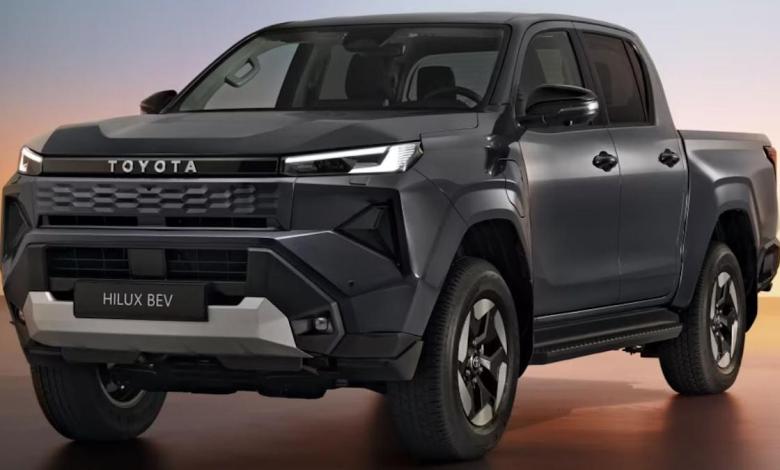
The arrival of a fully electric Toyota Hilux marks one of the most important turning points in the history of a pickup that has built its reputation on ruggedness, reliability and real-world utility.
Toyota is opening this new chapter first in Australia, where the Hilux BEV is expected to arrive in showrooms in May 2026. This makes Australia the first market outside of Thailand to put the Hilux electric on sale.
The first thing buyers will notice is that switching to electric power is expensive. Using the recent AUD/USD rate of around 0.69, the Hilux BEV range starts at around $51,900 for the SR double-cab chassis, rises to around $52,900 for the SR double-cab pick-up and tops out at around $57,400 for the SR5 double-cab pick-up, all before local on-road costs.
Toyota’s official Australian pricing is A$74,990, A$76,490 and A$82,990 respectively.

Photo courtesy: Autorepublika.
Toyota keeps the lineup simple. Australian buyers have two versions, SR and SR5, and every Hilux BEV uses the same dual-motor all-wheel drive setup. There is no special rear-wheel drive fleet that is cheaper at launch.
Toyota is clearly positioning the truck as a more premium, specialized product aimed at commercial, fleet and business users who want electric power without giving up the basic pickup format.
An electric powertrain with familiar Hilux priorities

Photo courtesy: Autorepublika.
The powertrain is built around a 59.2 kWh lithium-ion battery and two electric motors. Toyota claims the front motor produces 82 kW and 206 Nm, while the rear motor produces 130 kW and 268 Nm, for a total system output of 150 kW, or around 201 hp. The official range is up to 196 miles on the NEDC cycle for the pick-up versions and up to 152 miles for the chassis cab. DC fast charging peaks at 150 kW, allowing a 10-80% charge in around 30 minutes, while 10 kW AC charging can top up the battery in around 6.5 hours.
Toyota is also keen to reassure buyers that this one still handles like a Hilux when the pavement ends. The truck retains permanent four-wheel drive, Multi-Terrain Select and a specially developed chassis configuration with reinforced frame sections, MacPherson strut front suspension and a De Dion rear axle designed around the rear engine.
Published Australian specifications also list ground clearance of around 8.6 inches, wading depth of 27.6 inches and up to 4,409 pounds of braked towing capacity. These figures show that Toyota is trying to preserve the functional identity of the Hilux, even if the electric version still can’t match the towing power of its diesel relatives.
Well equipped, but still a real work truck

Photo courtesy: Autorepublika.
The equipment is generous even in basic form. The SR includes a 12.3-inch touchscreen, 12.3-inch driver display, wireless Apple CarPlay and Android Auto, dual-zone climate control, smart entry and start, and a 1,500-watt power outlet.
The SR5 adds leather-appointed trim, a power driver’s seat, heated front seats, a heated steering wheel, an 8-speaker audio system and additional visual upgrades. Toyota Safety Sense is standard across the range, adding features like autonomous emergency braking, adaptive cruise control, lane assist systems and other active safety technologies.
The Hilux BEV is not just a new version. It’s Toyota’s attempt to prove that one of the world’s most reliable work pickups can be adapted for the electric age without abandoning the qualities that made it famous.
The price is high, the range is modest by truck standards and the compromises are real. But the main message is clear. Toyota no longer views electric pickup trucks as an idea of the distant future. With the Hilux BEV, it finally puts one in front of customers and tests how far the old formula can evolve.
This article was originally published on Autorepublika.com and has been republished with permission from Guessing Heads. AI-assisted translation was used, followed by human editing and review.
Learn more
-
13 Muscle Cars So Neglected Most People Forgot About Them
-
15 automotive features that should never have been removed


