Rare earths get federal backing — and tech advances : NPR

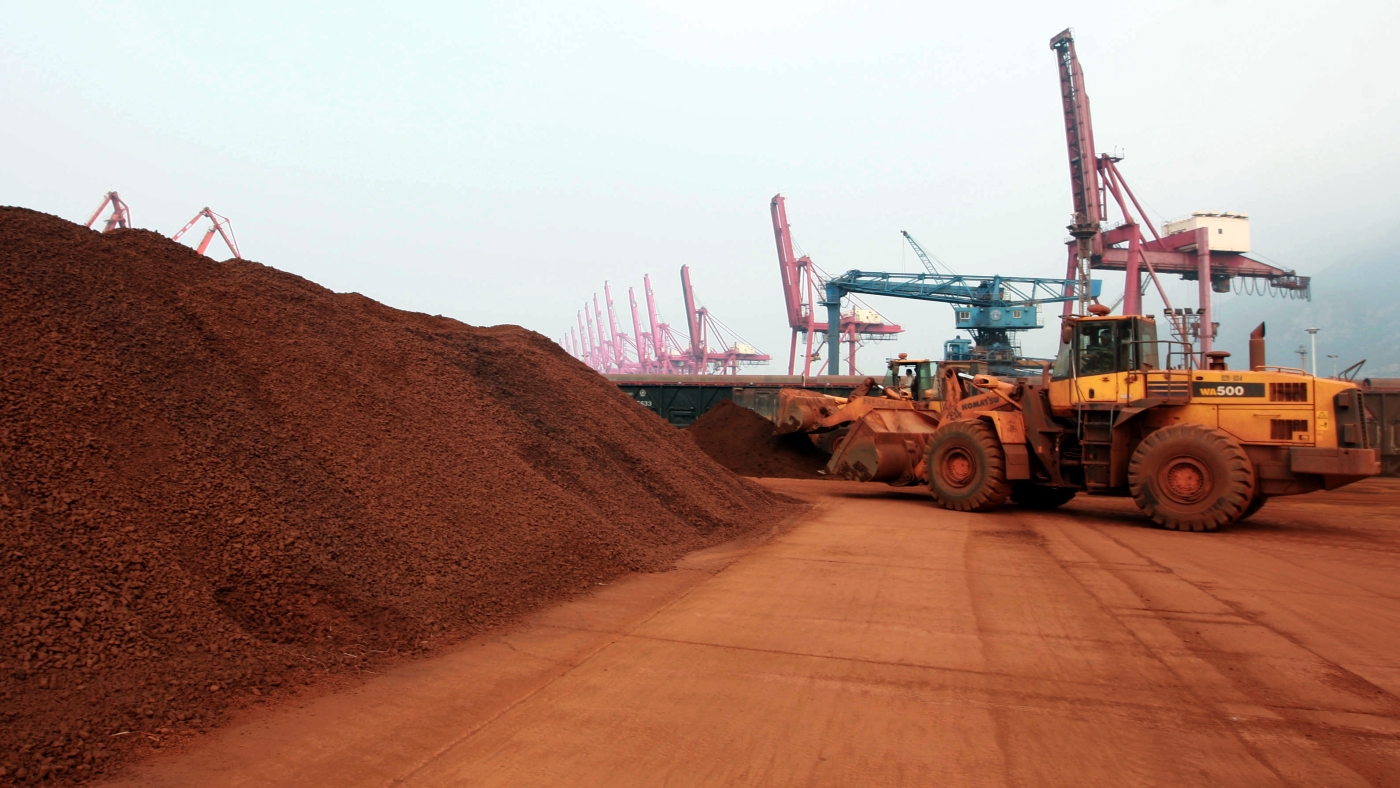

A rare earth mine in China’s Jiangsu province, photographed in 2010.
/AFP via Getty Images
hide caption
toggle caption
/AFP via Getty Images
With names like neodymium and dysprosium, rare earth elements sound exotic – and their perceived rarity has only added to their mystique.
In reality, rare earths are not that rare, but simply difficult to mine and refine. Yet they have become indispensable to modern life, integrated into everything from our smartphones and electric vehicle motors to wind turbines and medical imaging machines.
And demand is increasing.
The real choke point is processing and refining – a complex and environmentally sensitive step in which the United States has lagged and which China now dominates, controlling nearly 90% of global production.
The need for compact, high-torque electric motors, which use rare earth magnets three to four times more powerful than conventional magnets, is helping to drive demand. Production of these engines increases by about a third each year. Military aircraft also rely heavily on these elements; a RAND estimate suggests that an F-35 contains more than 900 pounds of rare earth materials in its engines and electronic components.
Adopt a private-public approach
To reduce dependence on foreign supply, the White House seeks to ensure US self-sufficiency in rare earth production. The federal government under President Trump has supported the sector in ways that deviate from traditional free market principles. Rather than relying solely on the private sector, the federal government has followed a strategy similar to China’s, providing hundreds of millions in loans and even taking stakes in key mines and startups.
ReElement Technologies, based in Indiana, is among the beneficiaries of this government support. Earlier this month, the Trump administration announced a partnership between the Pentagon, through its Office of Strategic Capital (OSC), ReElement and Vulcan Elements, a North Carolina-based company that produces rare earth magnets for military applications.
ReElement claims to have developed a more efficient and environmentally friendly method of processing and recycling rare earths, which involves chromatography. The company operates a marketing facility in Noblesville, Indiana, with a larger production site in Marion, Indiana, expected to come online next year.

Stacks of separated rare earths at the ReElement plant in Noblesville, Indiana.
ReElement Technologies Corp.
hide caption
toggle caption
ReElement Technologies Corp.
Mark Jensen, CEO of ReElement Technologies, confidently states that by the end of 2026, “we will be the largest producer of rare earth oxides in the United States.”

Because China’s dominance in refining is so great, the standard for U.S. success is modest, according to Bert Donnes, a research analyst at the investment bank William Blair.
ReElement, in partnership with Vulcan Elements, aims to produce 10,000 tonnes of neodymium-iron-boron magnets in the coming years not only in electric vehicles, but also in wind turbine generators, hard drives and MRI machines. Even that ambitious goal is just a fraction of the roughly 230,000 tons produced worldwide in 2024, according to the Institute of Electrical and Electronics Engineers, or IEEE.
“I would say if you see those numbers, you think this is going to be a massive installation,” says Donnes of ReElement’s current operations. “That’s not the case.”
Compared to a traditional processing facility, ReElement’s operation is compact, he says, which helps avoid any “not in my backyard” (NIMBY) backlash. “So it’s not like people are afraid of this process. Maybe they don’t know much about it because the process can be so small,” he says.
How the United States lost its lead
Starting in the 1980s, China began to outpace the United States and the rest of the world in rare earth production. Around the same time, environmental concerns grew at the United States’ only major rare earth mine, Mountain Pass in California, where spills of radioactive and toxic wastewater — byproducts of refining — raised alarms.
Mountain Pass is an open pit mine where they “drill and blast, mix their types and locations in the pit” before grinding the solid materials into smaller particles, according to Kelton Smith, senior process engineer for mining at Tetra Tech, a global consulting and engineering services company. A flotation process then concentrates the rare earths which are in turn leached with hydrochloric acid.
The California mine has had to halt production several times over the years due to environmental concerns. During this time, it changed ownership and eventually filed for bankruptcy protection before being purchased by MP Materials in 2017, which reopened the mine.
The unrest at Mountain Pass helped China gain a foothold and eventually overtake the United States in rare earths – just as demand for them was increasing. Beijing now produces about 60% of the world’s supply of these substances, according to the International Energy Agency. China also holds a significant share of the world’s proven reserves of ores containing these elements – about 34%, according to the US Geological Survey, but several other countries – including the United States – also have substantial reserves.
Trump’s trade war with China has made the shortage of rare earths even more acute. Because the United States does not have the capacity to process rare earths on a large scale, MP Materials has had to send its Mountain Pass ore to China for refining. But no more. Instead, the company must expand its limited capacity to process ore on site.
The problem is further complicated by the expansion of export controls announced last month by Beijing, which require foreign companies to obtain a license to be able to sell products containing rare earths of Chinese origin abroad.
Aaron Mintzes is deputy policy director and advisor at Earthworks, a national group focused on preventing the negative impacts of mining and energy development. “What we’re asking… is to do this treatment in a way that reduces the intensity and toxicity of the energy and the water,” he says.

Brent Elliott, a research associate professor of geology at the University of Texas, believes the United States has sufficient resources to meet demand. “It’s about the extraction potential and the logistics of getting it out of the ground in a way that is environmentally friendly but also socially responsible,” he says.
Partly because it is an environmentally messy process, with toxic byproducts, Beijing has gained an advantage by ignoring these consequences. “China can do it faster and better because they don’t have the same environmental concerns that we do,” Elliott says.

Many experts agree that the United States has sufficient reserves, but lacks the necessary processing capacity. Simon Jowitt, a geologist and director of the Nevada Bureau of Mines and Geology, says there are a number of rare earth deposits in the United States that have potential, but it’s rarely a simple proposition.
“You need a source of rare earths, a way to transport the rare earths, a way to concentrate them, and a way to put those rare earths into a form that can then be extracted,” Jowitt says. “If you don’t have one, you end up with something that’s not a mineral deposit and you’ll never get anything out of it.”
Last year, China enacted new regulations for rare earth processing that include strict environmental and safety regulations, but it remains to be seen how strict enforcement will be.
At the same time, it not only processes its own ore, but also imports raw ore from countries like Southeast Asia and Africa. It’s part of a broader strategy by China to establish itself as a global hub for rare earths, according to Gracelin Baskaran, director of the Critical Minerals Security Program at the Center for Strategic and International Studies.
“They are investing a lot of public resources in building processing capacity, so the minerals come from different places and are then sent to China to be refined,” Baskaran says. “What China has been extraordinarily good at is combining its foreign policy to secure rare earths around the world.”
A new process and federal investments
Refining is where ReElement comes in. The company uses large columns in a specialized filtration process developed at Purdue University to extract and purify precious metals from raw ore, but also recycled rare earths from old magnets. The process is more efficient and less damaging to the environment than older methods, such as those used by China.
Jensen, CEO of ReElement, says this method, known as solvent extraction, is “environmentally challenging” and difficult to scale. “It’s a dead technology,” he says, adding that his company’s ultimate goal is not necessarily to achieve American dominance, but to produce enough rare earths domestically to break the Chinese monopoly.
The One Big Beautiful bill, passed in July, allocated $7.5 billion to protect critical minerals. Days later, the Pentagon’s Office of Strategic Capital announced a $400 million investment in MP Materials, making the U.S. government the company’s largest shareholder. The Pentagon agency plans new investments in “[c]critical components, raw materials and rare earth elements used in microelectronics manufacturing.
As part of the deal with ReElement, Vulcan Elements will secure a $620 million loan from the Pentagon OSC, plus an additional $50 million provided by the Department of Commerce under the CHIPS and Science Act signed by former President Joe Biden. ReElement Technologies will receive an $80 million loan to support the expansion of its recycling and processing operations.
“I think we’re making great progress now because of all the grants that have been awarded and all the grants focused on critical minerals,” says Elliott, a geology professor at the University of Texas. “I think it can really set us up for success.”


