Making sense of the showdown at the CDC

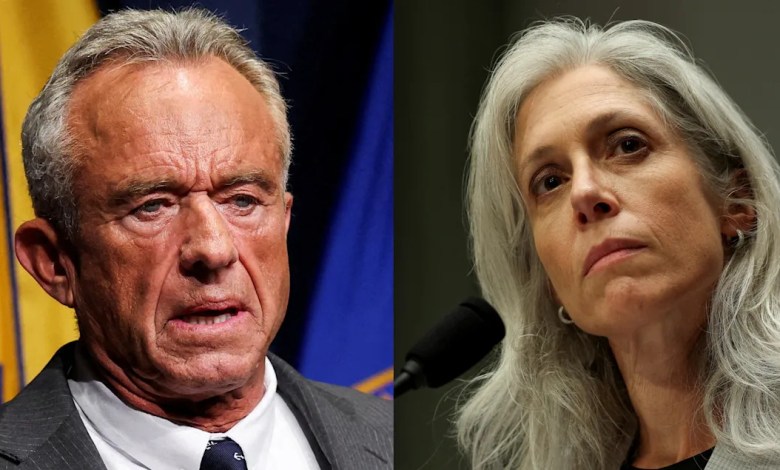
The nation’s top public health agency was thrown into uncertainty Wednesday night when the director of the Centers for Disease Control and Prevention was abruptly fired, only for her lawyers to insist she kept her job. Four other top CDC officials resigned, with one alleging in a scathing statement that Health and Human Services Secretary Robert F. Kennedy Jr. was carrying out a “militarization of public health” within the government.
A new interim director of the CDC was named Thursday evening, although the former director has not yet publicly acknowledged that her term has ended.
There have been so many announcements, legal challenges and accusations that it can be difficult to keep track of it all. Here’s a look at what happened, where things stand now, and where they might go from here.
What happened?
On Wednesday evening, HHS announced via social media that CDC Director Susan Monarez, who was sworn in less than a month ago, was no longer leading the agency.
Less than two hours later, Monarez’s lawyers responded saying that she had not in fact been fired and would also refuse to resign. They argued that Kennedy, although the CDC falls under her purview as HHS secretary, does not have the authority to fire her. Only President Trump has this power, they said.
“When CDC Director Susan Monarez refused to approve unscientific and reckless guidelines and to fire dedicated health experts, she chose to protect the public rather than serve a political agenda. For this, she was targeted,” Monarez’s lawyers wrote in a statement.
The White House issued its own statement Wednesday evening, saying Monorez was fired because she “was not aligned with the President’s agenda to Make America Great Again.” Monarez’s lawyers said that still wasn’t enough because it came from a White House spokesperson rather than Trump himself.
“As a presidential appointee and Senate-confirmed officer, only the president himself can fire her,” Mark Zaid, one of Monarez’s lawyers, wrote on social media.
White House press secretary Karoline Leavitt told reporters Thursday morning that Trump himself fired Monarez, but Zaid said that still wasn’t enough.
“[Leavitt] can say whatever she wants. …But that doesn’t make his words true, even when they come from a White House podium,” he wrote on social media.
Four other top CDC officials left the agency Wednesday evening due to frustration with the direction of the agency under RFK.
“I am no longer able to serve in this role due to the continued militarization of public health,” Demeter Daskalakis, head of the center that oversees national vaccination strategies, wrote in an email to colleagues and shared with the media.
The CDC’s chief medical officer, Debra Houry, its director of public health data, Jennifer Layden, and the director of the National Center for Immunization and Respiratory Diseases, Daniel Jernigan, also resigned.
During an interview on Fox News Thursday morning, Kennedy said it would be inappropriate for him to comment on personnel matters. But he leveled sharp criticism at the CDC, arguing that the agency is “in trouble” and adding that “there may be some people who shouldn’t work there anymore.”
Kennedy specifically denounced the CDC’s actions during the coronavirus pandemic.
“President Trump has very, very ambitious hopes for the CDC right now, and the CDC has problems,” he said. “We’ve seen the misinformation coming out of COVID. They’ve had the testing wrong. They’ve had the social distancing, the masks, the school closures that have done so much harm to the American people today.”
Trump has yet to publicly comment on Monarez’s firing, which would likely end uncertainty over his status.
However, HHS is moving forward as if the matter is settled. Jim O’Neill, Kennedy’s top deputy at the department, was named acting CDC director Thursday evening. O’Neill, a former health official turned Silicon Valley investor, has also been a frequent critic of the CDC during the pandemic, although he described himself as “very strongly pro-vaccine” during a confirmation hearing for his previous position in May.
How did we get here?
Kennedy was a controversial choice to lead HHS because of his long history of making health claims that go against scientific consensus, particularly regarding the safety and effectiveness of vaccines. He was confirmed by a narrow margin in the Senate, with all Democrats voting against his confirmation and all but one Republican voting for it.
Earlier this year, Kennedy announced massive layoffs within HHS, including hundreds of CDC employees. During his tenure, he realigned much of the department around his Make America Healthy Again agenda, which focuses on solutions to chronic diseases that often conflict with medical consensus. He also fired all members of the CDC’s vaccine advisory committee, replacing them with allies with a history of vaccine skepticism, and brought in a researcher whose work has been widely criticized by medical experts to conduct a study into the causes of autism.
Monarez, a career infectious disease researcher, was Trump’s second choice for CDC director. She was chosen after Trump’s first nominee, Dave Weldon, was withdrawn due to apparent concerns that Weldon could not get enough votes in the Senate to be confirmed because of his own past comments about vaccines.
Monarez reportedly clashed with Kennedy throughout her brief tenure as CDC director. Tensions within the agency escalated earlier this month after a gunman — motivated by extremely anti-vaccine beliefs — opened fire at the CDC headquarters in Atlanta, shattering hundreds of windows and killing a police officer. Following the attack, more than 750 HHS employees released a letter addressed to Kennedy asking him to stop spreading misinformation about vaccines. Monarez previously sent a memo to CDC employees lamenting the “deadly consequences” of vaccine conspiracies, although she did not directly place blame on Kennedy.
The situation came to a head Wednesday, hours after the Food and Drug Administration announced new guidelines for COVID-19 vaccines that make it harder for adults under 65 without underlying medical conditions to access shots.
What happens next?
Trump can officially end Monarez’s tenure at the CDC at any time by personally firing her.
The scandal may not end when Monarez is finally ousted. Republican Sen. Bill Cassidy, who heads the Senate committee on health-related issues, said the high-profile CDC departures would require congressional oversight.
Cassidy also requested that an upcoming meeting of the HHS Vaccine Advisory Committee be postponed until the allegations made by the deceased CDC members have been fully investigated.
“These decisions have a direct impact on the health of children and the meeting should not take place until meaningful monitoring has been carried out,” he wrote in a statement. “If the meeting continues, any recommendations made should be rejected as lacking legitimacy given the seriousness of the allegations and the current unrest within CDC leadership.”
A permanent director of the CDC must also be appointed. It is unclear whether O’Neill, who is expected to retain his position at HHS while also serving as acting director, will be appointed to serve in the position long-term. Any new director will have to be confirmed by the Senate.


