Trump touted support for gun rights but has defended restrictions in court


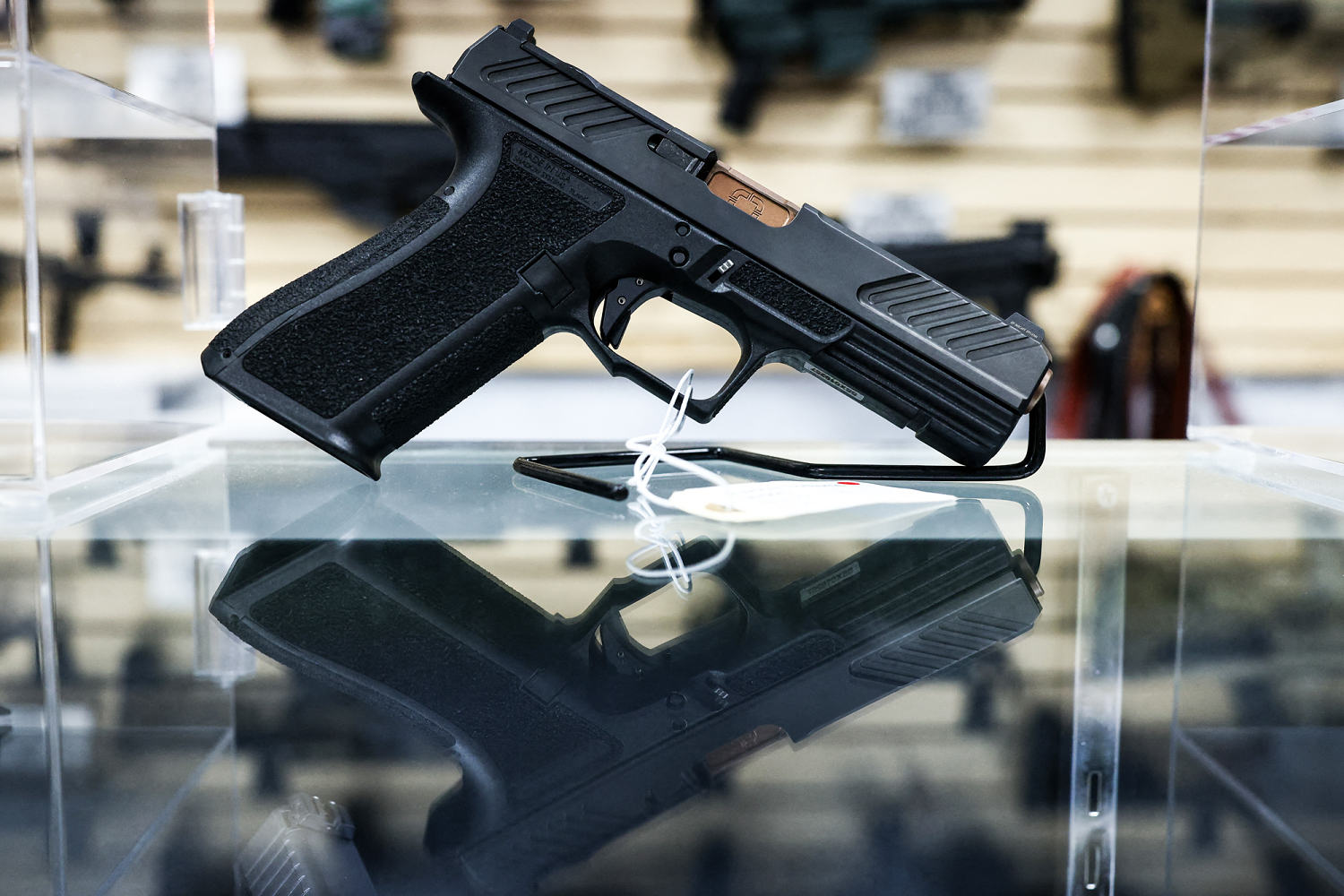
WASHINGTON — Shortly after taking office last year, President Donald Trump issued an executive order proclaiming his unwavering support for the right to bear arms, but a year later, gun rights advocates say the administration has fallen short of his promises.
Although the administration has challenged some state gun laws, it is also defending longstanding federal gun restrictions in court, one of which is being considered by the Supreme Court on Monday. This case concerns whether users of illegal drugs can be prohibited from owning firearms.
Gun rights advocates who challenge these laws say they are frustrated to see the Trump administration defend the restrictions.
“The Trump administration has been very good on gun rights issues that arise in the states. The same is not true at the federal level,” said Cody Wisniewski, president of the Firearms Policy Coalition Action Foundation.
Although the federal government generally has a duty to defend federal law, there have historically been exceptions when the Department of Justice concludes that a particular action is unconstitutional.
Wisniewski said he was somewhat perplexed by the government’s strategy, adding: “I haven’t received an explanation. »
Aidan Johnston, director of federal affairs at Gun Owners of America, also praised Trump for taking some steps toward gun rights but criticized the Justice Department for its “very mixed record on the Second Amendment” overall.
Trump and some members of his administration also recently angered Second Amendment supporters with comments they made after a federal agent killed protester Alex Pretti in Minneapolis. “Certainly, he shouldn’t have carried a gun,” Trump said at the time, echoing comments from other top officials.
The net result of the Trump administration’s case-by-case review of gun rights is that, in Monday’s Supreme Court case, the Trump administration is on the same side as gun safety groups like the Brady Center to Prevent Gun Violence.
“I can understand why they get a lot of heat, watching what they do in court and what they say,” Brady Center President Kris Brown said of the Justice Department. “It is impossible to conclude that there is any real consistency in the way the administration approaches the gun issue.”
Asked for comment on this story, White House spokeswoman Abigail Jackson said in a statement: “President Trump has been consistent for many years: he is an unapologetic supporter of the Second Amendment rights of law-abiding citizens. The Trump Administration will always defend and protect the constitutional right of Americans to bear arms.”
The Justice Department did not respond to multiple requests for comment.
Trump’s February 7, 2025 executive order directed the Justice Department to conduct a review and propose an action plan to protect the Second Amendment.
“Because it is fundamental to the maintenance of all other rights held by Americans, the right to keep and bear arms shall not be infringed,” the order states.
In June, senior Justice Department official Harmeet Dhillon, who heads the civil rights division, announced the creation of a special unit that would oversee gun rights cases. Traditionally, the division focuses on cases involving issues such as racial discrimination and voting rights.
The administration has, among other things, supported legal challenges to certain state restrictions, including opposing a Hawaii measure prohibiting people with firearms from entering private property open to the public without permission. The Supreme Court heard oral arguments in the case in January.
The Justice Department also sued the District of Columbia, the U.S. Virgin Islands and the Los Angeles County Sheriff’s Department, alleging various gun law violations.
Dhillon has loudly proclaimed his support for gun rights on social media, saying in an X-rated post last April that “gun rights are civil rights.”
In a December article, she said the Second Amendment was a “top priority” for the administration. Dhillon, through the Justice Department, did not respond to an interview request.
Trump himself has at times appeared equivocal about gun rights, as evidenced by comments he made after the Pretti shooting, including telling reporters, “You can’t have guns” in the situation Pretti found himself in. Trump also didn’t mention the topic during his recent State of the Union address.
During Trump’s first term, he pushed for a ban on shooting stocks, which allow semi-automatic rifles to fire faster, following a mass shooting in Las Vegas. But the measure was ultimately overturned by the Supreme Court.
For gun control advocates, the administration’s positioning reflects the difficult task of trying to satisfy Second Amendment absolutists while projecting a strong law-and-order message regarding gun violence.
“Trump must balance appeasement of an unpopular and extremist gun lobby with the clear political reality that gun safety is popular and effective,” argued Nick Suplina, senior vice president of law and policy at Everytown for Gun Safety, which advocates for greater gun restrictions.
The world of gun rights litigation remains in turmoil following the Supreme Court’s landmark 2022 ruling, which recognized for the first time the right to carry a firearm outside the home.
As a result, a host of new legal challenges to old laws have been launched. But the Supreme Court itself suggested in a 2024 ruling, which upheld a restriction on people accused of domestic violence possessing firearms, that it did not think all gun restrictions were presumptively invalid.
One of the laws currently in the crosshairs is the federal ban on drug users owning firearms, a measure that made headlines when President Joe Biden’s son Hunter was charged with violating it. Hunter Biden was found guilty but pardoned by his father.
The case heard Monday by the Supreme Court involves Ali Danial Hemani, an alleged regular marijuana user who was charged with breaking the law.
The Trump administration is defending the law, with Solicitor General D. John Sauer saying in court papers that it is consistent with the Second Amendment for the government to “temporarily disarm certain categories of dangerous persons.”
Sauer acknowledged that “the government bears a heavy burden to justify restrictions” on the Second Amendment. But, he added, “this case presents limited circumstances in which the government can meet this rigorous burden.”
Supporters of the Second Amendment largely take an absolutist stance on gun regulation, viewing any restrictions as unconstitutional.
The administration’s approach to two other federal restrictions has also drawn attention from gun rights supporters.
Sauer recently asked the Supreme Court not to hear, at least for now, gun rights challenges to laws that prohibit young people ages 18 to 20 from purchasing firearms and prohibit anyone convicted of a felony from owning a firearm. His filings mostly avoided discussing whether the measures were constitutional, focusing more on technical reasons why the Supreme Court should not get involved at this point.
Activists like Wisniewski say they understand that administration lawyers sometimes make litigation decisions that take into account their chances of winning at the Supreme Court.
But, he added, he and others believe the right to bear arms is a fundamental human right that should not be subject to any nuance.
“Anything that deviates from it or goes against it is not only a violation of the Second Amendment, but also just plain offensive,” he said.


